
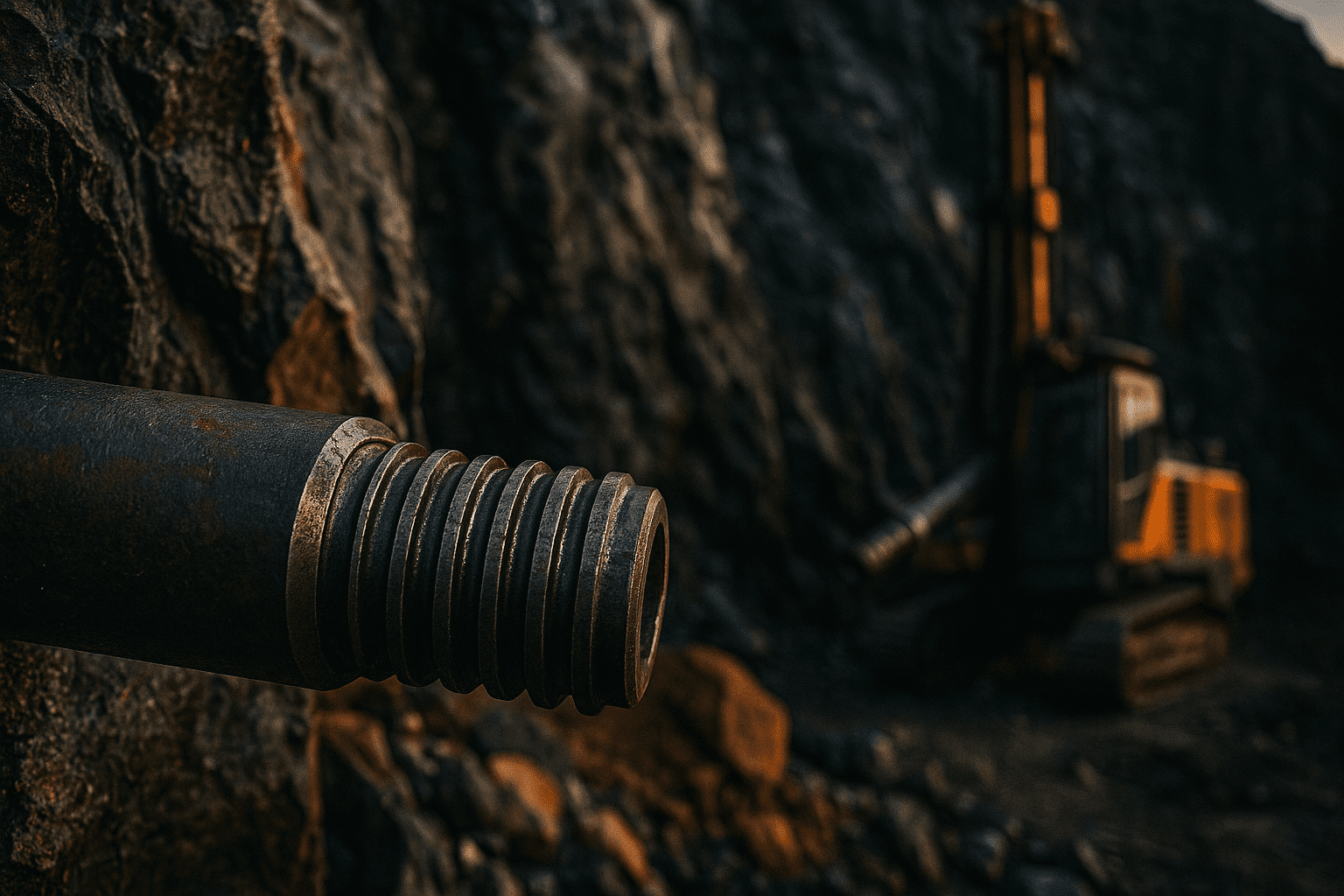
I once watched a drilling crew lose nearly two weeks on a tunnel job because the wrong rod type caused repeated deviation in a 30-meter hole. The equipment wasn’t the issue — the rods simply didn’t match the ground conditions. It’s an expensive mistake, and one that happens far more often than contractors like to admit.
Choosing the wrong drill rod slows penetration, throws the hole off-line, wears out threads, and sometimes snaps a rod without warning. The good news is that picking the right type doesn’t have to be complicated. Once you understand a few practical decision points, the entire buying process becomes more predictable.
When Standard Rods Aren’t Enough — Why You Need Anchor Drills
Before we get into the selection framework, it’s worth acknowledging a simple truth: not every drilling job can rely on standard rods. In collapsing, loose, or unstable formations, drilling and reinforcement must happen at the same time — which is exactly where anchor drills become essential.
Start with Your Drilling Method — Everything Else Comes Later
Before comparing steel grades or prices, it’s essential to recognize that your drilling method is what truly determines which options from the different types of drill rods for rock drilling will actually perform well in the field.
One of the biggest mistakes buyers make is comparing prices or steel grades before identifying the drilling method. The method determines the forces the rod must handle — impact, torque, airflow, downforce, or support load.
Once the drilling method is clear, every other decision falls into place. Below is what each method demands in real-world drilling:
Top-Hammer Drilling — The Rod Is Part of the Impact Chain
Top-hammer systems depend on efficient energy transfer down the rod. In practice, that means the rod must:
- Stay straight under repeated impact
- Avoid absorbing energy
- Resist bending and side forces
Best-fit rods:
- MF rods
- Hex rods
Field note: If a top-hammer hole starts to “walk,” round rods are usually the reason.
DTH Drilling — Airflow and Torque Decide Everything
With the hammer at the bottom, the rod’s job is to deliver air and torque while keeping vibration under control.
Best-fit rods:
- Larger diameters
- Thicker walls
- Unrestricted airflow
Field note: Most early DTH rod failures come from rods with poor air passages.
Rotary Drilling — Weight and Alignment Rule
Rotary work relies on controlled rotation and steady downforce. The rod must:
- Stay stable at depth
- Resist twisting
- Maintain long-distance alignment
Strength and stiffness matter more than impact resistance here.
Ground Support / Anchoring — Standard Rods Will Not Work
Loose or collapsing formations close around the rod immediately. Only drill-and-grout anchor systems can stabilize the hole during drilling.

Match the Rod to the Formation (The Most Common Failure Point)
More rod failures come from formation mismatch than from steel quality. Here’s a practical guide used by field contractors:
Hard, Abrasive Rock
- Strong impact
- High wear
- Greater risk of deviation
Best fit: hex or MF rods.
Hard rock punishes misalignment; round rods drift quickly.
Soft Rock / Mudstone
- Lower impact
- More dust
- Higher need for flushing
Best fit: round rods.
Fractured or Mixed Ground
- Unpredictable stress
- Micro-bending
- Thread twisting
Best fit: hex rods, MF rods, larger diameters.
Field note: Irregular drilling sound usually means mixed layers.
Loose Sand / Collapsing Ground
Only self-drilling anchor systems work here — standard rods fail instantly.
Rod Type + Thread Structure = Stability
Rod selection is not just about steel. Thread geometry affects:
- Alignment
- Energy transfer
- Wear patterns
- Joint strength
MM rods are modular and economical but lose alignment with every joint.
MF rods keep the string straight and maintain cleaner energy transfer.
Tapered rods are fine for shallow or quarry work, but not deep or high-force jobs.
Depth, Diameter & Flushing — The Trio That Determines Rod Survival
Rod failures often happen when the job demands exceed the rod’s design.
Deep holes create micro-bending, friction, and deviation — MF or hex rods handle this best.
Large diameters require strong airflow and flushing. Poor flushing is one of the most common unseen causes of rod damage.
If the bit feels unusually hot, flushing has already failed.
Cost, Lifespan & Risk — A More Accurate Way to Compare Rods
Price per rod is not the real cost. The true metric is:
- Cost per drilled meter
- Risk costs: misalignment, downtime, stuck rods, broken threads
A cheap rod that fails early often costs more than a premium MF rod in the long run.
Professionals switch to anchor systems in unstable formations for one reason:
Failure is even more expensive.
Common Mistakes Buyers Make
- Using rod choices from unrelated projects
- Choosing round rods for hard rock
- Using MM rods in precision applications
- Underestimating flushing requirements
- Focusing on unit price instead of risk
Fixing these saves weeks of downtime.
A Simple 4-Step Selection Framework
- Identify the drilling method
- Confirm the formation
- Check depth and hole diameter
- Match rod type + thread structure
Follow these four steps and nearly all confusion disappears.
Conclusion
Drill rods influence drilling speed, accuracy, equipment life, and overall project stability. With the selection framework in this guide, you can make confident decisions that reflect actual formations and operational risks.
If you need a reference point, reviewing different types of drill rods for rock drilling is a reliable starting place. And whenever the formation can’t support the borehole, switching to anchor drill systems isn’t an upgrade — it’s a requirement.
In drilling, the rod you choose determines whether tomorrow’s work starts smoothly
— or starts over
