

Introduction
Many North American die casting shops are tired of molds cracking long before they should.
The problem often starts with small heat checks around gates and corners. Then come repeated welding repairs, polishing work, dimensional instability, and unexpected downtime. Eventually, maintenance costs become harder to control than the mold itself.
This is one reason more tooling engineers are moving toward H11 tool steel.
Modern aluminum die casting creates extreme thermal cycling. Faster cycle times, larger structural castings, and aggressive cooling systems place far more stress on molds than they did years ago. Under these conditions, many shops realized that maximum hardness alone does not guarantee longer mold life.
In real production, toughness and thermal fatigue resistance often matter more.
Why Mold Cracking Became a Bigger Problem
In the past, many die casting molds were replaced because of wear. Today, thermal fatigue is often the real reason molds fail early.
The cavity surface heats rapidly when molten aluminum enters the die. Seconds later, cooling lines and release spray reduce the temperature again. This constant expansion and contraction creates stress inside the steel during every production cycle.
Over time, microscopic cracks begin forming on the surface. Those cracks spread deeper into the mold until repair welding becomes necessary.
For high-volume automotive casting programs, this creates serious operational problems:
1. unplanned downtime
2. unstable part quality
3. repeated repair cost
4. production delays
5. and shorter mold life
Many shops discovered that some harder hot work steels performed well against wear but struggled under continuous thermal cycling.
That pushed more companies to reconsider H11 tool steel.
Why H11 Performs Better Under Thermal Cycling
H11 tool steel is not a new steel grade, but its balance of toughness and hot strength fits modern die casting conditions very well.
Compared with harder hot work grades, H11tool steel is generally less sensitive to thermal cracking. The steel absorbs thermal stress more effectively instead of allowing cracks to spread rapidly through brittle areas.
This becomes especially important around gates, sharp corners, cooling channels, and thin-wall sections where stress concentrates during every production cycle.
In many production environments, molds fail from cracking long before wear becomes critical. That is why many tooling engineers now prioritize crack resistance over simply increasing hardness.
Harder Steel Does Not Always Mean Better Performance
One of the biggest misconceptions in die casting is that higher hardness automatically improves tooling performance.
Higher hardness improves wear resistance, but it also reduces toughness. Under severe thermal cycling, harder molds often become more sensitive to corner cracking, heat checking, and brittle fracture.
Many die casting shops learned this through expensive repair cycles.
A mold may show excellent hardness data during inspection but still fail early once production begins. The issue is often not the steel itself, but the mold’s inability to absorb repeated thermal stress efficiently.
H11 tool steel became popular partly because it offers a more balanced combination of:
toughness,thermal fatigue resistance,hot strength,and repair stability.
For aluminum die casting, that balance is often more valuable than chasing the highest HRC number.
Larger Castings Changed Steel Requirements
The rise of large automotive aluminum castings changed tooling requirements significantly across North America.
Modern molds now face larger thermal gradients, stronger cooling intensity, and longer production runs. Structural castings for EV platforms are especially demanding because temperature distribution inside the die becomes highly uneven during operation.
Under these conditions, thermal fatigue spreads much faster if the steel lacks sufficient toughness.
This is one reason H11 tool steel continues gaining popularity for large die casting molds.
Repair Stability Matters
Most high-volume die casting molds eventually require welding repairs.
The problem is that some steels become unstable after repeated repair cycles. Cracks return near the weld area, residual stress builds up, and mold life becomes increasingly unpredictable.
H11 tool steel generally handles repair welding better than many harder hot work grades because its toughness reduces crack sensitivity around repaired sections.
For expensive automotive molds, this becomes a major advantage.
Why More Shops Are Choosing ESR H11
Many North American die casting companies now prefer ESR H11 tool steel for demanding tooling applications.
ESR (Electroslag Remelting) improves steel cleanliness and microstructure consistency. Compared with conventional material, ESR H11 tool steel usually provides fewer inclusions, better toughness consistency, and improved fatigue resistance.
This matters because inclusions often become crack initiation points during long production runs.
Although ESR material costs more upfront, many shops consider it worthwhile because downtime and repeated repairs are far more expensive than the steel itself.
Supplier Consistency Also Matters
Steel grade alone does not determine tooling performance.
Forging quality, heat treatment control, ultrasonic inspection, and machining condition all influence how the mold behaves later in production.
This is why many die casting companies work closely with specialized hot work tool steel suppliers instead of focusing only on the lowest material price.
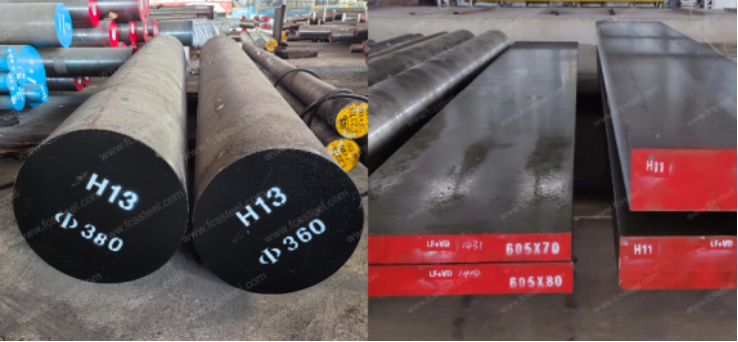
Suppliers such as FCS Steel are increasingly involved in die casting applications because many mold makers want more stable ESR quality and better consistency for high-cycle aluminum casting molds.
What Die Casting Shops Actually Want
Most production managers are no longer searching for the hardest steel.
What they really want is:fewer cracks,longer mold life,less downtime,more stable production,lower repair frequency,and predictable tooling performance.
That is exactly why H11 tool steel continues gaining market share in North American die casting.
FAQ’s
1. Is H11 better than H13 for aluminum die casting?
H11 tool steel generally offers better toughness and thermal crack resistance, especially in molds exposed to severe thermal cycling. H13 tool steel still performs well, but many shops prefer H11 tool steel when cracking becomes the main problem.
2. Why do H11 molds still crack?
Most cracking problems are caused by thermal fatigue, excessive hardness, poor EDM finishing, uneven cooling, or bad preheating practices rather than the steel grade alone.
3. Does ESR H11 really improve mold life?
Yes. ESR H11 tool steel usually provides cleaner microstructure, better toughness consistency, and improved resistance to fatigue-related cracking in high-cycle production.
4. Is H11 more expensive than standard hot work tool steel?
Usually yes, but many die casting shops accept the higher material cost because longer mold life and lower downtime reduce total production cost.
Final Thoughts
North American die casting shops are shifting toward H11 tool steel because modern aluminum casting creates far more thermal stress than before.
Larger molds, faster cycles, aggressive cooling, and high-volume production exposed the limitations of relying only on hardness.
Under these conditions, toughness and thermal fatigue resistance became critical.
That is why H11 continues gaining attention across the die casting industry. It offers a practical balance between hot strength, crack resistance, repair stability, and long-term mold performance for demanding aluminum die casting applications.