

What Engineering Teams Actually Pay After Switching
New Relic’s dual billing model – per-user seat fees from $49 to $349/month for full platform access, plus per-GB ingestion charges – creates a cost structure that compounds unpredictably as teams grow. The newer Compute Capacity Unit (CCU) model removes seats but introduces billing opacity that is even harder to forecast. For teams hitting that ceiling, the question is not whether alternatives exist but what they actually cost at your scale.
This guide breaks down 7 alternatives by real-world pricing, deployment model, and OpenTelemetry support. The tools covered:
- CubeAPM – self-hosted, OTel-native, ingestion-based pricing
- Elastic APM – distributed tracing on the Elastic Stack
- Splunk Observability Cloud – full-fidelity monitoring with SIEM integration
- Coralogix – in-stream processing with customer-owned storage
- IBM Instana – automatic discovery for hybrid enterprise environments
- Datadog – broadest SaaS ecosystem with 900+ integrations
- Grafana Cloud – open-source LGTM stack, managed or self-hosted
*Estimates based on 30TB/month ingestion, 100 hosts, 20 users, 30-day retention. Full methodology at end of article.*
Feature Comparison at a Glance
Before diving into individual tools, here is how these seven alternatives compare across the capabilities that matter most when leaving New Relic.
| Feature | CubeAPM | Elastic APM | Splunk | Coralogix | Instana | Datadog | Grafana Cloud |
|---|---|---|---|---|---|---|---|
| OTel Native | Yes | Partial | Yes (distro) | Yes | Yes | Partial* | Yes |
| Self-Hosted | Yes (managed) | Yes (SSPL) | No | Hybrid** | Yes | No | Yes (OSS) |
| Data Residency | Always (in-VPC) | If self-hosted | SaaS only | Customer S3 | On-prem option | SaaS only | If self-hosted |
| APM + Traces | Yes | Yes | Yes | Yes | Yes | Yes | Config needed |
| Log Management | Yes | Yes | Yes | Yes | Yes | Yes | Loki |
| Infra Monitoring | Yes | Yes | Yes | Yes | Yes | Yes | Mimir |
| K8s Monitoring | Yes | Yes | Yes | Yes | Yes | Yes | Yes |
| RUM | Yes | JS agent | Yes | Yes | Yes | Yes | Faro |
| AI/ML Detection | Growing | ML-based | Yes | Yes | Agentic AI | Watchdog | Limited |
| Unlimited Users | Yes | Self-hosted | No | Yes | Yes | No | Self-hosted |
| Unlimited Retention | Yes | Self-hosted | No | Infinite (S3) | No | No | Self-hosted |
* Datadog’s OTel metrics are often billed as custom metrics, adding cost for teams adopting open standards. ** Coralogix uses a SaaS control plane with customer-owned cloud storage.
1. CubeAPM
Best for: DevOps and platform teams that want full-stack observability inside their own cloud without SaaS data egress, pricing sprawl, or DIY self-hosting overhead
CubeAPM is a self-hosted, OpenTelemetry-native, full-stack observability platform. It runs inside your AWS, GCP, or Azure VPC – traces, logs, and metrics never leave your infrastructure boundary. CubeAPM handles upgrades, patches, and platform operations; you provide the infrastructure.
Ranked in the top 10 APM platforms in G2’s Spring 2026 APM Grid Report. Capterra 5/5, G2 5/5, and #4 easiest-to-use APM tools on G2. Used by Policybazaar (insurance), Delhivery ($3.5B logistics – 75% savings after replacing three separate monitoring tools), Mamaearth ($1.2B), world’s largest bus aggregator – redBus (part of MakeMyTrip Limited (NASDAQ: MMYT), 8+ countries), Ola, and Practo (healthcare). SOC 2 Type II and ISO 27001 certified.
Key Features
- Full MELT observability: APM, logs, infrastructure, Kubernetes, Kafka monitoring, RUM, synthetic monitoring, and error tracking
- OpenTelemetry-native: Compatible with OpenTelemetry, Datadog, New Relic, Elastic, and Prometheus agents for incremental migration
- Zero cloud egress: Telemetry stays in-VPC. Your monitoring stays up even if the internet doesn’t.
- AI-based Smart Sampling: Retains traces that matter while reducing storage overhead.
- Unlimited retention and users: Included in pricing – no separate charges
- MCP server: CubeAPM provides an MCP server, which customers can use to query CubeAPM in natural language.
- 800+ integrations: Kubernetes, synthetic monitoring, RUM, and error tracking included.
Pricing
Ingestion-based pricing of $0.15/GB. No per-user fees. No per-host charges. Single billing dimension – no surprises from metrics, hosts, or users.
At 30TB/month: ~$5,100/month all-in ($4,500 license + ~$600 infra)
Delhivery: 75% savings after replacing three separate monitoring tools. Mamaearth: ~70% savings, migrated in under an hour. redBus: 4x faster dashboards, 50% faster MTTR.
“Dashboards are astonishingly fast compared to New Relic – the migration process was also super smooth.”
Direct engineering support via WhatsApp and Slack channels – responds in minutes during incidents.
Cons
- Requires self-hosted deployment in cloud or on-prem; may not suit teams looking for a SaaS-only model
- AI/ML anomaly detection is growing but not as mature as Dynatrace Davis AI.
2. Elastic APM
Best for: Teams already on the ELK stack who want to add APM without a new vendor
Elastic APM is the distributed tracing and application monitoring component of the Elastic Stack. For teams already indexing logs in Elasticsearch and visualizing in Kibana, adding APM is natural. It provides distributed tracing, service maps, error tracking, and MELT correlation.
Note: Elastic APM’s OSS version reached end-of-service in September 2025 – evaluate managed options carefully for new deployments.
Key Features
- Native Elasticsearch integration: APM data correlates directly with log indices.
- OpenTelemetry compatible across serverless, self-managed, and hybrid deployments.
- Machine learning-based anomaly detection via Elastic ML.
- RUM via JavaScript agent for frontend experience monitoring.
- Available self-hosted (SSPL license) or Elastic Cloud.
Pricing
Self-hosted is free; you cover infrastructure. Elastic Cloud: consumption-based. Serverless Observability: Logs Essentials from $0.07/GB ingested + $0.017/GB retained/month.
At 30TB/month (Elastic Cloud): ~$8,000-$15,000/month
Self-hosted is operationally demanding at scale – teams that want the self-hosted cost advantage without the backend burden may find vendor-managed alternatives more practical.
Cons
- Significant operational overhead to run self-hosted at scale.
- KQL (Kibana Query Language) is less developer-friendly than SQL.
- 2021 SSPL licensing change – review for open-source compliance.
- APM experience is less polished than purpose-built APM tools.
3. Splunk Observability Cloud
Best for: Organizations already invested in Splunk’s SIEM and log management ecosystem
Splunk Observability Cloud delivers real-time, full-fidelity monitoring with no default sampling. It uses the Splunk Distribution of the OpenTelemetry Collector, which gives teams a standards-based data path even within a proprietary platform. The primary value is for organizations already running Splunk Enterprise or Splunk Cloud for SIEM – adding observability extends existing investment rather than introducing a new vendor.
Key Features
- Full-fidelity monitoring: Captures every trace, not sampled subsets.
- Splunk OTel Collector: Standards-based collection and routing.
- Deep integration with Splunk SIEM for security-observability correlation.
- Modular packaging: infrastructure, APM, RUM, synthetics.
- Tag Spotlight for rapid troubleshooting across dimensions.
Pricing
Modular with separate packaging. Infrastructure from $15/host/month, App & Infra from $60/host/month, End-to-End from $75/host/month.
At 30TB/month: ~$35,000-$60,000+/month
Splunk is the most expensive platform in this comparison. For teams without an existing Splunk investment, the cost premium is difficult to justify when simpler pricing models deliver comparable observability. Per-GB alternatives can cut that bill by 70-85%.
Cons
- Most expensive option in this comparison.
- Modular pricing makes total cost hard to forecast.
- SaaS-only; not suitable for self-hosted or data residency requirements.
- Value primarily justifiable with existing Splunk ecosystem investment.
4. Coralogix
Best for: Teams that want cost-controlled observability with in-VPC data storage
Coralogix takes a different approach to cost control: its Streama engine processes telemetry in-stream, which means teams can monitor up to 4x more data without indexing everything. The TCO Cost Optimizer routes critical logs to instant analysis and low-value telemetry to archive. Data is stored in the customer’s own S3 bucket with infinite retention – a meaningful advantage for compliance-driven teams.
Key Features
- Streama engine: In-stream processing monitors data without indexing, reducing costs.
- TCO Cost Optimizer: Automated tiering routes telemetry by criticality.
- DataPrime query engine: Unified querying across logs, metrics, and traces.
- 300+ integrations, OpenTelemetry native support.
- Customer cloud storage (AWS, Azure, GCP) with infinite retention.
- APM, RUM, log analytics, infrastructure, SIEM, and AI observability.
Pricing
Unit-based ($1.50/unit). Logs $0.42/GB, Traces $0.16/GB, Metrics $0.05/GB. Unlimited users and hosts included.
At 30TB/month: ~$8,000-$14,000/month (varies by signal mix and indexing tier)
Coralogix stores data in the customer’s S3 bucket, which avoids some egress charges. However, the SaaS control plane still processes telemetry externally. Teams needing full in-VPC control – where no telemetry leaves the infrastructure boundary – may find fully self-hosted platforms a better structural fit.
Cons
- DataPrime is a proprietary query language (not PromQL or SQL).
- Unit-based pricing requires upfront planning to model accurately.
- Not fully self-hosted; SaaS control plane with customer-owned storage.
- 4,000+ customers but smaller brand recognition than Datadog or Splunk.
5. IBM Instana
Best for: Enterprises with complex hybrid and multi-cloud environments needing automatic discovery
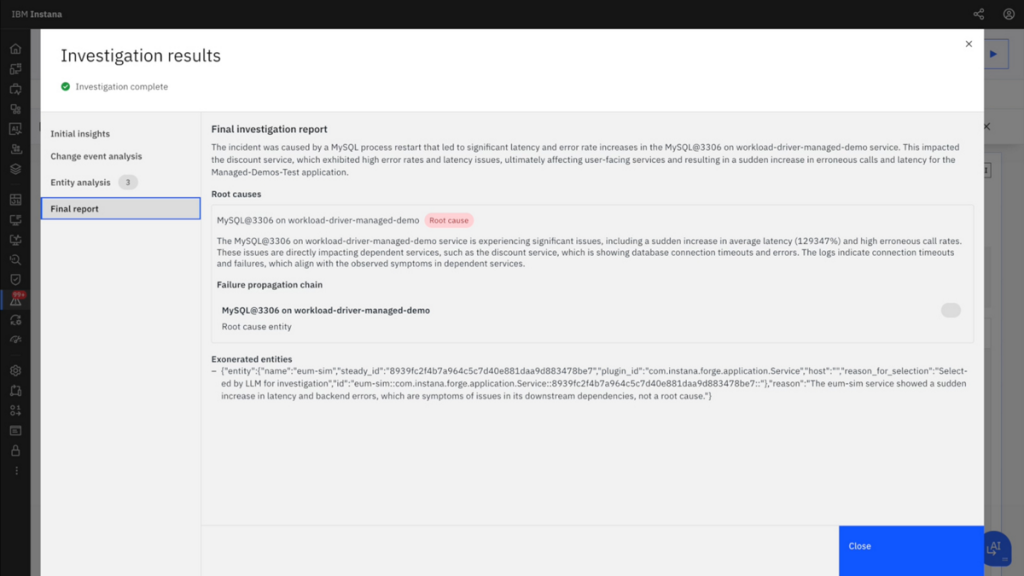
IBM Instana positions itself as full-stack observability powered by agentic AI. Its strongest feature is automatic service discovery and dependency mapping across 300+ technologies – no manual configuration needed. For large enterprises running complex hybrid environments, Instana reduces the time from deployment to full visibility. All OpenTelemetry signals (traces, metrics, logs) are generally available.
Key Features
- Automatic discovery: Maps services, dependencies, and topology across 300+ technologies.
- 1-second granularity: Real-time visibility without sampling.
- Kubernetes monitoring with pod, container, and service mesh visibility.
- Agentic AI incident investigation (preview).
- Synthetic monitoring with managed global points of presence.
- Self-hosted and SaaS deployment options.
Pricing
Licensed by Managed Virtual Server (MVS). Minimum 10 hosts. Unlimited users. Logs from $0.35/GB. Fair-use: 325 GB/Standard SaaS MVS/month.
At 30TB/month: ~$10,500-$37,000/month (wide range depending on host count and modules)
Instana’s per-host MVS licensing is predictable for host-stable environments but less economical for teams with variable or container-heavy workloads. Teams running 100+ hosts that want simpler per-GB billing may find the cost delta significant.
Cons
- Host-based MVS licensing (not per-GB) – cost scales with hosts, not data.
- Some AI features still in preview.
- Enterprise-oriented – may be more platform than smaller teams need.
- Minimum 10-host commitment.
6. Datadog
Best for: Broad SaaS ecosystem coverage with the budget to manage billing complexity
Datadog is the largest commercial observability platform and New Relic’s most direct competitor. Its integration catalog (900+) and feature breadth are unmatched – APM, logs, security, RUM, synthetics, and network monitoring under one roof. The trade-off is cost: host-based pricing compounds quickly at scale, and custom metrics charges are a persistent source of bill shock.
Key Features
- Unified observability: metrics, logs, APM, RUM, synthetics, security, database monitoring.
- 900+ integrations – largest ecosystem in the category.
- Kubernetes Explorer with pod, deployment, and resource visibility.
- Watchdog AI proactively surfaces anomalies.
- OpenTelemetry support via OTel Collector and Datadog Agent.
Pricing
Multi-dimensional billing: hosts + custom metrics + log ingestion ($0.10/GB) + log indexing (~$1.70/million events) + APM spans + RUM sessions. OTel metrics are often billed as custom metrics.
At 30TB/month: ~$30,000-$45,000+/month
Breakdown (30% logs indexed): 100 hosts ~$2,400 + log ingest 20TB ~$2,000 + log indexing ~$30,000 + APM spans ~$3,000-5,000 + custom metrics ~$5,000+. Log indexing is the dominant cost driver.
At these volumes, the cost gap between multi-dimensional billing and simple per-GB models becomes substantial. Teams sending 30TB/month of telemetry to an external SaaS platform also incur ~$3,000/month in cloud egress fees, which does not appear on the observability invoice.
Cons
- Billing complexity: host fees + custom metric overages + log indexing combine unpredictably.
- OTel metrics billed as custom metrics – adds cost for teams adopting open standards.
- SaaS-only; not suitable for data residency requirements; self-hosted alternatives are worth evaluating for those use cases.
- Total cost at scale significantly exceeds alternatives with simpler pricing models.
7. Grafana Cloud (LGTM Stack)
Best for: OTel-first teams that want flexible dashboards and open-source foundations
Grafana Labs assembled the LGTM stack – Loki (logs), Grafana (dashboards), Tempo (traces), Mimir (metrics) – into a coherent observability platform. Grafana Cloud is the managed version. Paired with Grafana Alloy (an OTel Collector distribution), it provides dedicated OTLP endpoints that auto-route signals to the right backend. Best for teams already running Prometheus who want to extend to full observability without a forklift migration.
Key Features
- LGTM stack: Mimir for metrics, Loki for logs, Tempo for traces.
- Grafana Alloy: OTel Collector distribution with built-in Prometheus pipelines.
- Strongest dashboarding and visualization across multiple telemetry sources.
- k6 performance testing integrated into the observability ecosystem.
- Cost attribution and Adaptive Metrics/Logs features to reduce billing.
Pricing
Usage-based across telemetry types. Logs: $0.05/GB process + $0.40/GB write + $0.10/GB retain. Traces: same structure. Metrics: $6.50/1k active series. Platform fee: $19/month.
At 30TB/month (managed cloud): ~$15,000-$20,000+/month
Self-hosted (OSS) is free but operationally demanding at scale – you need dedicated SRE expertise to run Loki, Tempo, and Mimir in production. For teams that want the self-hosted cost profile without managing the backend, vendor-managed platforms handle operations within your VPC.
Cons
- No native APM out-of-the-box; requires significant configuration.
- Self-hosting at scale requires dedicated SRE expertise.
- Usage-based pricing still grows with volume on managed cloud.
- LGTM stack has a steep learning curve for teams new to Grafana.
Cost Comparison at 30TB/Month Ingestion
| Tool | Est. Cost @ 30TB/mo | Pricing Model | OTel Native | Data Residency | Self-Hosted |
|---|---|---|---|---|---|
| CubeAPM | ~$5,100/mo all-in | $0.15/GB ingestion-based | Native | Always (in-VPC) | Yes (vendor-managed) |
| Elastic APM | ~$8K-$15K | Deployment-based | Partial | If self-hosted | Yes (SSPL) |
| Splunk | ~$35K-$60K+ | Host + module-based | Yes (distro) | SaaS only | No |
| Coralogix | ~$8K-$14K | Unit-based | Native | Customer S3 | Hybrid |
| IBM Instana | ~$10.5K-$37K | Per-host (MVS) | Yes | On-prem option | Yes |
| Datadog | ~$30K-$45K+ | Host + feature-based | Partial* | SaaS only | No |
| Grafana Cloud | ~$15K-$20K+ | Usage-based | Native | If self-hosted | Yes (OSS) |
| New Relic (ref.) | ~$20K-$25K+ | Ingest + per-user | Partial | SaaS only | No |
* OTel metrics in Datadog are often billed as custom metrics. New Relic included as reference. All estimates use the methodology assumptions below. Vendor discounts and EDP commitments can significantly reduce SaaS costs.
What New Relic Actually Costs at Your Team Size
Most comparison guides show pricing tiers. What they do not show is how those tiers combine – data ingest + user seats + synthetics + cloud egress – into a real monthly bill.
| Team Profile | Data / Users | New Relic /mo | CubeAPM /mo | Annual Saving | Saving % |
|---|---|---|---|---|---|
| Small team | 500 GB, 3 users | ~$458 | ~$75 | ~$4,596/yr | ~84% |
| Growing team | 5 TB, 10 users | ~$4,955 | ~$750 | ~$50,460/yr | ~85% |
| Mid-market | 30 TB, 50 users | ~$24,745 | ~$4,500 | ~$242,940/yr | ~82% |
| Enterprise | 200 TB, 150 users | ~$97,750 | ~$30,000 | ~$813,000/yr | ~69% |
New Relic costs: Standard plan, Original data ($0.40/GB beyond 100GB free), full platform users at $99 to $349 per user per month for full platform access. CubeAPM: $0.15/GB, no user fees. Enterprise pricing may include negotiated discounts not reflected here.
If you want to model your current New Relic bill before committing to a switch, the New Relic pricing calculator breaks down every cost dimension: data ingest, user seats, synthetics, and cloud egress fees most teams overlook.
The Hidden Cost: Cloud Data-Out Egress
When you send telemetry to any external SaaS platform – New Relic, Datadog, Splunk, or any cloud-hosted alternative – your cloud provider charges approximately $0.10/GB for data leaving your VPC. At 30TB/month, that is $3,000/month in AWS or GCP egress fees, which does not appear on your observability invoice. Self-hosted platforms running inside your VPC have zero data-out cost.
How to Migrate from New Relic to an OTel-Native Platform
Migration anxiety is real – you have built dashboards, tuned alerts, and accumulated operational knowledge in New Relic over months or years. The good news: switching to an OpenTelemetry-native platform is structurally less painful than previous APM migrations. Once your services emit OTLP data, you can point that data at any compatible backend with a configuration change rather than re-instrumentation.
| Week | Focus | Key Actions | Exit Criteria |
|---|---|---|---|
| 1 | Instrument inventory | List every service using NR agents. Map data volumes per service. Choose target platform. | Full inventory. Platform selected. |
| 2 | Parallel run | Deploy OTel Collector alongside NR agents on 1-2 non-critical services. Dual-write telemetry. Compare dashboards. | Traces/metrics parity confirmed on pilot services. |
| 3 | Dashboard migration | Recreate top 10 critical dashboards and all active alerts. Validate alert accuracy. Remove NR agents from pilot services. | Critical dashboards live. Alert parity verified. |
| 4 | Full cutover | Roll OTel agents to remaining services. Cancel NR agents service-by-service. Run NR in read-only mode for 2 weeks. | All services on new platform. NR agents decommissioned. |
Practical note: Run both platforms simultaneously for at least two weeks before cancelling New Relic. Teams consistently discover dashboards they forgot existed, alerts that were silently firing, or integrations that depended on NR’s API. Document what each dashboard is measuring, not the NRQL syntax, before migrating.
Which New Relic Alternative Is Right for Your Use Case?
- Choose CubeAPM if cost predictability and data sovereignty are priorities. Ingestion-based, predictable pricing of $0.15/GB, unlimited users, runs in-VPC with zero egress cost.
- Choose Elastic APM if your team already runs ELK and wants to add distributed tracing without introducing another vendor. Self-hosted option keeps data on your infrastructure.
- Choose Splunk if you are already invested in Splunk’s SIEM ecosystem and want full-fidelity monitoring integrated with your security stack.
- Choose Coralogix if you want cost-controlled observability with customer-owned storage and in-stream processing to reduce indexing costs.
- Choose IBM Instana if you need automatic service discovery across complex hybrid environments with minimal manual configuration.
- Choose Datadog if you need the broadest SaaS ecosystem and your budget supports host-based pricing at scale. Model custom metrics costs before committing.
- Choose Grafana Cloud if you are OTel-first, want flexible dashboards, and are comfortable managing or funding the LGTM stack.
When New Relic Is Still the Better Choice
New Relic is still the right choice for teams that want a broad commercial observability platform with strong full-stack coverage in one SaaS environment.
- If the free tier offering 100GB free per month is sufficient for your use case.
- You want one vendor covering APM, infrastructure, browser, synthetics, Kubernetes, and incident workflows in one place.
- You are already heavily invested in the New Relic ecosystem (dashboards, alerts, NRQL queries) and migration cost exceeds the pricing delta.
- You need native OTLP ingest inside a commercial SaaS platform without moving to a self-managed stack.
- You need mature synthetic monitoring with scripted browser/API tests and private locations.
- You are comfortable actively managing telemetry volume, CCU consumption, and ingest governance.
- You want AI-assisted observability (New Relic AI, alert-coverage analysis) built natively into the platform.
Final Thoughts
The cost gap between New Relic and its alternatives is real – but the right choice depends on more than price. Deployment model, OpenTelemetry maturity, operational overhead, and compliance requirements all shape the decision.
If data residency is a hard requirement, self-hosted platforms are the only structural solution – no SaaS alternative fully addresses this. If cost predictability is the primary driver, per-GB pricing models eliminate the billing surprises that come with host-based, seat-based, or multi-dimensional billing. If enterprise automation matters most, AI-driven platforms justify their premium for complex environments. And if your team already runs a specific ecosystem – ELK, Splunk, Prometheus – extending it for observability often makes more practical sense than introducing a new vendor.
Model your actual telemetry volume, user count, and cloud egress costs against your top two options before committing. The numbers at your scale will make the decision clearer than any feature matrix.
Methodology
*Methodology: 30TB/month (~20TB logs, 7TB traces, 3TB metrics), 30% log indexing, 500K metric series, core observability only. Based on public rate cards, early 2026. Vendor discounts and EDP commitments can significantly reduce SaaS costs.*
Frequently Asked Questions
1. What is the best New Relic alternative in 2026?
There is no single best option for every team. For cost predictability and data sovereignty, self-hosted OTel-native platforms offer the strongest structural advantages. Datadog for the broadest SaaS ecosystem. Grafana for dashboards and open-source flexibility. Splunk for teams already invested in its SIEM stack. Coralogix for cost-controlled observability with customer-owned storage.
2. Which New Relic alternative is cheapest at scale?
At 30TB/month, platforms with predictable per-GB pricing and no per-user fees offer the lowest TCO – particularly when cloud egress savings are included. Self-hosted platforms that keep telemetry in-VPC avoid ~$3,000/month in cloud data-out fees that SaaS alternatives incur.
3. Is Datadog better than New Relic?
Not across the board. Datadog has the largest integration ecosystem and strongest cloud-native monitoring breadth. New Relic remains strong for teams that want broad observability with OTLP ingest and a mature commercial platform. Both are significantly more expensive than OTel-native alternatives at the same data volume.
4. Can I use OpenTelemetry to replace New Relic agents?
Yes, and this is the recommended migration path. New Relic’s proprietary agents can be replaced with the OTel SDK for your language and the OTel Collector for batching and routing. New Relic itself accepts OTLP data, so you can migrate instrumentation to OTel without changing backends first – then point the Collector at your new platform when ready.
5. What is the hidden cost of SaaS observability?
Cloud egress. When you send telemetry to any external platform, your cloud provider charges approximately $0.10/GB for data leaving your VPC. At 30TB/month, that is $3,000/month in fees that do not appear on your observability invoice. Self-hosted platforms running inside your VPC eliminate this cost entirely.
6. How long does it take to migrate from New Relic?
A structured migration typically takes four weeks: inventory, parallel run, dashboard migration, and full cutover. Teams using OTel-compatible platforms report faster transitions – some complete initial setup in under an hour. The key is running both platforms simultaneously for at least two weeks before cancelling New Relic.