
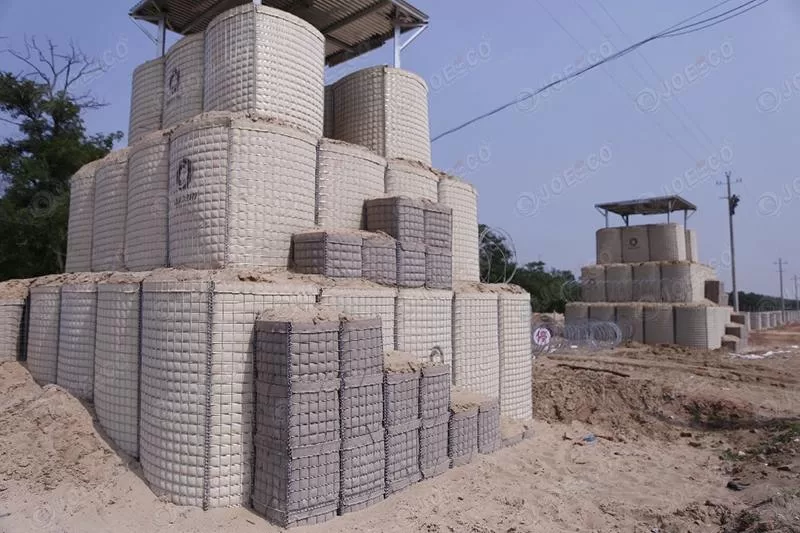
When we think of “security,” our minds often drift to high-tech sensors, encrypted firewalls, or sophisticated surveillance. But in the physical world—where floodwaters rise, and ballistic threats are real—security is often much more visceral. It’s about mass, stability, and the ability to deploy both at a moment’s notice. For decades, the gold standard for this kind of “on-demand” protection has been a design that is deceptively simple yet brilliantly engineered.
The Anatomy of Protection
To understand where we are, we have to look at where we started. The ancestor of modern rapid-fortification is the gabion. Traditionally, these were little more than wicker or wire baskets filled with earth or stones, used by military engineers to protect batteries and by civil engineers to prevent riverbank erosion. While effective, the traditional version was heavy and often required specific, bulky fill material to maintain its shape.
The revolution happened when the design evolved from a simple cage into a modular, lined system. By integrating a heavy-duty, non-woven polypropylene geotextile liner into a collapsible wire mesh frame, a new era of defense was born. This is where the Hesco barrier enters the frame, turning a labor-intensive process into a streamlined logistical operation.
Why Speed is a Force Multiplier
In an emergency, labor is your most expensive and scarcest resource. Imagine needing to protect a power substation from a surging river. Using traditional sandbags, you would need a small army of volunteers, thousands of bags, and days of grueling work.
With a modern barrier system, the equation changes entirely. Because these units are delivered flat-packed, they can be transported easily to remote locations. Once on-site, they are pulled open like an accordion and filled using a front-loader or excavator. What used to take a company of soldiers an entire afternoon can now be accomplished by two people and a piece of heavy machinery in less than twenty minutes. This efficiency is exactly why the Hesco barrier became the literal face of perimeter security in the most challenging environments on earth.
Versatility Beyond the Frontline
While its military pedigree is undeniable, the true genius of the design lies in its civilian adaptability. We are seeing these “walls in a box” used more frequently in:
- Flood Mitigation: Creating instant levees that can withstand the immense hydrostatic pressure of rising tides.
- Erosion Control: Stabilizing hillsides or coastlines after natural disasters.
- Infrastructure Protection: Shielding critical assets from vehicular impacts or industrial accidents.
The Bottom Line
True innovation isn’t always about microchips; sometimes, it’s about making a wall smarter. By combining the ancient wisdom of the earth-filled basket with modern materials science, we’ve created a system that is robust, reliable, and remarkably fast. In an unpredictable world, having the ability to turn a pile of local dirt into a world-class fortification in minutes isn’t just good engineering—it’s a lifesaver.