
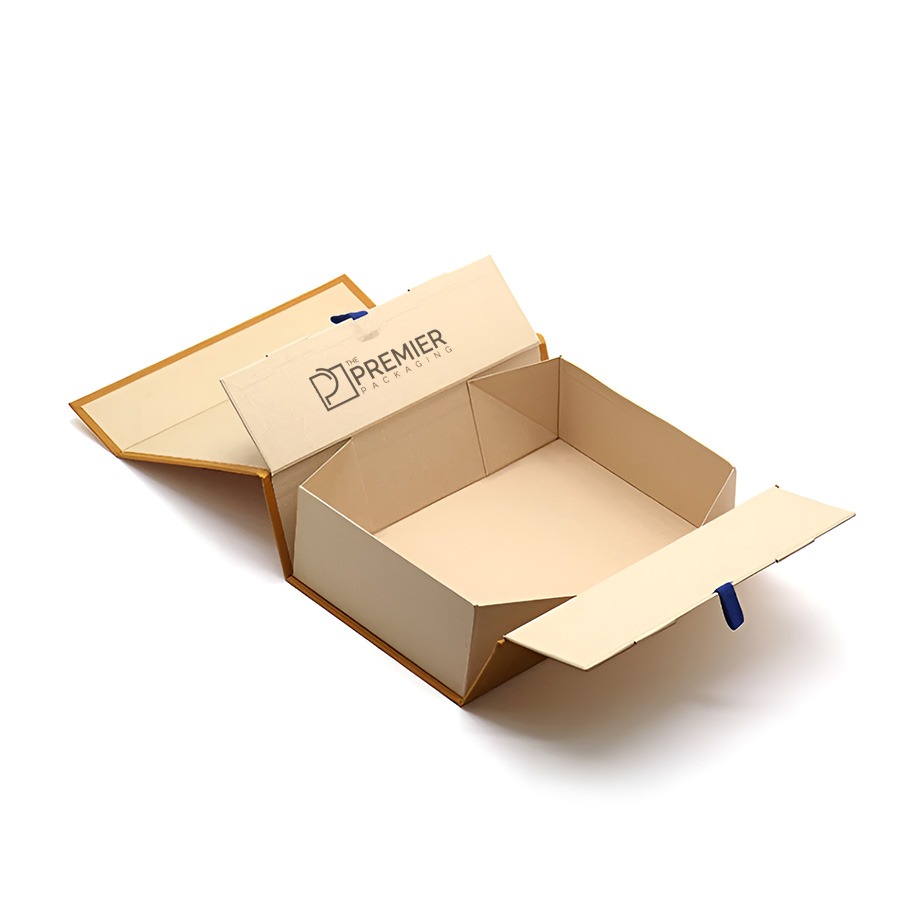
For years, retailers were in a tricky situation. You either purchased rigid boxes with setups that look great when unpacked, but require extra storage and shipping costs for empty air, or you opted for flat-packed folding cartons that save space but leave you with the feeling of flimsy cardboard.
This problem is completely addressed by the collapsible rigid boxes, also known as foldable rigid boxes. They are engineered with grooved channels and hidden magnetic closures that fold flat 100% for transit and storage, but unfolds into a heavy luxurious gift box when opened by pulling on the sides. Lets explore the design, true economics and structure of conversions for this year.
The Anatomy: Why It Works
The secret of a rigid box that collapses is its multi-layered design. The boxes are not corrugated boxes which need wavy paper fluting for strength but instead have a dense, heavy grey chipboard (usually in the range of 1200 to 1800 GSM).
Manufacturers make V-shaped groves into the inside of the chipboard to make it fold without snapping when making a thick board. Laminated between an outer wrap paper (such as textured kraft paper or art paper) and a liner.
You can slide the box into the wall created by your fulfillment team on these grooved tracks. The corners are later secured with either high tack double-sided adhesive strips incorporated into the flaps or interlocking structural tabs. The Neodymium magnets are inserted directly into the front lip of the paperboard, so that the lid snaps shut with a nice crisp “snap.
How to make them sell more
While a standard square box is an acceptable baseline, the design of the box can be customized to give a customer a product they’d like to capture and post on social media.
The Double-Door Gatefold
Rather than having a lid that swings open, there are two lids that are split in the center. Without the customer opening the item, it looks like the effect of opening double doors to expose the product on the inside. It is great for luxury cosmetics, jewelry designs and luxury clothes.
The Landscape Book-Box
This is a lookalike of a heavy hardcover coffee table book. The spine is straight and the box opens laterally (side to side). It instantly gives a feeling of luxury in the archive quality which makes it a very popular option for limited edition tech products, high-end liquors or even curated subscription gift sets.
The Hexagonal Popup Case
This variation is different from the traditional four-sided geometry, with the use of six panels each with a groove inside it. It can be folded to form a compact, neat diamond. It comes together to create a handsome hexagonal tower that will grab immediate attention on retail shelves or in lifestyle photography.
3. Financial Blueprint (Cost Breakdown)
A collapsible rigid box is more expensive to manufacture upfront than a thin cardboard mailer, but can significantly lower your supply chain costs through warehouse space optimization and inbound freight cost savings.
As many as four to five pallets of pre-assembled, rigid boxes contain the same amount of packaging as a single pallet of flat-packed collapsible boxes. This is the equivalent of huge savings in ocean shipping, domestic trucking and monthly warehouse space charges.
Factors that affect the price and additional components that change the price.
Special features such as metallic hot foil stamping, soft-touch anti-scratch lamination or spot UV gloss accents will result in an additional 10% to 15% to the base unit cost.
An EVA foam insert or a custom-molded pulp tray and a silk-lined bed will cost an extra $0.40 to $1.20 per box based on the complexity of the material inside your product.
| Production Quantity (MOQ) | Estimated Cost Per Unit (USD) | Best Suited For | Turnaround Time |
| 500 units | $4.50 – $6.50 | Startup launches & seasonal testing | 3 to 4 weeks (Domestic) |
| 2,500 units | $2.75 – $3.80 | Established e-commerce brands | 6 to 8 weeks (Overseas) |
| 5,000+ units | $1.80 – $2.30 | High-volume enterprise retail | 8 to 10 weeks (Overseas) |
Finding and Picking the Right Supplier
The manufacturer you select should sync up perfectly with your financial flow and delivery deadlines.
For growing businesses that want to maximize profits and can afford to place orders for more than 2,000 at a time, find high-volume manufacturers in East Asian printing centers. These boxes still need to be hand wrapped and hand assembled with the chipboard layers, and overseas facilities provide unmatched price per unit at scale. Just make sure that they have FSC (Forest Stewardship Council) certification to ensure sustainable sourcing of paper.
If you’re a smaller company, consider agile product drops or quick turnarounds of 30 days or less, you should consider using a domestic packaging broker that uses automated die-cutting digital machines. The per unit cost will be a little higher than standard, but you can still take advantage of lower minimums and sea transport delays to international countries can be avoided altogether.
Final Words
Investing in collapsible rigid packaging is all about combining luxury and operational logic. It shows that you don’t need to sacrifice top brand presentation in order to keep your supply chain lean and efficient. This setup eliminates the need for the expensive storage space and shipping fees of a typical box, offering a scalable approach to delivering an unboxing experience that can’t be forgotten. When planning your packaging approach, consider your production volume, choose your supplier, optimize box size and use the textural appeal of the materials to sell your product.