

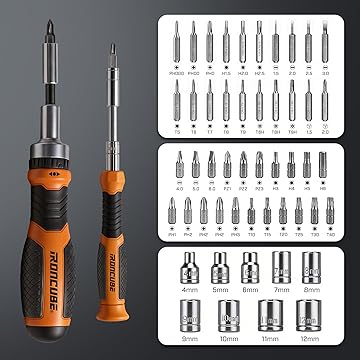
A cordless drill is fast. But fast is not always what you need. Drive a small screw into softwood at full drill speed and the head is stripped before you know it happened. Work inside a narrow electrical panel and the drill body simply will not fit. Try to tighten a delicate terminal on a circuit board and a drill becomes a liability rather than a tool. That is exactly where a ratcheting screwdriver set earns its place — not by replacing the drill, but by doing the jobs the drill handles badly.
The screwdriver ratchet mechanism is one of the most underappreciated advances in hand tool design. It takes the continuous-turn efficiency of a ratcheting wrench and applies it to screw driving — eliminating the constant lifting and repositioning that makes standard screwdrivers so slow on multi-screw jobs. The result is a hand tool that works significantly faster than a standard screwdriver and with far more precision and control than any drill.
This guide covers how the ratchet mechanism works, where a ratcheting screwdriver set outperforms a drill, what to look for when buying, and which sets from IRONCUBE Works deliver the combination of bit variety, build quality, and value that makes them worth the investment in 2026.
What Is a Ratcheting Screwdriver and Why Use One?
A ratcheting screwdriver is a hand tool that drives screws without requiring the user to lift and reposition the tool after each partial turn. The ratchet screwdriver handle contains a directional pawl mechanism — identical in principle to the mechanism used in ratcheting wrenches — that allows the bit to advance in one direction while freewheeling in the return stroke. The user rocks the handle back and forth and the screw turns continuously forward.
According to the mechanical tool overview on Wikipedia, the ratchet mechanism was first widely adopted in wrenches during the early 20th century, with screwdriver applications following as precision manufacturing allowed the same pawl-and-gear design to be miniaturised into handle form. Today, the multi-bit ratcheting screwdriver is standard equipment in professional tool kits across automotive, electrical, and construction trades.
How the Ratcheting Mechanism Speeds Up Driving
To understand the speed benefit, consider what happens when you drive a screw with a standard screwdriver. The bit engages the head. You turn until your hand reaches the limit of its rotation arc. Then you lift the driver off the screw, reposition your grip, and turn again. For a screw that takes 18 full turns to drive, you perform that lift-and-reposition sequence roughly 12 to 15 times.
A ratcheting screwdriver set eliminates those repositioning steps entirely. The handle ratchets back without lifting the bit from the screw head. You just rock your wrist. The same 18-turn screw becomes a continuous motion — faster, less fatiguing, and with maintained pressure on the bit throughout, which reduces the risk of cam-out. The practical speed difference on a job with 20 or more screws is significant enough that experienced tradespeople specifically carry a ratcheting set for installation work.
Ratcheting Screwdriver vs Standard Screwdriver — Speed and Control
The table below compares the two tools across the factors that matter most in real working conditions:
| Task Factor | Standard Screwdriver | Ratcheting Screwdriver | Practical Difference |
| Strokes to drive M5 screw (20mm) | ~18 full turns | ~18 turns, continuous ratchet strokes | ~3–5 seconds |
| Repositioning per screw | Every half-turn | None — ratchet advances continuously | Removes 8–12 lifts |
| Torque control | Good — felt directly | Excellent — direct hand feedback | No overtighten risk |
| Bit change time | 10–15 seconds (unscrew chuck) | 3–5 seconds (push-fit hex release) | Faster on multi-bit jobs |
| Noise level | Silent | Silent | Preferred for quiet zones |
| Access in 50mm clearance | Limited | Good — compact handle | Better in confined spaces |
The numbers above reflect practical working conditions rather than theoretical maximums. The ratcheting screwdriver benefits are most pronounced on multi-screw jobs — cabinet installation, electrical panel work, furniture assembly — where the accumulated time savings across dozens of screws become very tangible.
5 Situations Where a Ratcheting Screwdriver Outperforms a Drill
The full comparison between a ratcheting screwdriver set and a cordless drill is more nuanced than most tool buyers expect. The table below shows where each tool has the advantage:
| Factor | Ratcheting Screwdriver Set | Cordless Drill / Driver |
| Speed on open repetitive work | Slower | Much faster |
| Precision torque control | Excellent | Moderate — clutch needed |
| Noise level | Silent | 85–95 dB |
| Body clearance needed | Minimal — handle only | Large — motor housing |
| Near live electronics | Safe | Risk of vibration damage |
| Battery required | No | Yes (cordless) or cord |
| Cam-out risk on soft heads | Low — hand controlled | High at speed |
| Weight | 100–250g | 800–1,500g |
| Cost | Lower | Higher |
| Best for precision small screws | Yes | No |
The drill wins on speed in open conditions. But in the five situations below, the ratcheting screwdriver set is the more appropriate tool — and often the only practical one.
Precision Work Where Drills Overtighten
Electronics assembly, hinge installation on hardwood furniture, and any fastener driving into soft or coated materials all share the same risk with a drill: overtightening happens before you can stop it. Drill clutch settings help, but they are not a substitute for the direct tactile feedback of a hand tool. A ratcheting screwdriver lets you feel the resistance change as the screw seats — and stop precisely at the right moment without stripping the thread or crushing the material surface.
This precision matters on Phillips and Pozidriv screws especially. The cross-head profile is designed to cam out under excessive torque — which is useful as a safety mechanism but destructive when it happens to a screw you wanted to stay put. Driving cross-head screws by hand through a quality ratcheting screwdriver set essentially eliminates cam-out risk because the torque never exceeds what the hand applies.
Tight Spaces Where Drill Bodies Cannot Fit
The motor housing of a cordless drill adds significant bulk around the bit. In many working conditions — deep inside a cabinet, behind a wall plate, within an electrical enclosure — that bulk physically prevents the drill from reaching the fastener at the correct angle. A ratchet screwdriver handle is narrow, compact, and can be combined with extension bars or flexible shaft attachments to reach positions a drill cannot approach at all.
Automotive interior work is a classic example. Dashboard screws, door card fasteners, and instrument cluster fixings all sit in recesses where a drill body would contact surrounding trim before the bit reaches the screw. Professional automotive technicians routinely use ratcheting screwdrivers alongside their power tools for exactly this reason. The IRONCUBE YouTube channel has product demonstration content showing these access scenarios in real conditions.
Quiet Environments — Hospitals, Offices, Residences
A drill driver produces 85 to 95 decibels at the operator’s position — louder than a lawnmower and well above the threshold that requires hearing protection in UK and US workplace health regulations. In hospitals, residential buildings, offices, and recording studios, that noise is unacceptable during occupied hours. A ratcheting screwdriver set is completely silent. Maintenance work that would otherwise require scheduling outside business hours can be done during normal occupancy with a hand ratchet tool, which saves significant cost and disruption on managed commercial properties.
Tasks Near Sensitive Electronics
Vibration is the invisible risk when using power tools near active circuit boards, hard drives, or server equipment. Drill vibration — even at low speed — can dislodge solder joints, shift connectors, and damage magnetic storage media. A ratcheting screwdriver set produces zero vibration. IT technicians, AV installation engineers, and electronics repair professionals all use ratcheting hand tools specifically to protect sensitive hardware during installation and maintenance work.
Beyond vibration, the electromagnetic interference produced by electric drill motors is a genuine concern in EMC-sensitive environments. Hand ratcheting tools produce none.
When Portability Matters — No Battery, No Cord
A cordless drill needs a charged battery. A corded drill needs a socket. A ratcheting screwdriver set needs neither. For site work in remote locations, field service visits, emergency repairs, or any situation where power access is uncertain, the hand ratchet is the reliable option. It weighs a fraction of a drill, fits in a jacket pocket, and is ready to use regardless of whether the nearest socket is occupied or the battery is flat.
For tradespeople who work across multiple sites, this portability means a ratcheting screwdriver set is always in the bag even when the drill stays in the van. The compact storage of a quality multi-bit ratcheting screwdriver set — particularly those with onboard bit storage — makes them practical everyday carry tools.
How to Choose the Best Ratcheting Screwdriver Set
The market offers a wide range of ratcheting screwdriver set options at very different quality levels. These are the factors that separate a tool that earns regular use from one that ends up at the back of a drawer.
Bit Variety — Phillips, Flathead, Torx, Security, Hex
The bit selection in a quality set should cover the full range of drive profiles encountered across the most common applications. The table below maps each bit type to its primary use case:
| Bit Type | Drive Profile | Common Applications |
| Phillips #1, #2, #3 | Cross head | Furniture, cabinets, most panel screws — essential |
| Flathead 5–8mm | Single slot | Electrical terminals, legacy fittings |
| Torx T10–T30 | 6-point star | Automotive panels, appliances, computers |
| Hex 3–6mm | Hex socket | Furniture bolts, bicycle components |
| Square / Robertson | Square socket | North American woodworking and electrical |
| Pozidriv PZ2 | Modified cross | European furniture and joinery |
| Security Torx (tamper) | Torx with pin | Electronics, appliance housings |
| Nut driver 5.5–8mm | Hex socket | Small nuts in panels and electronics |
A 10-piece set covering the top two or three sizes in Phillips, Torx, and hex handles roughly 80% of everyday fastening tasks. A 47-piece or 56-piece set adds security bits, nut drivers, and extended reach options — necessary for professional use but optional for home workshop buyers. The IRONCUBE 47-piece ratchet screwdriver and socket bit set and the 56-piece ratcheting screwdriver bits and sockets set cover both the everyday and professional ranges comprehensively.
Check that all bits use the standard 1/4-inch hex shank format. This ensures compatibility with other handles, extension bars, and power drivers you already own.
Handle Comfort and Ratchet Direction Switch
The handle is where ergonomics and mechanism reliability come together. A quality ratcheting screwdriver set handle should have a bi-material construction — hard polymer core for structural rigidity, soft TPR overmould for grip. The soft overmould remains grippy under oil and moisture, which matters for automotive and plumbing applications where your hands are unlikely to be completely clean.
The direction switch — typically a collar or slide selector — must operate cleanly between three positions: tighten, loosen, and locked (for direct manual drive). A switch that drifts mid-use is not just inconvenient; it risks backing out a screw you are in the process of tightening. Test the detent action. A firm, positive click between positions is the sign of a quality mechanism. A soft or vague selector is a sign of budget construction that will fail under sustained use.
Onboard Bit Storage vs Separate Case
Two storage approaches exist for ratcheting screwdriver sets, and each has real advantages. Onboard storage — bits held in a magazine inside the handle or in a flip-out holder behind the bit holder — means the tool is self-contained. You grab the handle and every bit comes with it. This is the right choice for service technicians, maintenance workers, and anyone who needs the set immediately accessible without searching for a case.
Separate case storage — a moulded tray or organised compartment case — allows a larger bit selection, better protection of the bits during transport, and easier visual stock-checking. The 47-piece and 56-piece IRONCUBE sets use case storage precisely because their bit count exceeds what any practical onboard holder can accommodate. For a smaller everyday carry set, onboard storage makes more sense. For a full-range professional ratcheting screwdriver set, the case is the better option.
Top Ratcheting Screwdriver Sets from IRONCUBE Works
IRONCUBE produces ratcheting screwdriver sets across a range of piece counts and configurations. The full range is available at the IRONCUBE Amazon storefront and on the IRONCUBE screwdrivers product page. These are the two configurations that cover the broadest range of buyers.
IRONCUBE 10-Piece Angle Ratchet Screwdriver Set
The 10-piece angle ratchet set is built specifically for confined-space work. The 90-degree offset head positions the handle perpendicular to the screw axis, which changes the clearance requirement from vertical to lateral. In spaces where standard drivers cannot operate at all — behind dashboard panels, inside junction boxes, within furniture frames — the angle ratchet set reaches the fastener cleanly.
The set includes Phillips #1 and #2, flathead 6 mm and 8 mm, Torx T15, T20 and T25, and hex 4 mm, 5 mm and 6 mm. The bit holder is magnetic, rated for inverted use — so bits do not fall out in blind-access scenarios. The handle uses a three-position direction selector with firm detent positions. Construction is bi-material with a glass-filled nylon core and TPR overmould. This is the best first ratcheting screwdriver set for automotive technicians, electricians, and cabinet installers who regularly encounter tight-space fasteners.
Best Multi-Bit Ratcheting Screwdriver for Versatility — 47- and 56-Piece Sets
For buyers who need the broadest possible bit coverage in a single kit, the multi-bit ratcheting screwdriver sets in the 47-piece and 56-piece configurations provide professional-grade versatility. Both include standard Phillips, flathead, Torx, hex, and nut driver bits alongside security Torx (tamper-resistant), Pozidriv, and square/Robertson bits — the full spread required for automotive, electronics, appliance repair, and general trade use.
The 56-piece set adds socket bits in common metric and SAE sizes, effectively combining a ratcheting screwdriver set with a compact socket set in a single organised case. For buyers who are deciding between a screwdriver set and a socket set as their second tool purchase, this configuration resolves the choice by covering both. The socket bits use the same 1/4-inch hex shank as the screwdriver bits, so the same ratchet handle drives both.
Both sets are available at the IRONCUBE Amazon store. For buyers building out a full hand tool kit that includes wrenches alongside screwdrivers, the IRONCUBE wrenches range covers the ratcheting combination wrench sets that complement these screwdriver configurations.
How to Maintain Your Ratcheting Screwdriver for Years of Use
A quality ratcheting screwdriver set maintained properly will outlast many cheaper replacements. The maintenance requirements are minimal — but ignoring them eventually leads to mechanism failure that is not worth the repair cost.
The ratchet mechanism is the primary wear point. It contains a spring-loaded pawl and a hardened steel gear. Keep these parts free from dirt and metal particles by wiping the bit holder area after use in dusty or abrasive environments. Never soak the mechanism in solvent — penetrating cleaners wash out the factory lubricant and accelerate pawl wear. Instead, apply a small drop of light machine oil to the mechanism every few months of regular use. The oil works into the pawl spring and gear teeth, reducing friction and extending service life.
Bits are consumables, not permanent parts. S2 steel bits — the standard in quality ratcheting sets — have a typical hardness of HRC 60–62. They will wear over thousands of cycles, but the wear shows up first as rounded corners on the drive profile rather than sudden failure. Replace individual bits when you notice them starting to slip in well-seated fastener heads. Continuing to use a worn bit risks damaging both the fastener and the material around it.
Store the set in its case with the bits in their designated slots. Contact between loose bits scratches the drive surfaces and makes size identification harder over time. Keep the case in a dry environment — the bits are steel and will rust if stored in a damp toolbox or workshop van without protection. A light wipe of oil on the bit shanks before long-term storage prevents surface oxidation.
For wrench maintenance guidance that follows the same principles, the IRONCUBE best ratcheting wrench guide covers the care requirements for ratchet mechanisms in detail — the same approach applies to screwdriver sets. The non-ratcheting wrenches article and the wrench size chart are also useful references when building out a complete toolkit alongside your ratcheting screwdriver set.
Frequently Asked Questions — Ratcheting Screwdriver Set
What is the difference between a ratcheting screwdriver and a standard screwdriver?
A standard screwdriver requires the user to lift the tool and reposition their grip after each partial turn. A ratcheting screwdriver set eliminates this step through the screwdriver ratchet mechanism — a directional pawl inside the handle that allows the bit to advance in one direction while freewheeling in the return stroke. The practical effect is continuous screw driving without repositioning, which is significantly faster on multi-screw jobs and substantially reduces hand fatigue over a full working day. The ratchet mechanism also maintains pressure on the bit throughout the stroke, reducing cam-out risk compared to the repeated engagement and disengagement of a standard driver.
Is a ratcheting screwdriver set worth buying if I already own a drill?
Yes — for several reasons that the drill does not address. A ratcheting screwdriver set offers precision torque control that a drill clutch cannot fully replicate, complete silence suitable for noise-sensitive environments, zero vibration for work near sensitive electronics, and access to confined spaces where the drill motor housing physically cannot enter. Many professional trades carry both tools precisely because they perform differently in different scenarios. The ratcheting set is not a drill replacement — it handles the jobs the drill handles badly.
What bits are compatible with a ratcheting screwdriver set?
Most quality ratcheting screwdriver sets use the standard 1/4-inch hex shank bit format — the same format used in cordless drills, impact drivers, and ratcheting screwdriver handles across brands. Any standard 25 mm or 50 mm hex-shank bit — Phillips, flathead, Torx, hex, Pozidriv, square, or security profile — will fit. This universal compatibility means you can expand your bit selection with any standard bits without being locked into the manufacturer’s own range. Always confirm the bit holder format on your specific tool before buying separate bits.
How long does a ratcheting screwdriver set last?
A quality ratcheting screwdriver set made with hardened steel pawl and gear components — HRC 60+ on the mechanism parts — will withstand years of professional use with basic maintenance. Budget sets with softer metal mechanisms typically fail within 6 to 18 months of regular use as the pawl teeth round off. The bits are consumables and should be replaced individually when they show wear, which is normal and expected. A quality handle with a quality mechanism can outlast dozens of bit replacements, making the initial investment in a well-built set more economical over time than repeatedly buying budget replacements.
What is the best ratcheting screwdriver set in 2026 for professional use?
For professional use in 2026, the best ratchet screwdriver 2026 choice depends on the primary application. For confined-space work — automotive, electrical, cabinet installation — the IRONCUBE 10-piece angle ratcheting screwdriver set delivers the access and bit range that trade work requires. For general professional use requiring maximum bit coverage, the 56-piece IRONCUBE set covers screwdriving and socket driving from a single organised case. Both are available at the IRONCUBE Amazon storefront. For questions about specific applications or bulk orders, the team at IRONCUBE contact page provides direct support.
Summary: Why a Ratcheting Screwdriver Set Belongs in Every Toolkit
A drill is fast in the open. But a ratcheting screwdriver set is the tool that handles precision, silence, access, and portability — the four scenarios where a drill consistently underperforms. It drives screws faster than a standard screwdriver. It works in spaces a drill body cannot enter. It delivers tactile torque feedback that no power tool can replicate. And it requires no battery, no cord, and no power source of any kind.
The ratcheting screwdriver benefits compound across every job that involves more than a handful of screws. For cabinet installers, electricians, automotive technicians, furniture builders, and IT professionals, the set earns its cost back on the first full day of use. For home workshops, it adds capability that the drill simply does not cover.
IRONCUBE produces ratcheting screwdriver sets across configurations from 10-piece angle ratchet kits to 56-piece multi-bit and socket sets. The full range is available at the IRONCUBE Amazon storefront and the IRONCUBE screwdrivers product page. For buyers also sourcing wrenches, the printable metric to SAE conversion chart is a handy reference, and the full IRONCUBE Works site covers the complete hand tool range in one place.