

It is one of the most common questions from anyone building a toolkit from scratch. Do you start with a socket set vs wrench set? Both turn bolts. Both come in metric and SAE. Both claim to be essential. And yet they are fundamentally different tools that excel in different situations — which means the wrong choice first leads to frustration on the very jobs you bought the tool to handle.
The honest answer is that every serious toolkit eventually needs both. But most people cannot buy everything at once, and the question of which to prioritise matters. A socket set without a wrench set leaves you helpless on bolts that sockets cannot access. A wrench set without a socket set is slow on open-space fastening and cannot handle deeply recessed bolts at all. Understanding the socket wrench difference — not just in theory but in the real working situations you will actually face — is what allows you to make the right call for your specific needs.
This guide makes that decision straightforward. It covers how each tool type actually works, when each one outperforms the other, a direct wrench vs socket comparison across every relevant factor, and a practical buying strategy that fits most budgets. By the end, you will know exactly which to buy first and what to add next. The IRONCUBE Works hand tool range covers both, so there is a clear path forward once you have decided.
The Fundamental Difference Between Socket Sets and Wrench Sets
At the mechanical level, the socket set vs wrench set question is about how the tool connects to the fastener. A socket slides down over a bolt head from above, engaging it from the top. A wrench slides onto the bolt from the side, engaging it around the perimeter. That single difference — top engagement versus side engagement — explains almost everything about when each tool works and when it does not.
According to the mechanical engineering overview of hand tools on Wikipedia, the drive geometry of a fastener tool determines both its torque capacity and its access constraints. Top engagement allows more force to be applied through a longer lever arm with extensions. Side engagement allows the tool to fit into clearance gaps that top-engagement tools cannot enter.
How a Socket Set Works — Drive Size, Extensions, and Attachments
A socket set consists of three main components: the drive handle (usually a ratchet), the sockets themselves (sized to specific bolt heads), and the optional extension bars and adapters that position the socket above or inside a recessed fastener. The drive handle connects to the socket through a square drive post — most commonly 1/4-inch, 3/8-inch, or 1/2-inch — and delivers rotational force through the socket to the bolt head.
The drive size determines the maximum torque the system can handle and the range of socket sizes available. The table below shows how drive size maps to application:
| Drive Size | Socket Range | Typical Applications | Notes |
| 1/4 inch | Small fasteners 4–14 mm | Electronics, sensors, interior trim | Compact, low torque |
| 3/8 inch | Mid-range 8–24 mm | Most automotive work, home repair | Most versatile — best first choice |
| 1/2 inch | Large fasteners 17–38 mm | Wheel bolts, suspension, heavy hardware | High torque, bulkier |
| 3/4 inch | Very large 24–50+ mm | Commercial vehicles, heavy machinery | Industrial use |
The versatility of a socket set comes from this modular system. Extensions let the ratchet handle sit outside an engine bay while the socket reaches deep inside. Universal joints allow angled access. Adapters connect different drive sizes. A single ratchet handle can drive dozens of different sockets, which makes the system highly cost-effective for workspaces where fastener variety is high.
How a Wrench Set Works — Fixed Sizes and Direct Grip
A wrench set consists of individual fixed-size tools — each one sized to a specific bolt or nut dimension. A combination wrench has a box end (closed ring) and an open end (open jaw), both sized to the same fastener. The box end grips all six faces of the bolt for maximum contact. The open end slides onto the bolt from the side, which is faster to engage but grips only two faces.
The ratchet socket vs combination wrench comparison often comes down to this: the ratcheting box end on a quality combination wrench combines the multi-face grip of the box end with the continuous-turn convenience of a ratchet, without the need for extensions or a separate drive handle. For a detailed look at how ratcheting wrenches work, the IRONCUBE ratcheting wrench guide covers the mechanism and specifications in full.
What wrenches sacrifice in torque leverage and depth reach, they gain entirely in lateral access. A wrench can reach a bolt that is surrounded by obstructions on three sides, as long as there is space to slide the jaw in from the fourth side. A socket needs clear vertical access — and that is simply not always available.
When to Use a Socket Set Over a Wrench Set
The when to use socket set question has a consistent answer: reach for the socket set when the bolt is recessed, when maximum torque is required, or when speed on open-access repetitive fastening matters. These three scenarios cover the majority of socket set use cases across automotive, home improvement, and mechanical work.
High Torque Applications — Lug Nuts and Large Bolts
Wheel lug nuts are the clearest example. They require 80 to 130 ft-lb of torque depending on the vehicle. Achieving that with a combination wrench is possible — but the handle length required makes it impractical in the working position a lug nut occupies. A 1/2-inch drive ratchet or breaker bar with a deep socket delivers the torque needed cleanly, with the extended handle providing proper mechanical advantage.
The same principle applies to suspension top mount nuts, differential cover bolts, and engine mount hardware. These fasteners combine high torque requirements with working positions that favour a long-handled drive tool. Trying to break them loose with a standard wrench is slower, less controlled, and harder on the tool.
Recessed Fasteners in Deep Cavities
Spark plugs sit inside tubular recesses in the cylinder head — typically 40 to 80 mm deep. A standard socket cannot reach them without a deep socket specifically designed for this purpose. Even then, an extension bar is usually needed to position the ratchet handle outside the engine bay. No combination wrench can perform this task at all.
Suspension strut tower nuts, transmission drain plugs, and differential fill bolts all share this characteristic — they sit in recesses that only a socket with the right extension can reach. For any toolkit that will handle engine or suspension work, these scenarios make a socket set non-negotiable eventually.
Speed-Focused Assembly and Disassembly
When you are assembling flat-pack furniture, fitting an exhaust system, or reassembling a cylinder head, the same bolt size appears dozens of times. A socket set with a ratchet handle — or better, a power driver with a socket adapter — works through these fasteners far faster than a wrench set. The ratchet mechanism advances without repositioning. Extensions allow comfortable working posture. And the modular nature of the system means you can switch socket sizes in seconds without changing tools.
For anyone who builds furniture regularly, does mechanical assembly work, or runs a workshop, the speed benefit of a socket set on repetitive open-access fastening justifies the investment clearly.
When to Use a Wrench Set Over a Socket Set
The flip side of the socket set vs wrench set comparison reveals the situations where wrenches win decisively. These are not edge cases. They appear on virtually every vehicle and in most mechanical work environments — which is why professional mechanics own both tools and reach for the wrench set specifically when these conditions arise.
Tight Spaces Where Socket Extensions Cannot Reach
An extension bar positions the socket axially above the fastener — but it does not change the lateral clearance requirement. To use a socket, you need clear space directly above the bolt head. If a bracket, hose, or adjacent component blocks that vertical path, the socket cannot engage the fastener regardless of how many extension bars you add.
A thin-profile ratcheting combination wrench approaches from the side. It needs only enough lateral clearance to slide the jaw over the bolt head — sometimes just a few millimetres. Alternator brackets, brake calliper pins, battery terminal bolts, and O2 sensor mounts on modern vehicles all fall into this category. The non-ratcheting wrenches guide covers why open-end access is often the only practical option for these situations.
Flat Surfaces with Limited Clearance
Some fasteners sit on flat surfaces where there is no vertical clearance for a socket to slide down over the bolt head. Hose clamp screws, brake line fittings, fuel rail bolts, and pipe union nuts are all examples. The open end of a combination wrench slides onto these fittings from the side — flat against the surface — in a way that no socket can replicate.
This is also why flare nut wrenches — a specialised wrench type with a nearly-closed end — exist specifically for brake and fuel line work. The full wrench range at IRONCUBE includes options for exactly these scenarios.
Quick Adjustments Without Switching Sockets
On a complex job with multiple fastener sizes in close proximity — dashboard removal, brake system servicing, suspension work — constantly selecting the right socket and attaching it to the drive handle slows you down. A mechanic who keeps a ratcheting wrench set on the bench can grab the right size immediately, work the fastener, and move on without the socket selection step.
This workflow advantage is particularly significant in professional workshop environments where time is money. An experienced mechanic doing a brake pad change rarely reaches for the socket set at all — the ratcheting wrench handles every bolt on the job faster because there is no setup time between sizes. For size reference across jobs, the printable metric to SAE wrench conversion chart is a practical tool to keep at the workstation.
Comparison Table — Socket Set vs Wrench Set
The table below puts the socket set vs wrench set comparison across every relevant factor in a single view. Use this as a reference when deciding which to prioritise:
| Factor | Socket Set | Wrench Set |
| Torque capacity | Very high — ratchet drive + extension | High — direct wrench-to-bolt |
| Access in tight spaces | Limited — socket needs axial clearance | Excellent — slim profile fits around obstructions |
| Speed (repetitive work) | Faster — no repositioning with ratchet | Moderate — requires repositioning on each stroke |
| Recessed fasteners | Excellent — deep sockets reach cavities | Poor — wrench needs flat surface access |
| Portability | Bulkier — drive handle + socket tray | Compact — roll pouch or slim case |
| Cost (entry level) | Higher — more components per set | Lower — fewer parts, lower entry price |
| Versatility | Very high — extensions, adapters, bits | Moderate — fixed sizes only |
| Ease of use | Moderate — requires socket selection | High — size selection only |
| Best for beginners | No — more learning curve | Yes — intuitive to use immediately |
| Best for professionals | Yes — core workshop tool | Yes — essential complement to sockets |
Neither tool wins across the board. That is precisely the point. The wrench vs socket comparison always ends in a draw at the category level — because they are designed for different working conditions. The table above is a decision aid, not a verdict. Your specific jobs determine which column matters more.
Which Tool for Which Job — A Practical Scenario Reference
The table below answers the socket set vs wrench set question for specific common tasks. This is the most direct form of the comparison — not by feature, but by actual working situation:
| Job / Fastener | Best Tool | Reason |
| Wheel lug nuts | Socket set | Deep socket + 1/2″ drive ratchet |
| Alternator bracket bolt | Wrench set | Ratcheting wrench in tight engine bay |
| Oil drain plug | Either | Socket faster; wrench works in shallow spaces |
| Brake calliper pin | Wrench set | Flat clearance — socket needs axial approach |
| Battery terminal bolt | Wrench set | Tight access, short swing arc needed |
| Spark plugs | Socket set | Deep socket essential — plug sits in a well |
| Furniture assembly bolt | Either | Socket faster; wrench simpler for beginners |
| Suspension top mount nut | Socket set | Recessed under strut tower — needs extension |
| Hose clamp screw | Wrench set | Open end fits profile; socket cannot engage |
| Exhaust manifold nut | Socket set | Heat + reach — deep socket with long extension |
This reference covers the scenarios most home mechanics and automotive DIY workers encounter. For each job where “either” appears, the socket set is generally faster on open-access jobs; the wrench set is generally easier to deploy without setup time. Watch the IRONCUBE YouTube channel for demonstrations that show these tools in real working conditions.
The Smart Strategy — Buy Both, But Start Strategically
Now that the socket set vs wrench set comparison is clear, the practical question is: where do you start? The answer depends on what work you do most often. But for most people — home mechanics, DIY enthusiasts, and light professional users — there is a logical sequence that builds a useful toolkit without overspending at the start.
Start with a Ratcheting Wrench Set, Then Add Sockets
A ratcheting combination wrench set is more immediately versatile for the widest range of common tasks. It handles tight-space fasteners that sockets cannot reach, works on flat-surface bolts, requires no setup time, and serves as its own drive handle without additional components. For someone starting from zero, a quality 12-piece metric and SAE ratcheting wrench set covers roughly 70% of the fastening tasks most people encounter.
The socket set or wrench set first question resolves clearly for most buyers: start with the wrench set, because its access versatility handles more scenarios without supplementary tools. Add a 3/8-inch drive socket set — which covers the most useful socket range for automotive and home use — as the second purchase. Together, these two sets handle essentially all common fastening applications.
The IRONCUBE wrenches product page is the right starting point for finding the correct wrench set configuration for your needs.
How IRONCUBE Bundles Solve Both Needs
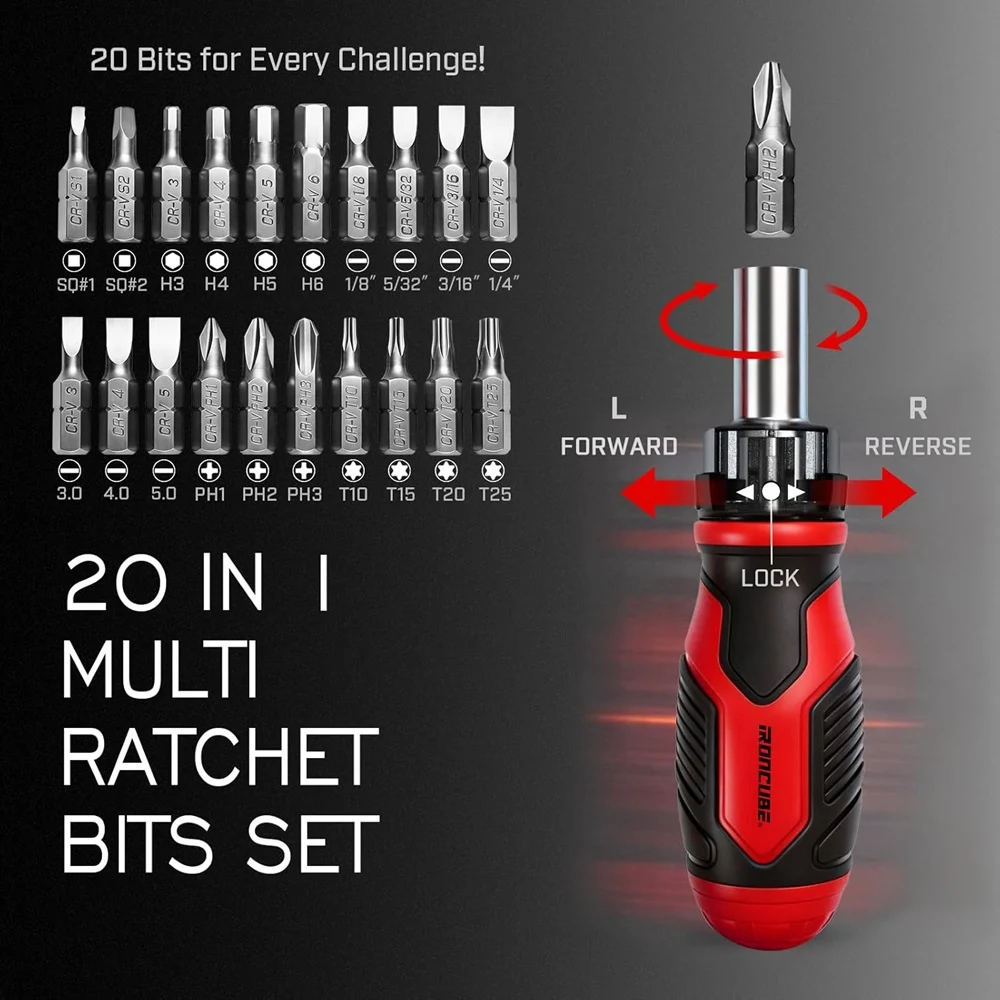
For buyers who want to cover both tool categories from a single purchase, IRONCUBE produces combination sets that include ratcheting screwdriver functionality alongside socket and bit coverage. The 47-piece ratchet screwdriver and socket bit set combines a ratcheting handle, socket bits, and screwdriver bits in a single organised case — covering light socket work and fastening in one kit.
For buyers who need a more comprehensive bit and socket range, the 56-piece ratcheting screwdriver bits and sockets set expands the coverage significantly. Both sets are designed for buyers who want to start covering both the screwdriving and socket-turning spectrum without separate purchases.
For standalone ratcheting wrench sets in combined metric and SAE configurations, the IRONCUBE 12-piece set on Amazon is the direct option — chrome vanadium steel, reversible ratchet mechanism, and a labelled storage case. It is the right starting wrench set for most buyers.
If you are unsure which configuration fits your needs, the wrench size chart helps identify which sizes you need for specific vehicle types, and the contact page connects you with the IRONCUBE team for tailored recommendations.
Frequently Asked Questions — Socket Set vs Wrench Set
Is a socket set or wrench set better for beginners?
For most beginners, a wrench set is the better first purchase. The socket set vs wrench set comparison for beginners comes down to simplicity: a combination wrench has no setup steps, no socket selection, and no drive handle to connect. You pick the right size, slide it onto the bolt, and turn. That directness makes it less intimidating and faster to use on the most common home repair and light automotive tasks. A socket set adds more capability — but also more complexity. Building familiarity with wrenches first gives a stronger foundation for understanding when to reach for the socket set later.
Can a socket set replace a wrench set entirely?
No — and the socket set vs wrench set question should not be framed as one replacing the other. Sockets cannot reach bolts where vertical clearance is blocked by surrounding components. They cannot engage flat-surface fittings like hose clamps or brake line unions. And they are slower for quick single-bolt adjustments where setup time outweighs the speed of ratcheting. Professional mechanics with full socket sets still reach for their wrench set multiple times on every vehicle service. The ratchet socket vs combination wrench comparison always ends at the same conclusion: both are necessary, neither is redundant.
What is the practical socket wrench difference for automotive work?
The socket wrench difference for automotive work comes down to access geometry. Sockets excel at recessed fasteners — spark plugs, suspension mounts, oil filters in deep recesses — where extensions position the drive handle outside the engine bay while the socket reaches in. Wrenches excel at surrounded fasteners — alternator bolts, battery terminals, sensor mounts — where lateral access is available but vertical clearance is blocked. In practice, a car service typically requires both tools. The socket set vs wrench set distinction is not which vehicle to use each on, but which bolt on any given vehicle each tool handles best.
What size socket set should I buy alongside a wrench set?
For most home mechanics and automotive DIY users, a 3/8-inch drive socket set is the most practical companion to a wrench set. The 3/8-inch drive covers socket sizes from 8 mm to 24 mm — the range that addresses the vast majority of automotive and home improvement fasteners. It is more versatile than a 1/4-inch drive (which tops out at smaller sizes) and more practical than a 1/2-inch drive (which is bulkier and heavier for everyday tasks). In the socket set vs wrench set building sequence, a 3/8-inch drive set with a ratchet handle and a selection of metric and SAE sockets is the right second purchase after a 12-piece combination wrench set.
Do professionals use wrench sets or socket sets more often?
Professional mechanics use both constantly — and the frequency depends on the specific job. Engine work and suspension servicing lean heavily on the socket set, because of the recessed fasteners and high torque requirements involved. Interior work, electrical, brake servicing, and accessory work lean on the wrench set, because of the confined-space access requirements those jobs involve. In the socket set vs wrench set debate among professionals, the consensus is always the same: the question is not which is better, but which is right for the bolt in front of you right now. That is why a complete professional toolkit contains both, sized and organised for fast deployment in the conditions each handles best.
Summary: Socket Set vs Wrench Set — The Right Tool for the Right Job
The socket set vs wrench set question does not have one answer. It has two, depending on what you are working on. Socket sets win on recessed fasteners, high-torque applications, and speed on repetitive open-access work. Wrench sets win on confined-space bolts, flat-surface fittings, and quick single-bolt adjustments without setup time. Neither replaces the other. Both belong in a complete toolkit.
For most buyers starting out, the practical sequence is clear: begin with a quality 12-piece metric and SAE ratcheting wrench set for immediate versatility across the widest range of tasks, then add a 3/8-inch drive socket set to cover the recessed and high-torque scenarios that wrenches cannot handle. That combination covers essentially every common fastening task in automotive, home improvement, and mechanical work.
IRONCUBE builds both tool categories to professional-grade specification. The ratcheting wrench set — available on Amazon — is the right starting point. The 47-piece ratchet screwdriver and socket set and the 56-piece screwdriver bits and sockets set cover the screwdriver and socket side. Explore the full IRONCUBE wrenches range and the screwdrivers range to build the toolkit that fits your work.