

Pick up any combination wrench and you are holding two different tools in one handle. One end is open. The other is a closed ring. Both turn bolts. But they work differently, grip differently, and excel in entirely different situations. Understanding the open end vs box end wrench distinction is not a trivial technical point — it is the difference between finishing a job cleanly and rounding a bolt head you will spend the next hour trying to remove.
The box end vs open end difference comes down to how each end contacts the fastener. An open jaw grips two flat faces. A closed ring grips all six. That single geometric difference cascades into everything: how much torque each end can safely transmit, which working positions each suits, where each end fails, and when the wrong choice damages the fastener instead of moving it.
This guide covers everything you need to know about open end vs box end wrench selection — how each end is engineered, the precise scenarios where each performs best, a direct performance comparison across every relevant factor, and how a combination wrench from IRONCUBE Works gives you both ends in a single professional tool. According to the mechanical overview of wrenches on Wikipedia, combination wrenches exist specifically to provide both access types in a single carried tool — and understanding which end to reach for first is what makes that design work in practice.
Understanding the Two Sides of a Combination Wrench
A combination wrench is the most common wrench type in professional toolkits precisely because it provides both end designs in a single tool. The wrench types explained at this fundamental level — open end on one side, box end on the other — give the user access to two entirely different fastening approaches without carrying two separate tools. But the two ends are not interchangeable. Each has a specific geometry, a specific grip mode, and a specific set of working conditions where it outperforms the other.
How the Open End Design Works
The open end of a combination wrench has a U-shaped jaw that grips two parallel flat faces of a hexagonal bolt or nut. The jaw opening is machined to a precise tolerance — slightly wider than the bolt flat-to-flat dimension — which allows it to slide over the fastener from the side without requiring top-down clearance.
Most open end wrenches are set at a 15-degree offset angle relative to the handle axis. This offset serves a practical purpose: in a full rotation, the user turns the wrench until the handle contacts an obstruction, then flips the wrench over to continue from the other flat face. The 15-degree offset means each flip advances the bolt by 15 degrees, allowing operation in spaces with very limited swing arc.
The contact geometry of an open end is inherently limited. With force applied across only two flat faces, the contact area is smaller than a box end — which means higher stress concentration at each contact point. On a bolt with slightly worn or corroded flats, that concentration is enough to deform the metal, creating the familiar rounded bolt that then resists every subsequent tool. This is the primary limitation of the open end that every experienced mechanic knows by instinct.
How the Box End Design Works
The box end of a combination wrench is a closed ring with internal geometry that contacts the full perimeter of the bolt head. The most common configuration is a 12-point ring — which contacts all six flats and all six corners of a standard hex bolt. A 6-point ring contacts only the six flat faces, distributing force more evenly but requiring more precise alignment before engaging.
Because the ring surrounds the entire bolt head, it cannot slip off under load. The force from the handle distributes across multiple contact points, dramatically reducing stress concentration at any single point. This is why when to use box end wrench guidance always points to high-torque applications and stubborn fasteners — the ring design simply cannot round the bolt the way an open jaw can under the same applied force.
The limitation of the box end is equally clear: to engage it, you must drop the ring down over the bolt head from above. That requires vertical clearance above the fastener. In many automotive and plumbing scenarios, that clearance does not exist — which is exactly when the open end takes over.
When to Use an Open End Wrench
The open end wrench advantages are all related to access. The open jaw slides onto the fastener from the side, operates on flat surfaces, and works in positions where a box end ring simply cannot engage. These three capabilities make the open end the correct first choice in a consistent set of working scenarios.
Sliding Onto Fasteners in Tight Spaces
When a bolt sits against a wall, a bracket, or a surface that blocks any approach from above, the box end ring cannot engage. There is no room to drop it down over the bolt head. The open jaw slides in from the side — along the flat surface — and grips the two accessible faces. This lateral engagement is the defining open end wrench advantage in automotive work: battery terminal bolts, fuel line connections, panel-mount fasteners, and any bolt installed flush against a surface are all situations where the open end is the only wrench end that can physically reach the fastener.
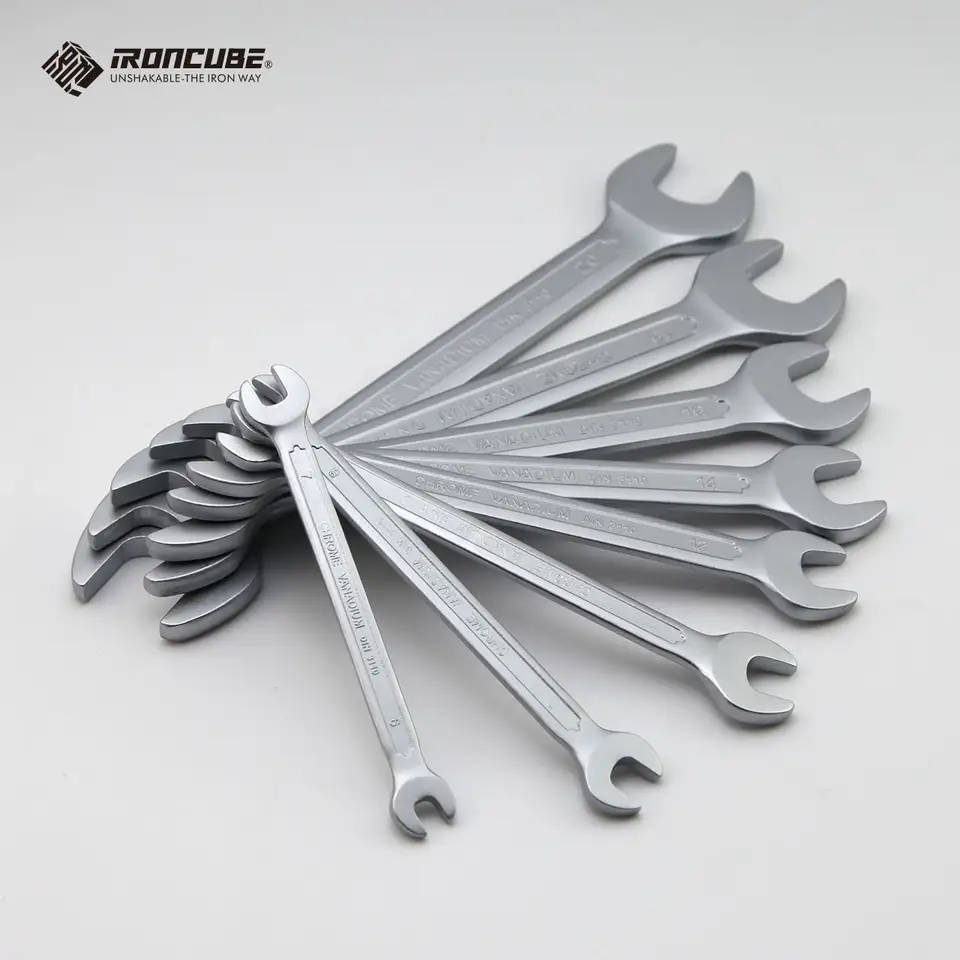
The IRONCUBE ANSI standard double open end wrench and the IRONCUBE DIN standard open end wrench are both built to their respective dimensional standards — ensuring jaw tolerances that grip flat surfaces cleanly without the play that causes rounding.
Quick-Turning Loose Nuts and Bolts
Once a nut or bolt is broken loose from its seating torque, the open end becomes the fastest way to run it down or off. Engagement is instantaneous — drop the jaw over the flats, turn, reposition, turn again. There is no alignment step required. For jobs with multiple fasteners of the same size that need to be removed quickly — wheel nuts on a trolley jack job, access panel screws, or hose clamp nuts — the open end runs through them faster than any other non-power tool.
This is why professional mechanics often use a specific workflow: the box end breaks the bolt loose (where full grip is needed), then the open end runs it off (where speed matters and the bolt is already moving freely).
Flat-Surface Fittings Where a Box End Will Not Fit
Plumbing fittings — particularly the compression nuts and union connections used in brake lines, fuel lines, and hydraulic systems — present a unique challenge. The pipe entering the fitting blocks any approach from directly above the nut. The only way to engage the fitting nut is from the side, along the pipe axis. An open jaw — specifically a flare-nut wrench, which has an almost-closed jaw designed to grip the nut perimeter without side-loading the pipe — handles these fittings correctly.
A standard box end ring cannot engage a pipe fitting at all without the pipe being first disconnected. For brake system work, the IRONCUBE wrench range includes fitting-specific options for exactly this requirement. The non-ratcheting wrenches guide covers the range of open end applications in detail.
When to Use a Box End Wrench
The box end of a combination wrench is the right choice whenever the fastener is under high load, corroded, or at risk of rounding. Understanding when to use box end wrench versus the open end comes down to one question: does this bolt need maximum grip, or maximum access? When it is grip, the box end is the answer.
Maximum Grip on Stubborn or Corroded Bolts
A corroded bolt has flat faces that are no longer perfectly flat. Road salt, moisture, and years of thermal cycling create surface pitting and deformation on the steel faces of any bolt that has been in service for more than a few years. An open jaw, contacting only those two faces, will start to deform the pits further under load — beginning the rounding process immediately.
The box end ring encircles the bolt head and distributes force around the entire perimeter. Even on a bolt with two slightly damaged flats, the ring finds grip on the remaining four or six points of the hex geometry and moves the fastener without further damage. This is why experienced mechanics never attempt to break loose a seized or corroded bolt with the open end — the box end first is the professional standard.
Preventing Bolt Rounding on High-Torque Applications
Wheel nuts, suspension top mount bolts, differential cover fasteners, and engine mount hardware all require torques in the range of 80 to 150 ft-lb or more. At those loads, the two-point contact of an open jaw creates enough stress concentration to deform even a clean, undamaged bolt flat under sudden load. The box end distributes the same force across six or twelve contact points, keeping stress below the deformation threshold of the steel.
The best ratcheting wrench set guide covers how ratcheting combination wrenches bring this box end grip advantage to continuous-turn fastening — particularly relevant for high-torque applications in confined engine bays where a breaker bar is impractical.
6-Point vs 12-Point Box Ends — Which Grips Better?
Within box end design, the 6-point vs 12-point distinction matters significantly for specific applications. The comparison table below shows the key differences:
| Type | Contact Method | Grip Strength | Repositioning | Best Scenarios |
| 6-point | Grips flat faces only | Very high — full face contact | 20–30% extra repositioning needed | Corroded bolts, high-torque applications |
| 12-point | Grips corners and flats | High — slightly less face contact | Fits more easily in any position | General professional use, common in combo wrench sets |
| Open end | Grips two flat faces | Moderate — 2-point contact only | Fastest engagement of all | Quick turns, lateral access, flat surfaces |
For most general professional use, a 12-point box end offers the best balance of grip and usability — it engages in more positions and works on standard-condition bolts without difficulty. However, for any bolt that is corroded, seized, or already showing signs of rounding, a 6-point ring is the correct choice. The flat-face-only contact of the 6-point distributes stress across the full face of each flat — maximising contact area and minimising further damage to already-compromised bolt geometry.
Why the Combination Wrench Gives You Both in One Tool
The combination wrench uses case for having both ends in a single tool becomes clear the moment you work through a real job. Consider a typical brake calliper bolt replacement: the bolt is corroded from road salt, the service interval is years overdue, and it sits in a position where the alternator bracket partially blocks the vertical approach. You reach for the box end to break it loose — full ring grip on the corroded flats, no risk of rounding. Once it moves, you flip the wrench to the open end to run it down quickly — faster engagement, no alignment step needed between turns. Two phases of the same job, two ends of the same tool.
That workflow repeats on virtually every mechanical job. Drain plugs, hose fittings, bracket bolts, sensor mounts — all of them benefit from the same two-phase approach. The combination wrench uses pattern is always: box end for the hard part, open end for the easy part. Which is why carrying two separate wrenches — a box-only and an open-only — is redundant. The combination wrench handles both phases in a single carried tool, which is why it became the dominant wrench type in professional workshops globally.
The 15-degree offset angle on the open end and the matching offset on the box end are both designed to work in the same swing arc — so the same wrench that fits the space on one end also works on the other end without repositioning your body or changing your grip angle.
Comparison Table — Open End vs Box End Wrench Performance Factors
The table below puts the open end vs box end wrench comparison across every performance factor in a single reference:
| Factor | Open End Wrench | Box End Wrench |
| Faces engaged on bolt | 2 flat faces | 6 or 12 faces — full circumference |
| Torque distribution | Concentrated on 2 points | Spread across 6 or 12 contact points |
| Risk of rounding bolt | Higher — especially on worn flats | Very low — full grip prevents slipping |
| Lateral access (from side) | Excellent — slides on from side | Not possible — must drop down over bolt |
| Use on corroded fasteners | Poor — slips under high load | Excellent — holds even on damaged flats |
| Speed of engagement | Faster — open jaw needs no alignment | Slightly slower — must align ring to bolt |
| Pipe and fitting use | Good — flare-nut variant available | Not suitable — cannot side-load |
| Best for initial break-loose | No — risk of rounding | Yes — full grip absorbs shock load |
| Best for running down loose nuts | Yes — fast engagement | Possible but slower to engage/disengage |
| Flat surface access | Excellent — open jaw lies flat | Limited — ring requires vertical clearance |
For the most common working scenarios, the table below maps specific jobs to the correct wrench end:
| Task / Fastener | End to Use | Reason |
| Corroded suspension bolt | Box end | Full-face grip minimises rounding risk |
| Brake line fitting nut | Open end (flare-nut) | Side access essential — pipe blocks top approach |
| Running down a loose wheel nut | Open end | Fast engagement, no tight torque needed |
| Final tightening of wheel nut | Box end | High torque — full grip required |
| Hose clamp screw | Open end | Flat surface — box end needs vertical clearance |
| Oil drain plug (initial break-loose) | Box end | Max grip on tight fastener |
| Oil drain plug (running it off) | Open end | Faster once the plug is loose |
| Battery terminal bolt | Open end | Lateral access in tight space |
| Alternator bracket bolt | Box end or ratcheting combo | High torque in confined access |
| Pipe union fitting | Open end (flare nut) | Cannot side-load a pipe fitting with box end |
These scenarios cover the majority of situations most mechanics and tradespeople encounter. When the job involves corroded bolts or high torque, the box end is the default. When the job involves lateral access or fast running of loose fasteners, the open end is the practical choice.
For size reference across both metric and SAE fasteners, the printable metric to SAE conversion chart and the wrench size chart cover the full conversion reference in a single view.
IRONCUBE Combination Wrench Sets — Forged for Both Applications
A combination wrench is only as good as the steel and manufacturing process behind it. At the torques and working conditions where both ends matter most, the quality of the forging and heat treatment determines whether the wrench holds its geometry under load or begins to deform — and start rounding the bolt instead of turning it.
IRONCUBE combination wrenches use drop-forged chrome vanadium steel throughout — the alloy and process combination that aligns grain structure for maximum strength and toughness under repeated torque loading. Both the open jaw and the box ring are machined to precise dimensional tolerances after forging, ensuring clean engagement on both ends without the play that leads to bolt damage over time.
The open end jaw tolerance is critical. A jaw that is even 0.2 mm over the nominal bolt flat dimension introduces enough play to begin rounding the bolt under heavy load — because the contact point shifts from the full face to a corner during the power stroke. IRONCUBE’s open end wrenches are manufactured to ANSI and DIN standards that control this tolerance precisely. The IRONCUBE ANSI double open end wrench meets ANSI B107.100 dimensional requirements. The IRONCUBE DIN standard open end wrench meets DIN 3110 requirements for European market compatibility.
The box end ring on IRONCUBE combination wrenches uses a 12-point configuration with machined chamfers that guide the ring onto the bolt head cleanly without jamming. The ring wall thickness is calculated to resist deformation at the rated torque — which for chrome vanadium combination wrenches typically exceeds the torque capacity of the bolt itself, meaning the wrench limits out at fastener failure before the ring deforms.
For buyers looking to build a complete wrench set, the IRONCUBE wrenches product category covers the full range — from individual open end wrenches to combined metric and SAE ratcheting sets. Watch the IRONCUBE product demonstrations on YouTube to see the tools in actual working conditions before buying.
For hand tools beyond wrenches — ratcheting screwdrivers, socket sets, and bit kits — the full IRONCUBE range is at the IRONCUBE Amazon storefront. Custom and bulk orders can be arranged through the IRONCUBE contact page.
Frequently Asked Questions — Open End and Box End Wrench
When should I use the open end vs box end wrench on the same bolt?
The standard professional approach is: use the box end to break the bolt loose, then switch to the open end to run it down or off. The open end vs box end wrench decision on any single bolt follows the torque level. High torque — initial break-loose, final tightening — requires the box end’s full-ring grip. Low torque — running a loose fastener — benefits from the open end’s fast engagement. On a combination wrench, both ends are always immediately available without a tool change, which is exactly why the combination wrench exists.
Does the open end wrench cause more bolt rounding than the box end?
Yes — under equal load conditions, the open end vs box end wrench comparison on bolt-rounding risk is not close. The open end contacts two flat faces. Under high load or on a corroded bolt, stress concentrates at those two points and begins to deform the corners between the flats. The box end distributes the same force across six or twelve contact points, keeping individual stress below the deformation threshold. The box end vs open end difference in rounding risk is why professional mechanics default to the box end for any fastener that is tight, corroded, or in a high-torque application.
Is a 6-point or 12-point box end better for my work?
The open end vs box end wrench question at the 6-point vs 12-point level comes down to fastener condition. For new, clean bolts in good condition, a 12-point box end engages in more positions and works just as well as a 6-point. For any bolt that is corroded, seized, or showing rounded corners, a 6-point ring provides more contact area on each remaining flat face — which is more important than repositioning convenience at that point. Most professional combination wrench sets use 12-point rings for general versatility, and experienced mechanics keep a 6-point set specifically for seized-fastener work.
Why does a combination wrench have both ends at the same size?
The combination wrench uses case requires both ends to be the same nominal size because they both serve the same bolt in the same job. If the open end were a different size than the box end, you would need to carry two separate wrenches for the two-phase workflow — breaking loose with the box end and running off with the open end — that a combination wrench handles in a single tool. The open end vs box end wrench on the same handle eliminates that need. Both ends fit the same bolt; the choice of which end to use is based on the working condition, not the fastener size.
Can I use an open end wrench on a bolt I can only reach from the side?
Yes — and that is exactly the scenario the open end is designed for. The open end wrench advantages in lateral access are the defining reason to use this end over the box end. When a bolt sits against a wall, bracket, or surface that blocks vertical access, the open jaw slides onto the bolt flats from the side without requiring clearance above the bolt head. This is the direct open end vs box end wrench access difference — the box ring must drop down over the bolt head and cannot be side-loaded. For any flat-surface or side-access fastener, the open end is the only practical hand wrench option.
Summary: Open End vs Box End Wrench — Use Both Deliberately
The open end vs box end wrench question is not about which end is better. Both ends exist because they solve different problems on the same job. The box end grips fully, transmits high torque safely, and protects corroded fasteners from further damage. The open end accesses lateral positions, works on flat surfaces, and runs loose fasteners down quickly. Together, they cover every phase of most mechanical fastening tasks.
The combination wrench uses design puts both ends in a single tool precisely so that professional mechanics can switch between the two approaches without a tool change. Understanding which end to reach for — and why — is what separates a mechanic who finishes the job cleanly from one who ends up dealing with a rounded bolt that was preventable.
IRONCUBE combination wrenches are forged to the dimensional standards that make both ends work correctly: ANSI and DIN compliant jaw tolerances on the open end, 12-point rings on the box end, drop-forged chrome vanadium steel throughout. Explore the full IRONCUBE wrenches range, including the ANSI double open end wrench and the DIN standard open end wrench, at ironcubeworks.com.