

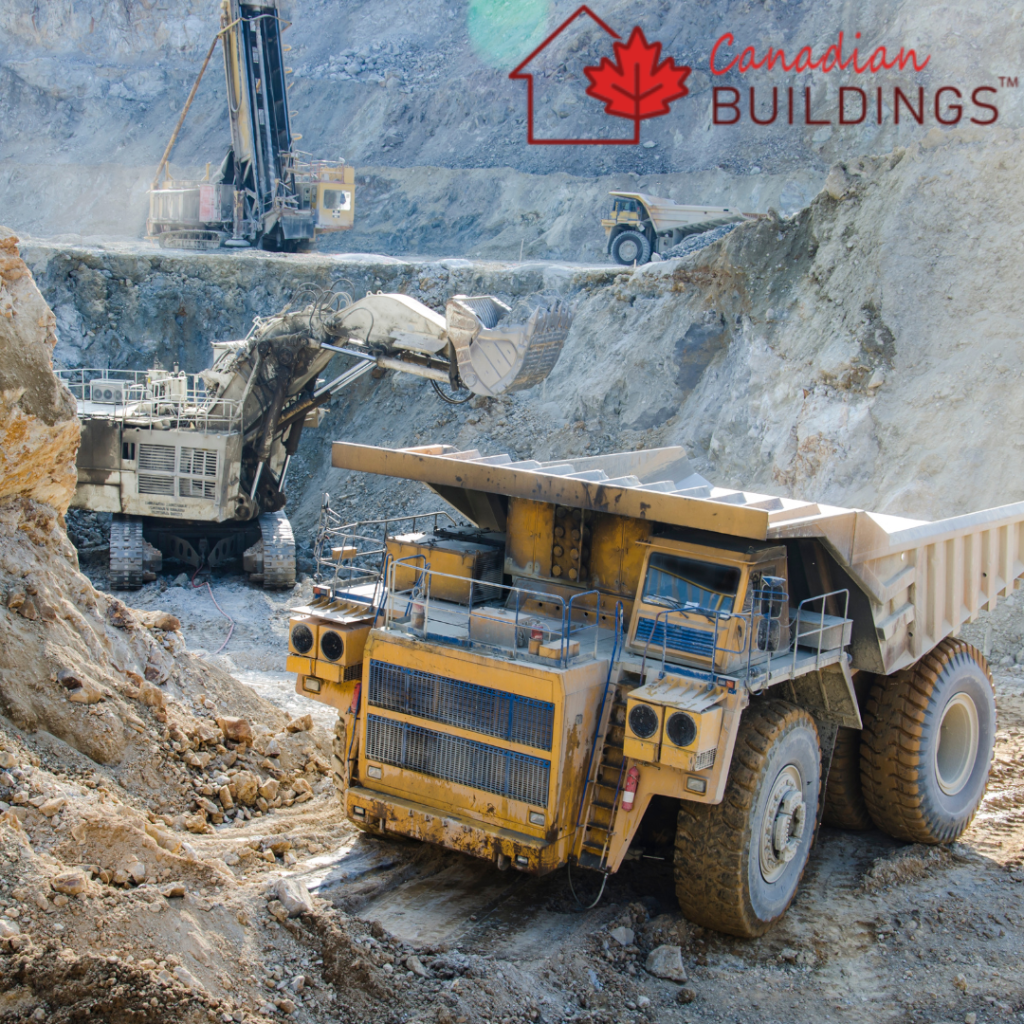
Mining operations are some of the most demanding construction environments on earth. The combination of remote locations, extreme weather, limited access windows, and tight production schedules creates a set of constraints that most conventional building systems are simply not equipped to handle. The mining building solutions that consistently perform under these conditions are not chosen for aesthetic reasons or industry habit; they are chosen because the logistical and structural realities of remote mine sites demand them.
Steel structures have become the default choice for mining operations precisely because they solve problems that other building systems cannot. When a project is located hours from the nearest town, accessible only by seasonal road or air, and operating on a schedule tied directly to production targets and investor commitments, the building systems used on that site need to perform reliably from the moment they arrive. There is no room for repeated deliveries of materials that did not ship complete, no tolerance for construction timelines that stretch because skilled trades are unavailable, and no budget for structural failures that shut down operations during the mining season.
The Real Constraints of Remote Mine Site Construction
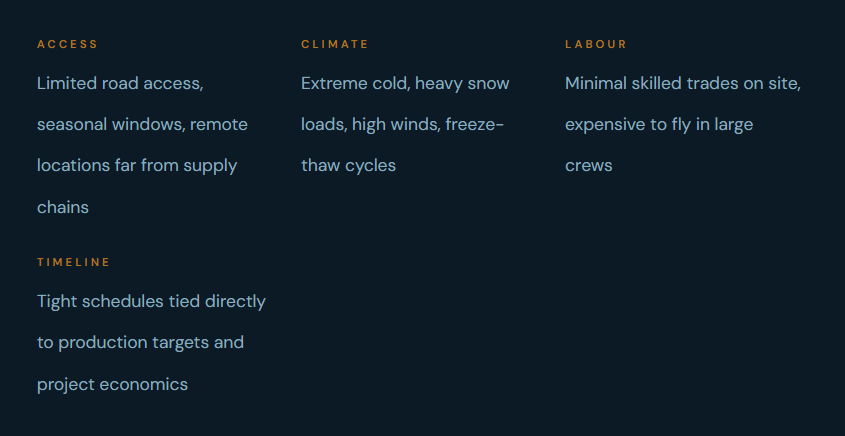
Understanding why steel dominates mining construction requires understanding the environment that mining builders actually work in. Remote sites do not have the infrastructure that urban construction takes for granted. Roads may only be accessible for part of the year, forcing all material deliveries into a narrow window before freeze-up or during brief summer access periods. Skilled tradespeople are scarce in isolated locations, and flying in large construction crews is expensive and logistically complex. Weather windows for exterior construction work can be short and unpredictable, meaning that time lost to bad weather directly affects project completion dates.
Transportation costs in remote mining environments are often more significant than material costs themselves. Every load that travels by helicopter, floatplane, or remote road carries a premium that compounds with the number of trips required. A building system that arrives in multiple incomplete shipments, or that requires additional materials sent later to correct errors or omissions, does not just create a scheduling problem; it creates a cost problem that can be substantial. Steel structures address this by shifting almost all complexity off-site, arriving as complete pre-engineered packages designed to assemble predictably with the components that came with them.
Transport Efficiency, The Advantage That Changes the Economics
At remote mine sites, the way a building system ships matters as much as how it performs once assembled. Pre-engineered steel structures are designed from the outset to ship efficiently. Components are fabricated to precise specifications off-site, packed compactly, and delivered as complete packages with predictable volumes and weights. There is minimal waste and minimal uncertainty about what will be in the shipment when it arrives.
Compare this to wood-framed or site-built construction systems, which typically require multiple deliveries, include oversized or awkwardly shaped loads, and depend on materials arriving in the correct sequence for the construction process to proceed without delays. In a remote environment where each delivery trip carries a significant cost, this unpredictability is not just inconvenient; it is a material budget risk. Steel’s compact, complete, pre-planned delivery format reduces the number of trips required and gives project managers a level of certainty about the construction process that other systems cannot match in the same environment.
Speed of Assembly When Access Windows Are Short
Steel structures are assembled from pre-engineered components rather than built from raw materials on site. This distinction is critical in environments where the available construction window is measured in weeks rather than months. A steel building does not require on-site cutting, fitting, or fabrication of structural members. The components arrive pre-cut, pre-drilled, and designed to fit together in a specific sequence that smaller, specialized crews can follow efficiently. The result is rapid erection once materials are on site, with fewer weather-dependent processes and less dependence on the large framing teams that wood construction requires.
For a mine site where the construction season might last from June to September and the building needs to be enclosed and operational before freeze-up, the difference between a system that can be erected in weeks and one that requires months is not a minor scheduling consideration; it is a fundamental project constraint. Steel construction keeps projects moving in environments where time is the most constrained resource on the entire site.
Steel structures are not chosen at mining sites because they are industrial or familiar. They are chosen because they work, have predictable timelines, have reliable performance in extreme conditions, and have long-term durability that reduces operational risk in places where maintenance is expensive and disruptions are costly.
Performance in Extreme Canadian Conditions
Canadian mining sites span environments that test building systems in ways that temperate-climate construction rarely encounters. Northern operations deal with extreme cold that makes materials brittle and construction processes difficult. Sites in mountainous regions face heavy snow loads and high wind exposure. Coastal and subarctic locations experience persistent moisture, freeze-thaw cycling, and seismic activity in some areas. The building systems used at these sites need to perform reliably across all of these conditions, not just in the mild end of the seasonal range.
Steel structures are engineered for precisely these conditions. Heavy snow loads are accounted for in the structural design through load calculations specific to the site location. High wind design criteria are incorporated into connection details and structural members. The material itself does not rot, warp, or suffer biological degradation in the moisture-heavy environments that wood construction struggles with. Structural performance remains consistent over time even under the repeated freeze-thaw cycling that is one of the most destructive forces acting on buildings in northern Canada. A steel structure built to the right specifications for a given site will continue to perform to those specifications decades after construction, without the progressive structural deterioration that other materials experience in harsh conditions.
Reduced Labour Dependency in Isolated Locations
One of the most practical advantages of steel construction at remote mining sites is how little it depends on large pools of skilled tradespeople. The bolt-together assembly systems used in pre-engineered steel buildings minimize on-site cutting, fitting, and fabrication. Sequencing conflicts between different trades are reduced because the structural system does not require the same layered construction process that wood framing involves. Smaller, specialized crews can erect steel buildings efficiently and safely, without the logistical complexity of coordinating large teams in a location where accommodation, food, and transportation for workers all carry significant costs.
For mining operators already managing complex logistics across multiple functions on a remote site, a building system that reduces dependence on skilled labour availability is a genuine operational advantage. The fewer variables in the construction process, the more predictable the outcome — and predictability is exactly what project managers at remote mine sites need when everything else on the project is already managing enough uncertainty.
Adaptability as Mining Operations Evolve
Mining operations are not static. Projects progress through exploration, development, and production phases that have very different facility requirements. Expansions are added as production targets increase. Equipment changes require modifications to maintenance facilities. Some operations eventually reach the end of their productive life and need to be decommissioned. The building systems used at mine sites need to support this ongoing evolution rather than creating obstacles to it.
Steel structures are inherently adaptable in ways that make them well-suited to this reality. Clear-span interiors allow equipment layouts to be completely rethought without structural modification, there are no columns in the middle of the floor plan that constrain where equipment can be placed or how maintenance workflows are organized. Additions can often be planned into the original structural design so that future expansion is straightforward rather than requiring significant re-engineering. Structures that have served their purpose can be disassembled and in some cases relocated to other sites rather than simply abandoned, an important consideration in remote environments where end-of-life remediation is a regulatory and financial obligation.
Lower Maintenance Where Maintenance Is Most Expensive
Every maintenance task at a remote mining site carries a cost premium that simply does not exist at accessible urban facilities. Flying in a specialist contractor to address a structural problem, sourcing replacement materials through remote logistics, and managing the safety and scheduling implications of maintenance work during active mining operations all add up to make maintenance at remote sites significantly more expensive per task than equivalent work would be in a standard commercial location. The building system that minimizes how often maintenance is required and how complex it is when it is needed has a meaningful financial advantage in this environment.
Steel structures require minimal structural maintenance compared to wood-framed or masonry alternatives. There are no biological degradation processes at work, no moisture absorption creating progressive structural weakening, and no pest intrusion creating hidden damage. The primary maintenance tasks, periodic inspection of coatings, checking fasteners, and addressing any surface corrosion before it progresses, are straightforward and can be performed by site personnel rather than specialist contractors. Lower maintenance translates directly into lower operational risk in locations where anything that can go wrong tends to do so at the worst possible time.
Safety and Structural Reliability
Mining operations in Canada operate under strict safety regulations that apply to every aspect of the work environment, including the buildings that house personnel and equipment. Steel structures contribute to safer mine sites through their non-combustible construction, their predictable structural behavior under design loads, and the engineered load paths that ensure the structure performs as designed even under stress. When a building houses workers, critical processing equipment, or power generation systems, the structural reliability of that building is not a secondary consideration — it is a fundamental safety requirement.
The fire resistance of steel is particularly relevant in mining environments where flammable materials, fuels, and chemicals are commonly present. A building structure that does not add fuel to a fire and that maintains its structural integrity under fire conditions for longer than combustible alternatives provides meaningful protection for both personnel and equipment. This performance aligns directly with the safety management standards that Canadian mining operations are required to meet.
The Range of Applications at a Typical Mine Site
The building types needed at a mining operation cover a wide range of functions, and steel provides effective solutions across all of them. Equipment maintenance buildings need clear-span interiors large enough to accommodate haul trucks and excavators, with overhead crane capacity and heavy floor loads that the structural system must be engineered to support. Processing facilities require enclosed, climate-controlled spaces with specific ventilation and drainage requirements. Warehouses for parts, supplies, and consumables need high-density storage capacity and efficient vehicle access. Power generation enclosures need to protect sensitive mechanical and electrical systems from extreme weather while accommodating the maintenance access those systems require.
Common Steel Building Applications at Mine Sites
Equipment maintenance buildings, ore processing facilities, parts and supply warehouses, power generation enclosures, administrative and support buildings, and worker accommodation structures—in each case the same priorities apply: speed of delivery, reliable performance in extreme conditions, low maintenance over the life of the operation and the structural adaptability to evolve as the mine moves through its operational phases.
Administrative and support buildings, including offices, control rooms, and safety facilities, also benefit from steel construction in remote environments because the same logistical advantages apply equally to lighter commercial applications. Worker accommodation camps use steel-framed construction for the same reasons, speed of assembly, transport efficiency, and durability in conditions that would rapidly degrade less robust building systems.
Why the Alternatives Fall Short in Remote Conditions
The case for steel at mining sites becomes clearer when examined against what the alternatives actually require. Wood-framed construction demands large volumes of material that ship less efficiently than steel components, skilled framing crews that are rarely available in remote locations, and ongoing maintenance to address moisture-related degradation and biological threats. Masonry and concrete construction require heavy placement equipment, extended curing times that compress available construction windows, and specialized skills that are even harder to source in remote locations than general framing labor. These limitations are manageable in accessible urban environments; in remote mining conditions, they become serious project risks.
Steel structures eliminate most of the variables that make these alternatives problematic in remote mining environments. The construction process is predictable, the performance is proven, and the long-term maintenance requirements are well understood and manageable with site personnel. For a project where failure means production disruption and cost overruns that affect the entire operation, that combination of predictability and reliability is not a preference; it is a requirement.
Steel structures are the proven answer to the building challenges that mining operations face at remote sites across Canada. Their transport efficiency, speed of assembly, structural performance in extreme conditions, low maintenance requirements, and adaptability to evolving operational needs make them the logical choice when the consequences of getting the construction wrong are measured in lost production, cost overruns, and safety risks. For mining operators who need buildings that work from day one and continue working for the life of the project, steel delivers what no other building system can match in the environments where Canadian mining actually happens.