

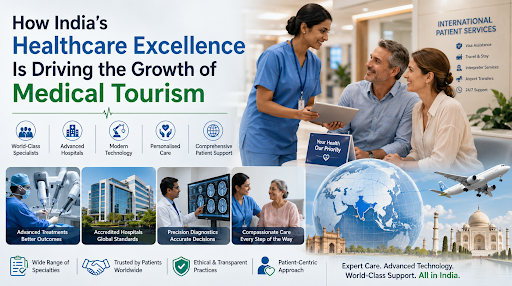
Healthcare is becoming increasingly global as patients look beyond their home countries for specialised medical care. Factors such as access to experienced specialists, advanced medical technology, shorter waiting times, and comprehensive patient support have encouraged more people to explore international treatment options. Over the past decade, India has emerged as one of the world’s most trusted destinations for overseas patients, offering a healthcare ecosystem that combines clinical expertise with modern infrastructure and coordinated care.
The rapid expansion of medical tourism in India reflects the country’s ability to meet the changing expectations of international patients. Rather than focusing solely on affordability, India has positioned itself as a destination where quality healthcare, innovation, and personalised patient services work together to create a positive treatment experience.
India’s Healthcare Sector Continues to Evolve
India has made significant progress in strengthening its healthcare system through investment in hospitals, medical education, research, and advanced technology. Major cities such as New Delhi, Mumbai, Chennai, Hyderabad, Bengaluru, Gurugram, and Kolkata now host hospitals equipped to manage a broad range of medical conditions using modern treatment techniques and multidisciplinary clinical teams.
Many healthcare institutions continue expanding specialist departments while introducing new technologies that improve diagnosis, treatment planning, and patient care. This ongoing development has enhanced India’s reputation among patients seeking reliable healthcare beyond their national borders.
The country’s commitment to continuous improvement remains one of the key reasons why international patients continue choosing India for specialised treatment.
Comprehensive Treatment Across Multiple Specialties
India offers healthcare services covering almost every major area of medicine. Patients travelling from overseas frequently seek treatment for complex conditions that require experienced specialists and advanced hospital facilities.
Some of the most common areas include:
- Cardiology and heart surgery
- Orthopaedic surgery and joint replacement
- Oncology and cancer care
- Neurosurgery
- Spine treatment
- Kidney and liver disorders
- Fertility and IVF services
- Plastic and reconstructive surgery
- Gastroenterology
- Preventive health assessments
The availability of multiple specialties within the same healthcare system enables patients to receive coordinated treatment from different experts without unnecessary delays.
Modern Medical Technology Supporting Better Outcomes
Technological innovation has transformed healthcare worldwide, and India’s leading hospitals continue adopting advanced medical solutions to improve patient care.
Robotic-assisted surgery, minimally invasive procedures, digital imaging, precision diagnostics, advanced pathology laboratories, and integrated health information systems all contribute to more efficient clinical decision-making. These technologies also help specialists collaborate effectively when treating patients with complex medical conditions.
As healthcare technology continues advancing, India remains committed to providing modern treatment options that support safe and efficient patient care.
Dedicated Support for International Patients
Travelling abroad for healthcare involves much more than selecting a hospital. International patients often require assistance with medical documentation, treatment scheduling, accommodation, travel planning, interpreter services, airport transfers, and communication before arriving in India.
Many overseas patients therefore choose medical tourism services in India to help coordinate different stages of the treatment journey. Professional coordination can simplify communication between patients and hospitals while reducing many of the practical challenges associated with international medical travel.
This additional support allows patients and their families to focus on treatment and recovery instead of administrative responsibilities.
The Importance of Personalised Healthcare
No two patients have identical medical conditions or treatment goals. Modern healthcare increasingly focuses on creating personalised care plans based on each individual’s clinical needs.
Before recommending treatment, specialists carefully evaluate previous medical records, diagnostic reports, laboratory findings, and imaging studies. Treatment plans are then developed according to the patient’s diagnosis, medical history, and overall health status.
This personalised approach helps improve communication while ensuring that treatment decisions are based on professional medical evaluation rather than general assumptions.
Why India Continues to Attract Global Patients
Several factors contribute to India’s continued growth as an international healthcare destination. Patients value experienced specialists, modern hospitals, comprehensive treatment options, shorter waiting periods for many procedures, and healthcare services designed specifically for overseas visitors.
In addition, India’s ability to combine clinical excellence with comparatively affordable healthcare continues attracting patients who want access to high-quality treatment without compromising on medical standards.
As global demand for specialised healthcare grows, India is expected to remain an important destination within the international medical tourism industry.
Planning a Successful Medical Journey
Successful medical travel begins with informed decision-making. Patients should carefully review treatment options, understand the proposed procedure, gather complete medical records, and discuss expected recovery before making travel arrangements.
Open communication with qualified healthcare professionals helps patients understand potential benefits, possible risks, rehabilitation requirements, and follow-up care. Careful planning also contributes to a smoother treatment experience from arrival through recovery.
Being well informed allows patients to approach international healthcare with greater confidence.
Important Considerations for International Patients
Patients planning treatment in India should remember that treatment recommendations, final treatment plans, and overall treatment costs are determined by the treating hospital and specialist following a comprehensive clinical evaluation. Initial estimates are based on available medical information and may change if additional investigations or specialist consultations become necessary.
Medical outcomes cannot be guaranteed because every patient’s condition, medical history, and response to treatment are unique. Medical visa approval is subject to the requirements and decisions of the relevant government authorities. Organ transplantation is regulated under strict legal, ethical, and medical eligibility requirements in India. Before travelling, patients should also discuss travel fitness, potential complications, rehabilitation, follow-up appointments, and continuity of care with qualified healthcare professionals.
Final Thoughts
India has successfully established itself as one of the world’s leading destinations for international healthcare by combining experienced specialists, advanced hospitals, innovative medical technology, and patient-focused support services. Its continued investment in healthcare quality, research, and innovation ensures that international patients have access to modern treatment options across a wide range of medical specialties.
For anyone considering medical treatment abroad, informed planning, realistic expectations, and ongoing communication with qualified healthcare providers are essential. With the right preparation, patients can confidently explore the opportunities offered through India’s rapidly growing medical tourism sector while receiving care tailored to their individual healthcare needs.