
Finding the best bluetooth speaker for bedroom use is not simply about buying the loudest wireless speaker available. Bedroom listening is fundamentally different from outdoor listening, party environments, or large entertainment spaces. In a bedroom, sound is experienced at closer distances, lower volumes, and for longer periods of time.
That changes everything.
A speaker that sounds exciting in a showroom or outdoor setting may become overwhelming, harsh, or fatiguing in a smaller personal environment. The ideal bedroom speaker is not designed around maximum output it is designed around balance, comfort, clarity, and controlled acoustics.
This article explores the engineering, acoustic, and listening factors that define a high-quality bedroom speaker and explains why refined tuning matters more than raw power.
Why Bedroom Listening Is Different
Bedrooms are acoustically smaller and more intimate than most listening spaces.
Unlike open living rooms or outdoor environments, bedrooms typically contain:
- Short listening distances
- Reflective nearby walls
- Soft furnishings like beds and curtains
- Lower ambient noise levels
These conditions create a listening environment where even small tuning differences become noticeable.
Near-Field Listening Changes Perception
Bedroom listening usually happens within a short distance of the speaker.
Examples include:
- Listening from bed
- Music while reading or working
- Quiet evening playback
This is known as near-field listening, where:
- Vocal clarity becomes more important
- Harsh treble feels more aggressive
- Bass buildup becomes more noticeable
The best bluetooth speaker for bedroom use is designed for controlled and comfortable sound, not overwhelming output.
The Problem With Overpowered Speakers in Small Rooms
Many wireless speakers are designed to create impact in noisy or open environments.
In a bedroom, those same tuning choices can create problems.
Excessive Bass Buildup
Strong bass interacts heavily with nearby walls and furniture.
This can lead to:
- Boomy resonance
- Vibrating furniture
- Reduced vocal clarity
- Fatiguing low-end pressure
Deep bass is valuable, but in a bedroom it must remain tight and controlled.
Aggressive High Frequencies
Many portable speakers boost treble to create excitement.
At close listening distances, this often results in:
- Listening fatigue
- Sharp vocal edges
- Harsh cymbals and instruments
Balanced tuning becomes far more important than exaggerated detail.
What Defines the Best Bluetooth Speaker for Bedroom Use
A high-quality bedroom speaker should prioritize:
- Smooth tonal balance
- Controlled bass response
- Clarity at low volume
- Stable stereo imaging
- Long-term listening comfort
These characteristics matter far more than maximum loudness.
Why Low-Volume Performance Matters
Most bedroom listening happens at moderate or quiet volume levels.
A poorly engineered speaker may lose quality when played quietly:
- Bass disappears
- Midrange becomes thin
- Detail collapses
The best bluetooth speaker for bedroom environments maintains:
- Full tonal balance
- Clear vocals
- Bass presence
even at low listening levels.
Bass Control vs Bass Quantity
A common mistake is assuming that more bass automatically means better sound.
In reality, uncontrolled bass creates several issues in small rooms.
The Difference Between Deep Bass and Boomy Bass
Deep Bass
- Controlled
- Structured
- Clear note separation
Boomy Bass
- Over-resonant
- Blurred timing
- Masks other frequencies
The best bedroom speakers emphasize precision over exaggeration.
Room Acoustics and Speaker Behavior
Bedrooms shape sound differently than larger spaces.
Reflection and Resonance
Because walls are close together:
- Low frequencies build up quickly
- Reflections become stronger
- Stereo imaging can collapse
Soft Furnishings Improve Acoustics
Beds, rugs, and curtains help absorb reflections.
This creates a more balanced environment for speakers with:
- Smooth frequency response
- Controlled low-end behavior
- Natural midrange presentation
Driver Engineering and Bedroom Audio Quality
The driver system determines how accurately a speaker reproduces sound.
Why Driver Quality Matters
In bedroom listening, distortion and imbalance become easier to hear because of the short listening distance.
Advanced driver systems may include:
- Neodymium magnet structures
- Long-throw voice coils
- Wide surrounds for stability
- Aluminum shorting rings for distortion reduction
These features improve:
- Clarity
- Dynamic control
- Bass precision
Enclosure Design: A Major Influence on Bedroom Sound
The enclosure affects how sound behaves internally and externally.
Rectangular Enclosures
Most portable speakers use box-shaped enclosures, which introduce:
- Parallel wall reflections
- Standing waves
- Uneven pressure zones
These issues become more noticeable in small rooms.
Curved and Spherical Designs
More advanced designs reduce internal acoustic problems by:
- Eliminating parallel surfaces
- Improving pressure distribution
- Reducing resonance buildup
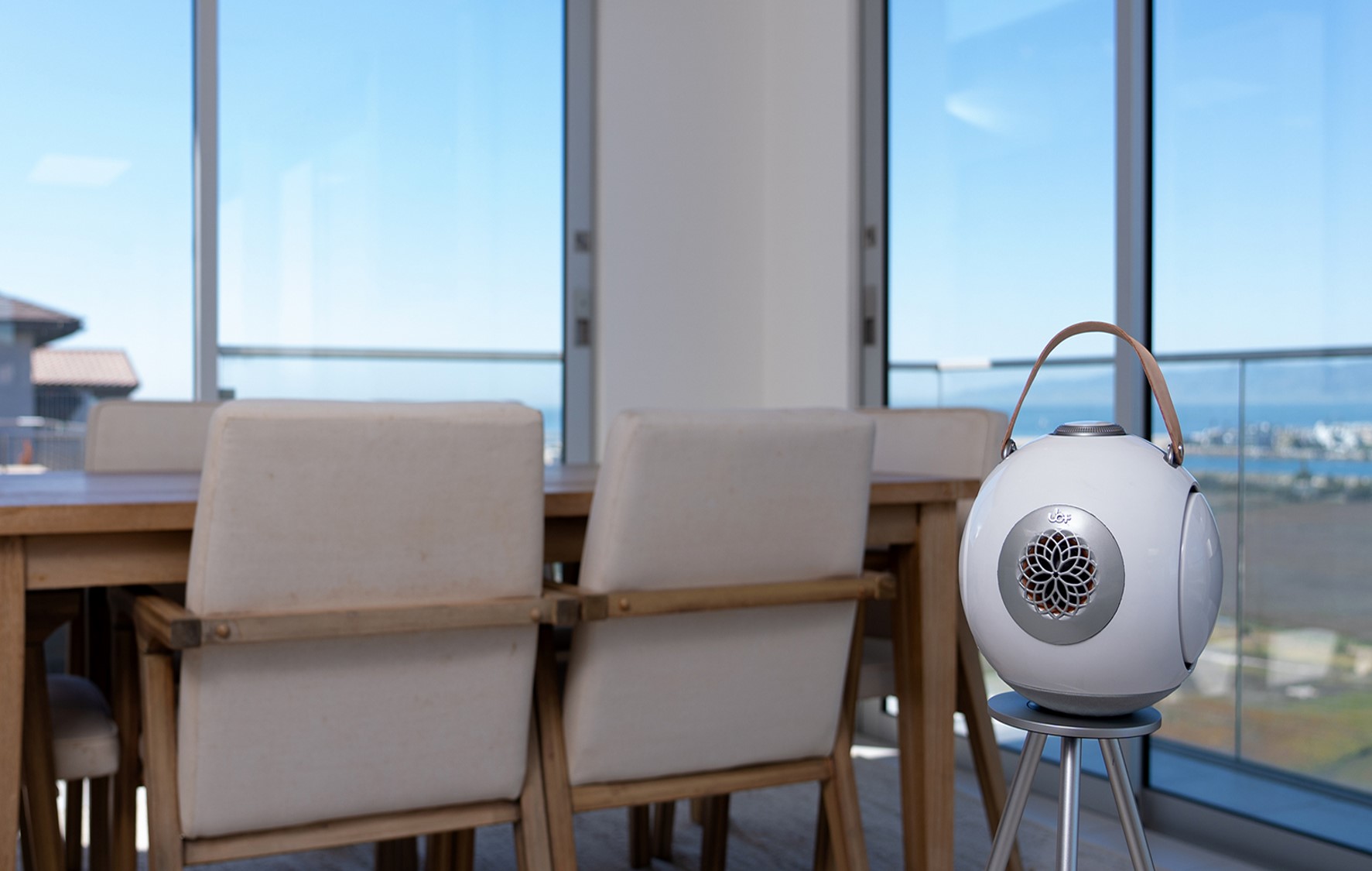
Systems inspired by spherical acoustic chambers such as the UB+ dB1 DOUBLEBASS demonstrate how enclosure geometry can improve bass control and tonal smoothness.
Helmholtz Resonance and Small-Room Bass
Compact speakers often use Helmholtz-inspired acoustic tuning to improve low-frequency performance.
How It Works
The enclosure and opening are tuned so that:
- Air oscillates at specific frequencies
- Bass efficiency increases
- Low-frequency extension improves naturally
Why It Matters in Bedrooms
This allows speakers to produce bass that feels:
- Deep
- Controlled
- Less overwhelming
without relying heavily on digital boosting.
Mechanical Bass vs DSP Bass
This distinction is especially important in bedroom listening.
DSP-Enhanced Bass
Digital bass enhancement creates:
- Strong immediate impact
- Elevated low-frequency emphasis
But often introduces:
- Distortion
- Listening fatigue
- Artificial tonal balance
Mechanical Bass Design
Physics-driven bass systems rely on:
- Air movement
- Resonance tuning
- Structural stability
The result is bass that feels:
- Natural
- Controlled
- Consistent over long sessions
Passive Radiators and Bedroom Performance
Passive radiators improve bass efficiency in compact speakers.
Their Role
They respond to internal pressure and reinforce low frequencies without additional power.
Advantages
- Better bass extension
- Reduced strain on the main driver
- Improved efficiency
Symmetrical Systems
Dual radiator layouts reduce:
- Cabinet vibration
- Mechanical imbalance
- Energy loss
This creates cleaner low-frequency performance.
Stereo Imaging in Personal Listening Spaces
Bedroom listening often happens at close range, making stereo imaging extremely noticeable.
What Good Imaging Creates
A refined speaker can create:
- Spaciousness
- Instrument separation
- Directional realism
Why It Matters
Good imaging makes music feel immersive without requiring high volume.
The best bluetooth speaker for bedroom listening creates a soundstage that feels:
- Open
- Balanced
- Comfortable within the room
Long-Term Listening Comfort
One of the most overlooked qualities in bedroom audio is fatigue management.
What Causes Listening Fatigue
- Harsh treble peaks
- Overboosted bass
- Distortion
- Dynamic compression
Signs of a Well-Tuned Speaker
A refined speaker allows hours of listening without discomfort.
You should be able to:
- Listen quietly at night
- Enjoy multiple genres naturally
- Maintain clarity without increasing volume
Real Bedroom Listening Scenarios
Relaxed Evening Listening
A balanced speaker provides:
- Warm vocals
- Controlled bass
- Smooth detail
without overwhelming the room.
Background Music During Work or Reading
The ideal speaker remains:
- Clear at low volume
- Non-fatiguing
- Consistent over time
Streaming and Movies
Bedroom speakers should deliver:
- Dialogue clarity
- Controlled cinematic bass
- Spacious presentation
without excessive loudness.
How to Evaluate the Best Bluetooth Speaker for Bedroom Use
Instead of focusing only on specifications, evaluate behavior:
- Does bass remain controlled at low volume?
- Are vocals clear and natural?
- Is long-term listening comfortable?
- Does the speaker avoid harshness?
- Is cabinet vibration minimal?
These factors determine real-world quality.
Common Buying Mistakes
Many people choose bedroom speakers based on the wrong priorities:
- Too much emphasis on loudness
- Overly bass-heavy tuning
- Ignoring room acoustics
- Choosing speakers designed for outdoor use
Bedroom listening requires a more refined approach.
The Future of Bedroom Audio Design
Modern speaker engineering is moving toward:
- Better acoustic tuning
- Improved low-volume clarity
- Reduced distortion
- Physics-driven bass systems
- Minimalist room-friendly design
This reflects a shift from raw power toward comfort, balance, and realism.
Conclusion
The best bluetooth speaker for bedroom listening is not the speaker with the most aggressive bass or highest volume. It is the one that creates a balanced, immersive, and comfortable listening experience within a personal space.
True bedroom audio quality comes from:
- Controlled bass
- Smooth tonal balance
- Low-volume clarity
- Stable acoustic design
- Precision engineering
When these elements come together, a speaker becomes part of the room itself—supporting relaxation, focus, and enjoyment without overwhelming the space.
Ultimately, the best bedroom speaker is one that understands how people actually listen at home: closely, quietly, and for long periods of time.