

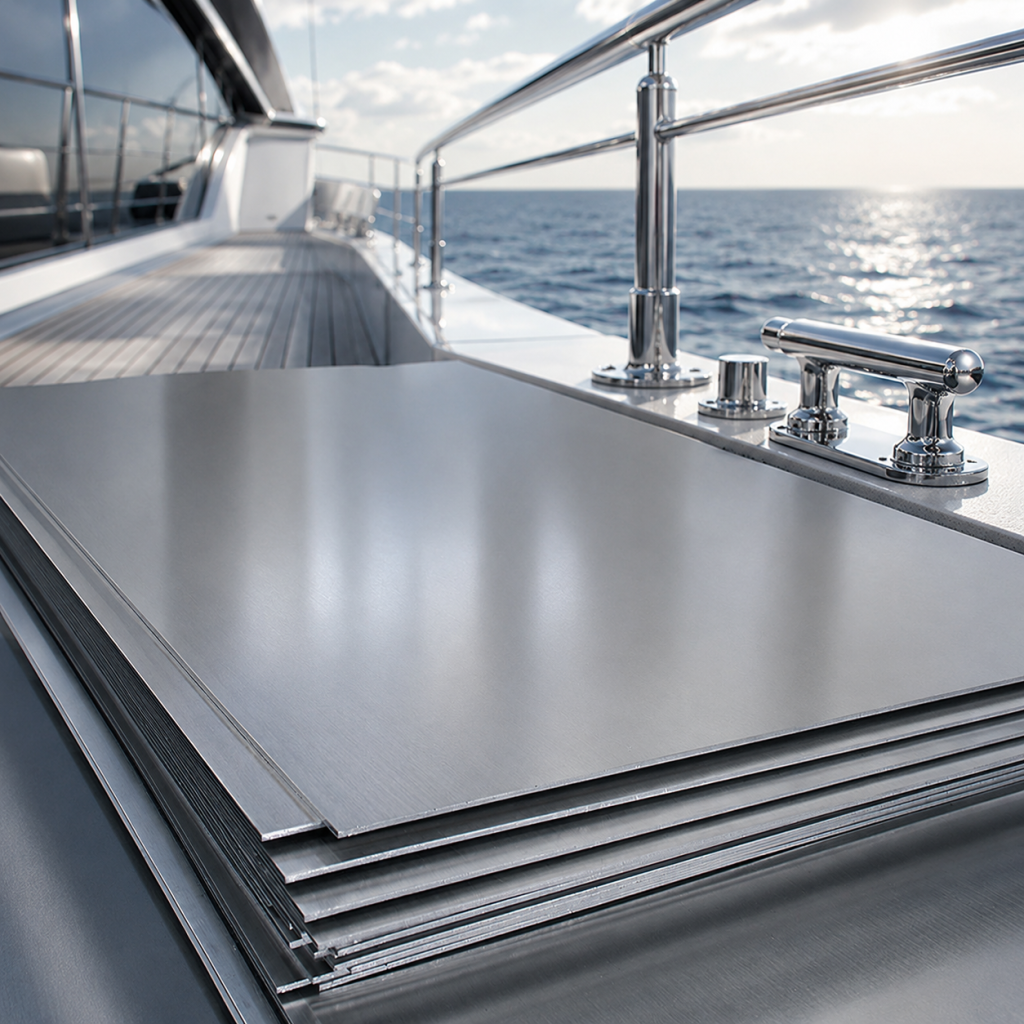
Marine environments place extreme pressure on metal components. Seawater, salt spray, coastal humidity, temperature changes, and continuous chloride exposure can gradually damage materials that perform well in ordinary industrial conditions.
For this reason, boat builders, offshore engineers, equipment manufacturers, and material buyers frequently ask:
Is 316L better than 304 for marine applications?
In most situations involving direct seawater or continuous coastal exposure, the answer is yes. The molybdenum and low-carbon composition of 316L gives it stronger resistance to chloride-related corrosion than standard 304 stainless steel.
However, 304 should not automatically be dismissed. It remains a cost-effective option for protected interior components, low-salt environments, and applications where exposure is occasional rather than continuous.
This guide compares 304 and 316L stainless steel, explains their corrosion behavior, and helps determine which grade offers the best long-term value for marine projects.
For a focused overview of the subject, read the complete guide on whether 316L is better than 304 for marine applications.
Why Marine Environments Are So Corrosive
Marine conditions are difficult because seawater contains high concentrations of chloride ions. These ions can penetrate weak points in the protective surface film of stainless steel.
According to the general technical overview of stainless steel, chromium helps create a thin passive oxide layer that protects the underlying metal from corrosion.
This passive layer can repair itself when exposed to oxygen. However, chloride-rich environments can repeatedly attack and destabilize it.
Common marine corrosion problems include:
- Pitting corrosion
- Crevice corrosion
- Surface staining
- Corrosion around welds
- Galvanic corrosion
- Stress-corrosion cracking in certain conditions
- Corrosion beneath deposits or fasteners
The level of risk depends on salinity, temperature, oxygen availability, surface finish, maintenance, component geometry, and length of exposure.
Selecting the correct alloy is therefore essential for boats, offshore platforms, coastal structures, desalination facilities, and marine-processing equipment.
What Is 304 Stainless Steel?
304 is one of the most widely used austenitic stainless steel grades.
It typically contains approximately:
- 18–20% chromium
- 8–10.5% nickel
- A maximum carbon content of around 0.08%
- Iron as the balance
This composition gives 304 a useful combination of corrosion resistance, strength, formability, appearance, and affordability.
Manufacturers commonly use it for:
- Food-processing equipment
- Kitchen appliances
- Architectural components
- Automotive parts
- Industrial machinery
- Storage containers
- Decorative products
- General fabrication
304 is popular because it performs well in many atmospheric, indoor, and mildly corrosive environments.
It is also widely available in sheet, foil, strip, and coil forms. Buyers looking for precision material can consult an experienced 304 stainless steel strip supplier.
What Is 316L Stainless Steel?
316L belongs to the same austenitic stainless steel family as 304, but it contains an important additional alloying element: molybdenum.
Typical 316L composition includes:
| Element | Approximate Range |
|---|---|
| Chromium | 16–18% |
| Nickel | 10–14% |
| Molybdenum | 2–3% |
| Carbon | Maximum approximately 0.03% |
| Iron | Balance |
The molybdenum improves resistance to pitting and crevice corrosion in chloride-containing environments.
The letter “L” means low carbon. Lower carbon content helps reduce chromium carbide formation during welding, which can improve corrosion resistance around welded areas.
These characteristics make 316L especially valuable for:
- Marine hardware
- Offshore equipment
- Coastal structures
- Welded piping
- Shipbuilding
- Chemical processing
- Desalination systems
- Salt-handling equipment
Why 316L Performs Better in Marine Applications
The main advantage of 316L is its improved resistance to chloride attack.
In seawater, chloride ions can damage the passive oxide layer on stainless steel. Once the film breaks down, localized corrosion may form.
304 can resist clean water, atmospheric moisture, and many mild industrial conditions. However, direct or prolonged seawater exposure can lead to pitting, staining, or corrosion around crevices.
The molybdenum in 316L strengthens resistance to these localized forms of attack.
As a result, 316L generally provides:
- Better resistance to saltwater
- Greater protection against pitting
- Improved performance around joints and crevices
- Longer service life in coastal environments
- Lower maintenance requirements
- Better reliability for difficult-to-replace components
This does not mean 316L is completely immune to seawater corrosion. Warm, stagnant, highly saline, or poorly maintained environments can still damage it.
Material grade must be supported by suitable design, surface condition, cleaning, and maintenance.
304 vs 316L: Marine Performance Comparison
| Property | 304 Stainless Steel | 316L Stainless Steel |
|---|---|---|
| General corrosion resistance | Very good | Excellent |
| Seawater resistance | Limited to moderate | Significantly better |
| Chloride resistance | Moderate | High |
| Pitting resistance | Moderate | Better |
| Crevice-corrosion resistance | Moderate | Better |
| Weldability | Excellent | Excellent |
| Post-weld corrosion resistance | Good with proper treatment | Better due to low carbon |
| Initial cost | Lower | Higher |
| Coastal suitability | Suitable for protected uses | Preferred for exposed components |
| Offshore suitability | Limited | Generally more appropriate |
| Expected maintenance | More frequent in salty conditions | Usually lower |
For applications that require 316 material in coil form, buyers can review the available 316 stainless steel coil product.
How Molybdenum Improves Corrosion Resistance
The performance difference between 304 and 316L is largely caused by molybdenum.
Chromium creates the protective passive layer that allows stainless steel to resist corrosion. Nickel supports the stable austenitic structure and improves toughness and formability.
Molybdenum adds another layer of protection by helping the passive film resist localized breakdown in chloride-containing environments.
This becomes especially important in:
- Seawater
- Salt spray
- Brine
- Coastal air
- Chlorinated cleaning systems
- Marine processing facilities
- Areas where salt deposits remain on the surface
The corrosion attack in these environments is often localized rather than uniform. A component may look intact overall while deep pits develop in small areas.
Because pitting can penetrate rapidly, a material with better localized corrosion resistance is often worth the additional cost.
The Importance of Low Carbon in 316L
The “L” in 316L indicates reduced carbon content.
During welding, stainless steel is heated to temperatures that may encourage carbon to react with chromium. Chromium carbides can form along grain boundaries, reducing the chromium available to protect nearby areas.
This condition is commonly called sensitization.
Lower carbon content reduces the likelihood of carbide precipitation. Therefore, 316L generally maintains better corrosion resistance around welded joints.
This is valuable in marine fabrication because many structures require:
- Continuous welds
- Pipe connections
- Structural frames
- Railings
- Tanks
- Brackets
- Offshore assemblies
- Custom-fabricated components
For welded marine systems, 316L can reduce the need for complex post-weld heat treatment, although cleaning and passivation may still be required.
Common Marine Uses of 316L Stainless Steel
316L is widely used in exposed marine components where saltwater resistance and long service life are important.
Boat and Yacht Hardware
Common applications include:
- Railings
- Cleats
- Ladders
- Handrails
- Hinges
- Fasteners
- Deck fittings
- Cable hardware
- Mooring components
Offshore Structures
Offshore platforms and energy systems may use 316L for selected equipment exposed to salt spray, humidity, and weather.
Coastal Construction
316L may be used in coastal architectural elements, support components, fasteners, drainage systems, and exterior fixtures.
Desalination Facilities
Desalination plants handle chloride-rich water continuously. Although some areas require even more corrosion-resistant alloys, 316L can be suitable for selected components.
Marine Transportation
Ships and marine transport systems use corrosion-resistant stainless steel for fittings, enclosures, equipment housings, piping, and structural accessories.
Seafood and Food Processing
Facilities near the coast or working with salted products may need stronger chloride resistance.
For related food-processing applications, review the guide to stainless steel foil for food contact.
Can 304 Stainless Steel Be Used in Marine Environments?
304 can still be suitable for some marine-related applications.
It may perform adequately when:
- The component is installed inside a boat
- Direct seawater contact is unlikely
- Salt exposure is occasional
- The area is regularly cleaned
- The environment is well ventilated
- The component is easy to inspect and replace
- Budget limitations are significant
- The project is located inland rather than directly on the coast
Examples may include protected cabin fittings, interior equipment panels, dry storage components, and decorative parts.
However, 304 is generally a risky choice for continuously exposed deck hardware, submerged components, offshore equipment, or assemblies where salt can collect in joints.
The decision should be based on actual exposure rather than simply labeling the entire project as “marine.”
Direct Exposure vs Coastal Exposure
Marine exposure can be divided into several categories.
Direct Seawater Immersion
This is one of the most demanding conditions. Continuous immersion, oxygen differences, biological deposits, and crevices can accelerate corrosion.
316L usually performs better than 304, but even 316L may require careful evaluation in warm or stagnant seawater.
Splash Zones
Components in splash zones experience repeated wetting and drying. Salt becomes concentrated as water evaporates, which can increase corrosion risk.
316L is usually the better choice.
Coastal Atmosphere
Airborne salt can settle on exposed surfaces even when the component never touches seawater directly.
304 may develop staining or pitting without regular cleaning. 316L offers better protection.
Protected Interior Areas
Interior boat or coastal-building components may experience limited salt exposure. In these situations, 304 may provide adequate performance.
Surface Finish Also Matters
Grade selection alone does not determine corrosion resistance.
A rough, scratched, contaminated, or poorly finished surface can corrode more quickly than a smooth, properly processed surface.
Important factors include:
- Surface roughness
- Polishing direction
- Embedded iron contamination
- Welding discoloration
- Heat tint
- Crevices
- Sharp corners
- Salt deposits
- Cleaning frequency
- Passivation treatment
A smoother finish usually reduces the number of locations where salt and contamination can collect.
After welding or fabrication, components may require cleaning and passivation to restore the protective surface condition.
The Role of Stainless Steel Foil in Marine Engineering
Marine manufacturers increasingly use thin stainless steel materials in precision applications.
Stainless steel foil may be used in:
- Thermal barriers
- Corrosion-resistant shims
- Gaskets
- Insulation systems
- Shielding components
- Sensor assemblies
- Precision seals
- Equipment liners
- Flexible protective layers
- Specialized electronic systems
Buyers can review available alloys and thicknesses through the stainless steel foil product range.
Ultra-thin material is available for highly specialized engineering applications. The guide explaining how thin stainless steel foil can get discusses production down to approximately 0.01 mm.
Foil, Strip, or Coil for Marine Manufacturing
The most appropriate product form depends on the manufacturing process.
Stainless Steel Foil
Foil is suitable for lightweight, flexible, precision, thermal, and shielding components.
Stainless Steel Strip
Precision strip is commonly used for:
- Clips
- Springs
- Fasteners
- Brackets
- Gaskets
- Retaining components
- Stamped parts
Available specifications can be reviewed in the stainless steel strip product range.
For applications requiring a different balance of strength and work hardening, manufacturers may also study 301 stainless steel foil.
Stainless Steel Coil
Coil supports continuous production processes such as roll forming, stamping, slitting, and automated fabrication.
Buyers can explore available stainless steel coil products.
A second review of precision stainless steel strip options may help manufacturers compare material forms for smaller stamped or formed parts.
Heat Resistance in Marine Equipment
Some marine systems experience both corrosion and elevated temperatures.
Examples include:
- Engine compartments
- Exhaust systems
- Thermal shields
- Offshore processing equipment
- Heat exchangers
- Insulation barriers
- Power-generation systems
Both 304 and 316L provide useful oxidation resistance at elevated temperatures, but operating temperature, exposure duration, atmosphere, stress, and fabrication history must be evaluated.
The stainless steel foil heat-treatment guide provides additional information about the behavior of thin stainless steel materials during thermal processing.
When foil is used as a protective wrap in heat-treatment operations, consult the guide to selecting the correct stainless steel foil thickness for heat-treat wrap.
Initial Cost vs Total Ownership Cost
316L normally costs more than 304 because it contains additional nickel and molybdenum.
However, initial material price is only one part of the total project cost.
A full cost comparison should include:
- Cleaning and maintenance
- Corrosion inspection
- Repair labor
- Replacement frequency
- Equipment downtime
- Access costs
- Lost production
- Safety risks
- Service-life expectations
For an interior component that is inexpensive and easy to replace, 304 may offer better economic value.
For an offshore fitting, structural fastener, welded pipe, or submerged assembly, the higher cost of 316L may be small compared with the cost of failure.
The harder a component is to inspect, maintain, or replace, the stronger the argument for selecting the more corrosion-resistant grade.
When 316L May Not Be Enough
Although 316L is frequently called marine-grade stainless steel, it is not suitable for every seawater condition.
More severe environments may require:
- Duplex stainless steel
- Super duplex stainless steel
- Higher-molybdenum alloys
- Nickel-based alloys
- Titanium
- Protective coatings
- Cathodic protection
316L may face limitations in:
- Warm stagnant seawater
- Fully submerged crevices
- Poorly oxygenated zones
- High-chloride process streams
- Areas with heavy biological deposits
- Highly stressed components
- Aggressive chemical exposure
Engineers should evaluate water chemistry, temperature, flow conditions, stress, component design, and expected maintenance before approving the alloy.
How to Choose Between 304 and 316L
Choose 304 When:
- Salt exposure is minimal
- The component is protected indoors
- Direct seawater contact is unlikely
- Cleaning is frequent
- Replacement is easy
- Cost is the main concern
- The application is not safety critical
Choose 316L When:
- The component faces salt spray
- Direct seawater exposure is expected
- Chloride resistance is important
- Extensive welding is required
- The component is difficult to replace
- Long service life is a priority
- Maintenance access is expensive
- The project is located offshore or directly on the coast
Selecting a Reliable Stainless Steel Supplier
Correct alloy selection is only useful when the supplied material meets the required specification.
A dependable supplier should provide:
- Material test certificates
- Chemical composition reports
- Heat or batch traceability
- Mechanical-property data
- Thickness and width tolerances
- Surface-finish information
- Quality inspection records
- Technical support
- Custom slitting or processing options
Buyers should verify whether they need 316, 316L, dual-certified 316/316L, or another grade.
They should also confirm:
- Required thickness
- Width
- Temper
- Surface finish
- Edge condition
- Flatness
- Quantity
- Marine exposure category
The main Stainless Steel Foil website provides information about precision foil, strip, coil, grades, and manufacturing capabilities.
The full stainless steel product catalog can be used to compare available forms and specifications.
Final Conclusion
316L generally performs better than 304 in marine applications because its molybdenum content improves resistance to chloride-induced pitting and crevice corrosion.
Its low-carbon composition also supports better corrosion performance around welded areas, making it particularly useful for shipbuilding, coastal construction, offshore systems, and marine hardware.
304 remains valuable for protected interiors, low-salt environments, and components that are easy to inspect or replace.
The final decision should consider:
- Direct or indirect seawater exposure
- Chloride concentration
- Temperature
- Welding requirements
- Surface finish
- Maintenance access
- Expected service life
- Failure consequences
- Total ownership cost
For critical marine components, the additional cost of 316L is often justified by longer service life and reduced maintenance.
Browse the complete product listings to compare stainless steel foil, strip, and coil options.
For technical assistance with grade, thickness, finish, or product selection, contact the stainless steel specialists.
Frequently Asked Questions
Is 316L better than 304 for marine applications?
Yes. 316L generally provides stronger resistance to seawater, salt spray, pitting, and chloride-related corrosion.
Why is 316L called marine-grade stainless steel?
It is often described as marine grade because its molybdenum content improves corrosion resistance in chloride-containing environments. However, it is not immune to corrosion under every seawater condition.
Does 304 stainless steel rust near the ocean?
304 can develop staining, pitting, or crevice corrosion when exposed to coastal salt deposits for long periods, particularly when it is not cleaned regularly.
Can 304 be used inside a boat?
Yes. 304 may be suitable for protected interior components that experience little direct seawater or salt-spray exposure.
Is 316L suitable for permanent seawater immersion?
It performs better than 304, but permanent immersion can still create corrosion risks, especially in warm, stagnant, or crevice-rich conditions. Engineering evaluation is recommended.
Why is 316L more expensive than 304?
316L contains molybdenum and generally more nickel. These alloying elements increase production cost but improve corrosion resistance.
Is 316L easy to weld?
Yes. Its low-carbon composition reduces the risk of chromium carbide precipitation during welding and helps preserve corrosion resistance around welded areas.
What marine components commonly use 316L?
Typical applications include railings, cleats, ladders, deck fittings, fasteners, piping, brackets, enclosures, coastal fixtures, and offshore equipment.
How can marine corrosion be reduced?
Use the correct alloy, avoid crevices, select a smooth finish, remove welding contamination, perform suitable passivation, clean salt deposits regularly, and inspect components periodically.