
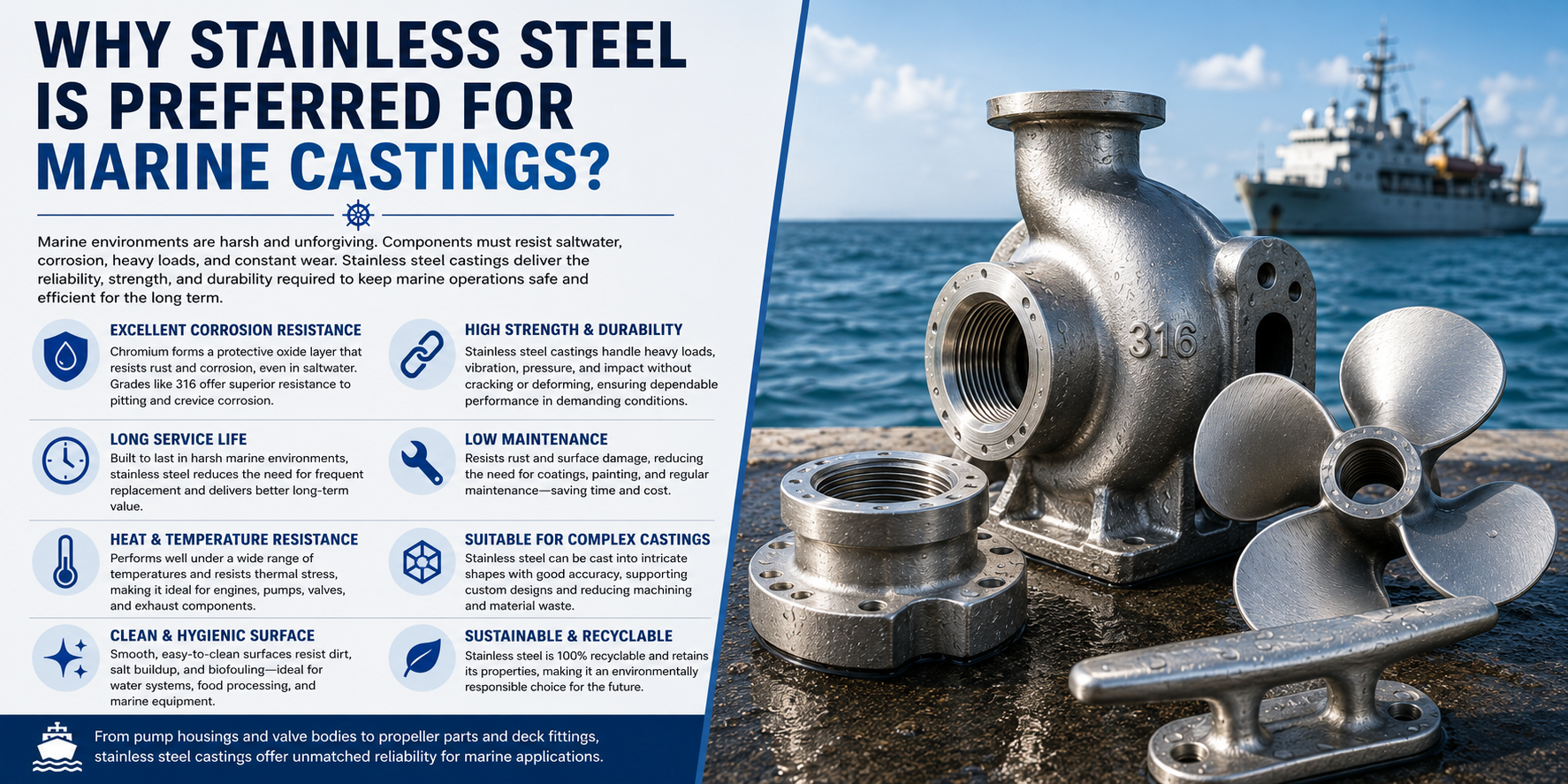
Marine environments are some of the toughest working conditions for metal components. Saltwater, moisture, changing temperatures, heavy loads, and constant exposure to corrosion can quickly damage ordinary materials. That is why material selection is so important in marine engineering.
Among the many metals used for marine castings, stainless steel is one of the most preferred choices. It offers strength, durability, corrosion resistance, and long service life, all of which are essential for parts used in boats, ships, offshore equipment, and coastal structures.
Marine castings are used in many applications, including pump housings, valve bodies, propeller parts, deck fittings, anchors, brackets, impellers, and structural components. These parts must perform reliably in demanding conditions. Stainless steel helps meet those expectations better than many other materials.
Excellent Corrosion Resistance
The main reason stainless steel is preferred for marine castings is its strong resistance to corrosion. Marine components are often exposed to saltwater, which is highly corrosive. Ordinary carbon steel can rust quickly in such conditions, leading to weakening, surface damage, and eventual failure.
Stainless steel contains chromium, which forms a thin protective oxide layer on the surface. This layer helps protect the metal from rust and corrosion. Even when the surface is scratched, the protective layer can reform in the presence of oxygen.
This makes stainless steel especially useful for marine parts that are constantly exposed to seawater, spray, humidity, or coastal air. Grades such as 316 stainless steel are commonly used because they contain molybdenum, which improves resistance to pitting and crevice corrosion caused by chlorides in saltwater.
High Strength and Durability
Marine castings often carry heavy loads and must withstand vibration, pressure, and impact. Stainless steel offers high mechanical strength, making it suitable for demanding marine applications.
Whether used in pumps, valves, fittings, or structural parts, stainless steel castings can handle tough operating conditions without losing their shape or performance. The material resists cracking, deformation, and wear better than many lower-grade metals.
Durability is especially important in marine industries because part failure can lead to costly downtime, safety risks, and expensive repairs. Stainless steel helps reduce these risks by offering long-term performance.
Long Service Life
Marine equipment is expensive to repair and replace, especially when it is installed on ships, offshore platforms, or underwater systems. Components may be difficult to access, and maintenance work can take time.
Stainless steel castings are valued because they last longer in harsh environments. Their corrosion resistance and strength help extend service life, reducing the need for frequent replacement. This makes stainless steel a cost-effective option over time, even if the initial material cost is higher than carbon steel or some other metals.
In marine applications, the lowest upfront cost is not always the best choice. A material that lasts longer and requires less maintenance often provides better value.
Low Maintenance Requirements
Another reason stainless steel is widely used for marine castings is its low maintenance requirement. Because it resists rust and surface damage, stainless steel does not need as much protective coating, painting, or regular treatment as many other metals.
This is a major advantage in marine environments, where maintenance can be difficult and expensive. Parts exposed to seawater or salty air need to remain reliable with minimal attention. Stainless steel helps reduce maintenance work while keeping equipment safe and functional.
While stainless steel still needs proper cleaning and inspection, it generally performs well with less upkeep compared to many alternatives.
Good Resistance to Heat and Temperature Changes
Marine components may be exposed to changing temperatures, engine heat, sunlight, cold seawater, and pressure variations. Stainless steel performs well under these changing conditions.
It has good heat resistance and maintains its strength across a wide temperature range. This makes it suitable for engine-related parts, exhaust components, pumps, valves, and other systems where temperature changes are common.
The ability to resist thermal stress helps stainless steel castings remain stable and reliable in demanding marine operations.
Suitable for Complex Casting Designs
Marine parts often need complex shapes, precise dimensions, and strong structural features. Stainless steel is well suited for casting processes because it can be formed into detailed components with good accuracy.
Investment casting, sand casting, and other casting methods can be used to produce stainless steel marine parts in different sizes and designs. This flexibility allows manufacturers to create custom components for specific marine applications.
The casting process also helps reduce machining work and material waste, especially for parts with complex geometry.
Hygienic and Clean Surface Finish
Stainless steel has a smooth, clean surface that is easy to maintain. This is useful in marine applications where cleanliness matters, such as food processing vessels, fishing boats, water systems, and marine equipment exposed to biological growth.
A smoother surface also helps reduce the buildup of dirt, salt, and contaminants. With proper finishing, stainless steel castings can offer both functional and aesthetic benefits.
Strong Performance in Safety-Critical Applications
Marine industries depend on reliable components. A failed valve, pump part, bracket, or fitting can affect the safety of the vessel, crew, and cargo. Stainless steel is trusted because it offers consistent performance under pressure.
Its combination of corrosion resistance, toughness, and strength makes it suitable for safety-critical marine parts. It can handle long exposure to harsh conditions without rapid weakening, which is essential for dependable operation.
Recyclability and Environmental Benefits
Sustainability is becoming more important in every industry, including marine engineering. Stainless steel is highly recyclable, which makes it an environmentally responsible material choice.
At the end of its service life, stainless steel can be recycled and reused without losing its key properties. Its long lifespan also means fewer replacements and less material waste over time.
Common Stainless Steel Grades Used in Marine Castings
Several stainless steel casting grades are used in marine castings, depending on the application. Grade 316 is one of the most common choices because of its strong resistance to saltwater corrosion. Duplex stainless steels are also used where higher strength and better corrosion resistance are needed.
The right grade depends on factors such as seawater exposure, load requirements, temperature, pressure, and budget. Choosing the correct stainless steel grade is important for getting the best performance from marine castings.
Conclusion
Stainless steel is preferred for marine castings because it performs well in harsh saltwater environments. It offers excellent corrosion resistance, high strength, durability, long service life, and low maintenance requirements. These qualities make it ideal for marine components that must remain reliable under tough conditions.
Although stainless steel may cost more upfront than some materials, its long-term value is clear. It reduces maintenance, improves safety, and extends the life of marine equipment. For ships, offshore systems, pumps, valves, fittings, and many other marine applications, stainless steel remains one of the most dependable material choices.
