
The transition to EU MDR 2017/745 significantly raised the bar for clinical evaluation in the medical device industry. Manufacturers must now present clear, traceable clinical evidence that proves both safety and performance.
Even with plenty of data, many Clinical Evaluation Reports (CERs) face delays or rejection. Usually, the problem isn’t a lack of information, but rather how that information is organized and justified.
A structured cer writing strategy is essential here. It ensures clinical data isn’t just a list of facts, but a cohesive argument that meets regulatory standards. For those looking to build a better framework, this cer writing strategy guide offers a deeper look at the foundational requirements.
What EU MDR Actually Expects from a CER
Under EU MDR, a CER is a scientific assessment rather than a simple summary. It must show a direct link between clinical data and the device’s intended use.
Guidance from the European Commission and frameworks like MEDDEV 2.7/1 Rev 4 highlight three main expectations:
- Clinical data must be directly relevant to the device.
- The evaluation process must be transparent and easy to replicate.
- Every conclusion needs to be backed by sound clinical reasoning.
A CER is also a living document. It must change as new clinical data, post-market findings, and risk updates emerge.
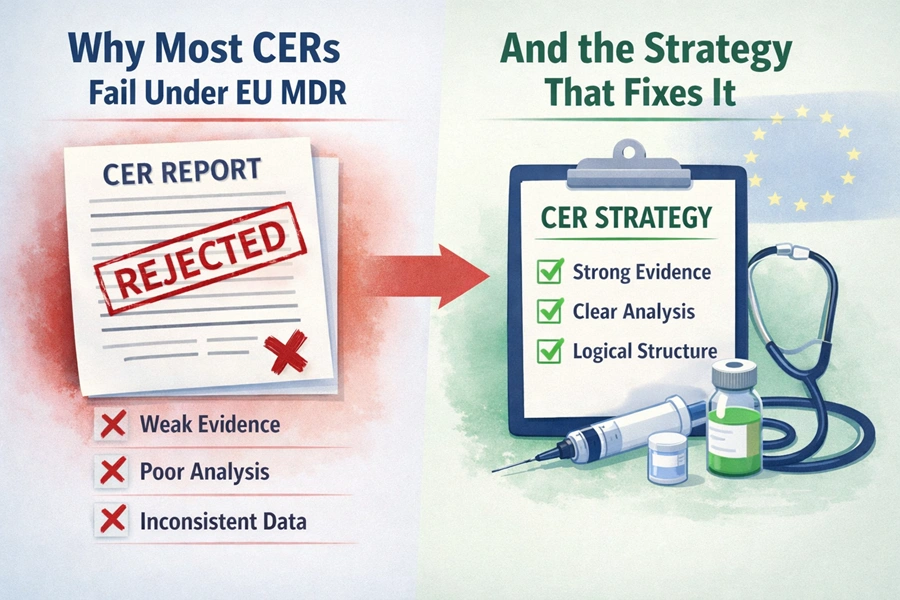
Why Most CERs Fail Under EU MDR
Weak Clinical Evidence Justification
Many reports include data but fail to explain why that data is enough. Regulators want to see exactly how each piece of evidence supports your safety and performance claims. Without this link, the report looks incomplete.
Poor Literature Review Methodology
A common mistake is a messy review process. Under EU MDR, literature reviews must follow systematic principles. This means using defined search strategies, documented databases, and clear inclusion criteria. If these are missing, the credibility of the entire CER drops.
Inadequate Demonstration of Equivalence
Equivalence claims are often used but rarely supported well enough. Regulators require deep comparisons of technical, biological, and clinical traits. Surface-level comparisons are usually rejected.
Lack of Clinical Reasoning
Listing clinical findings is only half the job. A CER must interpret that data and explain what it actually means. Reports that provide data without analysis fail the “scientific evaluation” test.
Structural and Consistency Issues
Inconsistent sections and disconnected conclusions are frequent red flags. For instance, if clinical conclusions don’t match your risk management files, it creates confusion for the reviewer.
The CER Writing Strategy That Fixes These Failures
Start with a Clear Clinical Question
Every CER should begin with a specific objective. Define the device’s purpose, the target population, and the clinical claims. A focused starting point keeps the rest of the analysis on track.
Build a Transparent Literature Review Process
A professional approach requires a repeatable review. You must specify your databases, search terms, and screening methods. Transparency is the fastest way to gain regulatory trust.
Strengthen Evidence Appraisal
Not all studies are equal. Each source should be checked for quality and potential bias. Using frameworks from organizations like the Cochrane Collaboration helps provide a reliable way to rank your evidence.
Connect Claim, Evidence, and Reasoning
The best CERs follow a logical path: claim, evidence, then reasoning. This makes the document easier to read and much easier to defend during an audit.
Maintain Traceability Across Documents
A CER works alongside other files. It must stay aligned with risk management documentation, clinical investigations, and post-market data. Standards such as ISO 14155 emphasize how important it is to keep this documentation consistent.
How a Better Strategy Supports Approval
A structured approach makes the regulatory review process more efficient. Notified Bodies prefer reports that justify conclusions and maintain a clear flow. This reduces the number of follow-up questions, which speeds up your approval timeline and supports long-term compliance.
Practical Considerations for Manufacturers
Creating a strong CER requires teamwork. Clinical experts, regulatory pros, and quality specialists need to collaborate to ensure the data is accurate.
Regular updates are also vital. Post-market clinical follow-up (PMCF) data must be fed back into the CER. Running an internal review before you submit can help catch gaps early.
Conclusion
Most CER failures under EU MDR come down to weak structure and unclear reasoning rather than missing data. A disciplined cer writing strategy solves these problems by focusing on clarity and evidence-based logic. This turns the CER from a stack of data into a strong clinical argument that stands up to scrutiny.
Frequently Asked Questions
It is a structured assessment of clinical data that proves a medical device is safe and performs as intended under EU regulations.
Rejection is usually due to messy literature reviews, weak evidence justification, or contradictions between different technical documents.
Success comes from a clear structure, transparent methods, high-quality evidence, and logical arguments that connect your data to your claims.
It should be updated regularly throughout the product life cycle, especially when new clinical or post-market data is collected.
Yes. It must be a structured, transparent process that follows systematic review principles.