
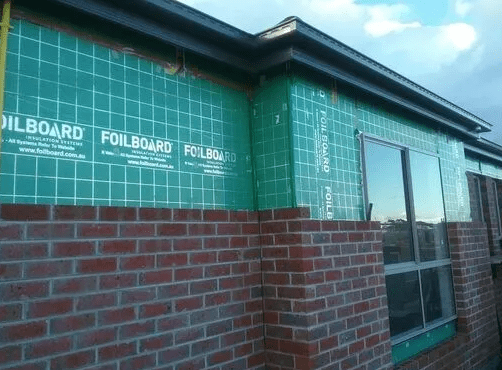
Most people insulate once and forget about it. Then summer hits. The power bill lands on the kitchen bench and suddenly everyone wants answers. The truth is, not all insulation handles the Australian climate the same way. Foilboard insulation sits in a different category entirely, and understanding why changes how you think about what your home actually needs.
The Two-Problem Solution
Heat travels through buildings in three ways — conduction, convection, and radiation. Bulk batts handle one of those reasonably well. Radiant heat, though, is the one that turns a roof space into an oven by midday, and standard glasswool does almost nothing about it. Foilboard works differently. The foam core slows conducted heat while the reflective foil surface bounces radiant heat away before it ever gets the chance to cross into the living space. Two problems, one product.
The Summer Wall Problem
Brick veneer is the default construction method across Australian suburbs. Most homeowners never get told about its biggest thermal weakness. Brick absorbs heat from the sun all day long. Come evening, when the outside temperature finally drops, that stored heat starts releasing — straight into the wall cavity. The house stays stuffy well into the night. Windows open, fan running, still uncomfortable. Foilboard installed within the wall system breaks that cycle by reflecting radiant heat back before it crosses the cavity. The internal lining stays cooler, and the bedroom actually cools down after sunset.
Where It Gets Overlooked
Underfloor spaces in older homes are the renovation afterthought nobody talks about. Cold draughts rising through timber floors get written off as part of living in an older house. They do not have to be. Foilboard insulation panels fitted between floor joists cut off those draughts and stop heat escaping through the floor in winter. Nothing structural needs to change. The difference underfoot happens quickly, and it is the kind of upgrade that quietly does its job every single year without needing attention.
Not All Foilboard Is Equal
Single-sided and double-sided foil products are not interchangeable. Single-sided panels work well where the reflective surface faces one air gap. Double-sided products are better suited to external wall cladding applications, where thermal movement occurs on both faces of the panel. It sounds like a minor distinction. In practice, choosing the wrong one leads to real underperformance — the kind that only becomes obvious once the installation is finished and the house still does not feel right.
Moisture and the Hidden Risk
Wall cavity condensation rarely gets discussed until there is already a visible problem. In regions that swing between warm days and cold nights, warm interior air meets cooler surfaces inside the cavity and deposits moisture. It does not happen overnight. Over months and years, though, that moisture works quietly into structural timbers and creates conditions for mould. Foilboard does not absorb moisture. It does not hold onto it and slowly release it into the surrounding structure. A wet batt sitting inside a wall cavity is doing a fraction of what it is supposed to — foilboard does not have that problem.
Performance Gaps in Renovation Work
Retrofit insulation jobs nearly always leave gaps. Noggins, framing junctions, awkward corners — batts cannot always sit cleanly around them. When bulk insulation gets compressed into a tight space, its thermal performance drops. Foilboard does not work that way. Panels cut precisely around structural elements and stay at full performance without needing to be squashed in. In renovation work, that matters more than most installers let on. Patchy coverage in a wall cavity tends to undermine the entire job, and rigid panels make patchy coverage much harder to accidentally create.
The Climate Zone Factor
Australia is a big country with a brutal range of climates. The far north wants radiant heat kept out almost year-round. Southern states need warmth retained through winter just as badly as they need cooling in summer. Foilboard insulation can be specified to meet either brief. The same product category that suits a beachside home in tropical Queensland also works in a mountain retreat that sees frost most mornings in July. Very few insulation options perform credibly across that range without some kind of compromise.
Conclusion
Foilboard insulation earns its reputation by solving problems that standard products tend to leave sitting in the wall. Radiant heat gain, moisture accumulation, coverage gaps in retrofit work — these are the issues that cause homes to underperform for years after the job is done. Australian homes take a serious beating from the climate, and the building envelope either holds up or it does not. Knowing how foilboard actually works, not just that it insulates, puts homeowners in a position to make choices that hold up long after the builder has moved on.
