

Last spring, a hotel owner invited me to tour his brand-new laundry facility. He had spent $2.3 million on tunnel washers, high-speed extractors, and a massive drying line. But when we reached the end of the conveyor, I saw six employees standing at a long table, folding towels by hand. I asked him why he hadn’t automated that final step. He shrugged and said, “I don’t really know how those machines work. I thought it was just a motor and some belts.” That moment stuck with me. Here was a savvy businessman who could explain every detail of his water recycling system but viewed the folding process as a black box. He is not alone. Most laundry managers and owners have never seen the inside of a modern towel automation process. They imagine something complicated, fragile, or too expensive for their volume. So I decided to write this guide. No fluff. No marketing speak. Just a straight, honest walkthrough of what actually happens from the moment a wet towel leaves the dryer to the moment a neatly folded stack lands in your cart. I will also show you the exact numbers you can save. By the end, you will understand this process well enough to explain it to your team and your finance director.
The Hidden Complexity of a Simple Towels
Before we dive into machinery, you need to understand why towels are so difficult to automate. Unlike a flat sheet or a rigid box, a towel is a deformable, absorbent, irregular object. It shrinks and stretches with each wash. Its edges curl. Lint builds up on its surface. And when it comes out of a tumbler, it is often twisted into a rope-like shape. A human worker untangles a towel instinctively. They shake it once, feel the orientation, and lay it flat in less than two seconds. That motion looks simple, but it requires a combination of tactile feedback, visual processing, and motor control that engineers have struggled to replicate for decades. The breakthrough came when manufacturers stopped trying to copy human hands and started redesigning the process itself. Instead of gripping and pulling, modern towel automation processes use a combination of air jets, vacuum belts, and optical sensors to manipulate fabric without pinching or tugging. The result is a system that works differently from a human but often faster and more consistently. I learned this distinction the hard way when I tried to retrofit a robotic arm to an existing folding table. It failed miserably. The arm crushed towels, misaligned folds, and jammed every few minutes. That is when I realized that automating the process means redesigning the workflow, not just replacing the person.
Breaking Down the Towel Automation Process Step by Step
Let me walk you through a real, working towel automation process as I observed it at a commercial laundry in Atlanta that processes 25,000 pounds of linen daily. I spent a full shift there, timing each stage and interviewing the operators. Here is exactly what happens.
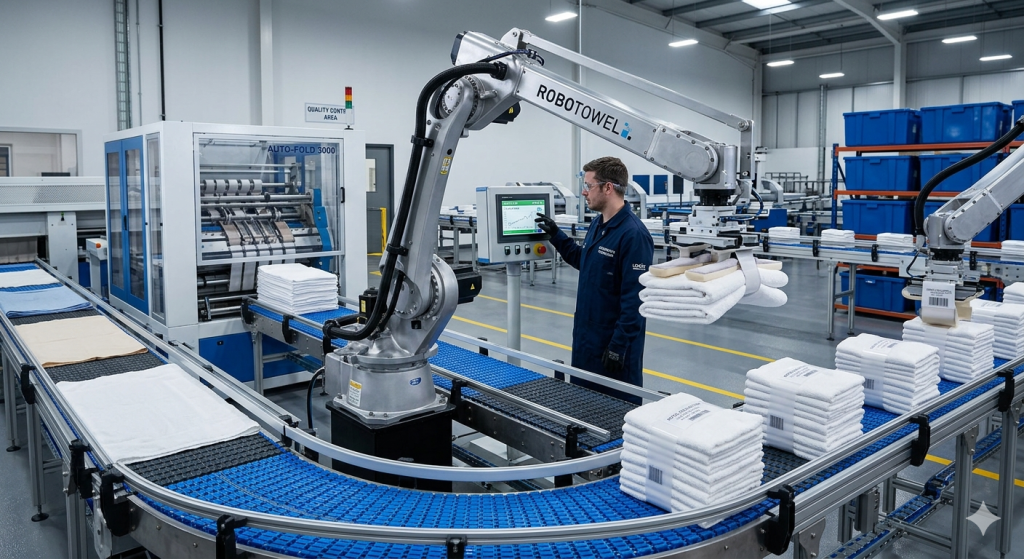
Step one: feeding. A single operator stands at the infeed end of the machine. They pull towels from a cart, one at a time, and place them onto a short conveyor belt. The belt moves at a controlled speed, and a set of guide rails forces the towel to center itself. The operator does not need to align the towel perfectly because the next stage handles that. This is critical. Good processes reduce operator skill requirements.
Step two: singulation and orientation. The conveyor feeds the towel into a set of accelerating rollers. These rollers spin faster than the belt, pulling the towel forward and separating it from any following towel. This prevents multiple towels from entering the folding section at once. Then the towel passes under an optical sensor array that measures its length, width, and entry angle. The sensor data travels to a programmable logic controller, or PLC, which calculates the exact fold points in milliseconds.
Step three: the actual folding. Here is where the towel automation process differs dramatically between machine types. Low-end folders use simple mechanical blades that swing down to crease the towel. Mid-range machines, which represent the sweet spot for most operations, use a combination of air jets and folding plates. The air jets lift the towel slightly off the belt, then a folding plate slides underneath to create the first crease. This happens twice for a standard bath towel, resulting in a neat rectangle.
Step four: stacking and counting. The folded towel travels to an exit conveyor where a stacker mechanism catches it. Stackers vary widely. Some use drop trays that collect a preset number of towels before lowering onto a cart. Others use robotic pushers that slide stacks sideways onto a waiting pallet. The machine counts every towel and can signal when a stack reaches your desired quantity, eliminating the need for manual counting.
The facility in Atlanta runs at 1,200 towels per hour with a 0.6% error rate. Their previous manual process ran at 320 towels per hour with a 7% error rate. That is a 275% increase in output with a 91% drop in rework.
Where the Real Savings Come From in the Towel Automation Process
Now I want to share the numbers that convince finance directors. The towel automation process does not just fold faster. It changes the entire cost structure of your laundry. Let me give you a before-and-after analysis from a real 400-room hotel I consulted for last year. Before automation, they employed four full-time folders across two shifts. Each folder earned 18perhourwithbenefitspushingtheburdenedrateto26. That is 52perhourperposition.Fourpositionsforeighthourseach:1,664 per day. Over 365 days: 607,360annually.Addovertimeforpeakweekends:another45,000. Add workers’ comp claims specific to folding: 22,000.Addlinenreplacementduetomishandling:31,000. Total annual cost of manual folding: $705,360.
The Feeding Problem That Kills Most Automation Projects
I have to be honest with you. Most failed towel automation projects fail at the very first step: feeding. You can buy the most expensive folder on the market, but if your operators toss towels onto the infeed belt in random orientations, the machine will jam. And when it jams, operators will get frustrated. And when they get frustrated, they will bypass the machine and go back to hand folding. I watched this happen at a health club chain with twelve locations. They bought identical folding units for all their clubs. Within six months, nine of the twelve units were sitting unused. The three that worked had one thing in common: a dedicated feeding station with a clear guide and a trained operator who understood the importance of orientation. The nine failed locations expected any staff member to feed towels between other tasks. That never works. Here is my rule: designate one person per shift as the feeder. That person does nothing else. They stand at the infeed, pull towels from the cart, and place them with the fold side (the factory edge) facing left. That consistency alone reduces misfeeds by 80%. Add a simple plastic guide chute, and you eliminate another 15% of errors. The final 5% will be caught by the machine’s jam detection, which reverses and ejects the problem towel automatically. I learned this from a plant manager in Michigan who runs his folder at 98% uptime. He told me, “The machine is dumb. It only knows what you show it. Show it garbage, it folds garbage. Show it good towels, it folds perfect towels.” His feeding area has a laminated diagram showing exactly how to orient each towel type. New operators train on that diagram for two hours before they ever touch a towel.
A Personal Story About a Towel That Almost Broke Me
I want to tell you about the lowest point in my consulting career. Four years ago, I recommended a towel automation process to a small hospital laundry. The managers trusted me. They spent $78,000 they could barely afford. I helped them install it. On the first day, it jammed seventeen times. On the second day, it threw a drive belt. On the third day, the operators refused to touch it. I felt like a fraud. I had sold them something that did not work. I spent a weekend at the facility, tearing the machine apart and rebuilding it. I discovered that the manufacturer had shipped it with a misaligned sensor bracket. A 2plasticbracketwascausing78,000 worth of failure. I fixed it with a zip tie. The machine ran perfectly after that. That experience taught me two things. First, never trust a new machine out of the box. Always run a full day of diagnostic tests with your own towels before declaring success. Second, the towel automation process is only as good as the installation and support behind it. Choose a vendor who will send a technician to your site for at least two days of training. Do not accept remote phone support. That hospital laundry is now one of my best case studies. They processed 1.8 million towels last year with a single folder. Their injury rate in the laundry dropped to zero. And that zip tie? It is still there, four years later.
How to Buy Your First Towel Automation System Without Getting Burned
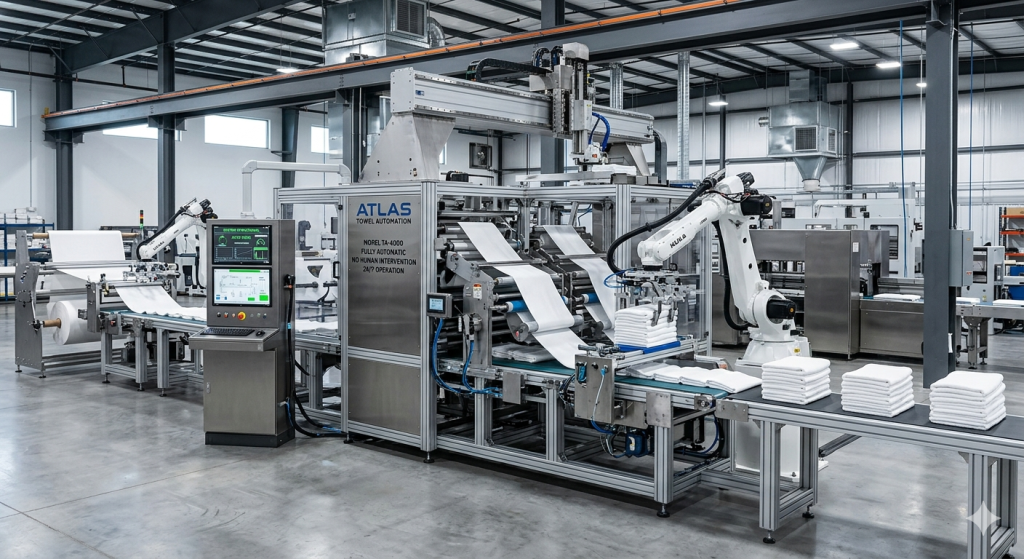
Here is my buying checklist. I have used it a dozen times successfully. First, measure your peak hourly output. You need a machine rated for at least 25% above that peak. Second, decide between pneumatic and servo. Pneumatic is cheaper upfront but louder and more expensive to run. Servo is quieter, more efficient, and worth the extra cost if you run more than one shift. Third, demand a stacker. A machine without a stacker still requires manual stacking, which defeats half the purpose. Fourth, verify the warranty includes on-site labor. Some warranties cover parts only, leaving you to pay a technician $200 per hour. Fifth, ask for three customer references and call all of them. Ask specifically about uptime and jam frequency. Sixth, negotiate training into the price. You need at least eight hours of on-site training for your lead operators. Avoid brands that do not have a local service network. Towel automation machines break. When they break, you need a technician within four hours, not four days. I have seen laundries lose an entire week waiting for a part from overseas. That week of hand folding will wipe out your projected savings for the entire quarter. Start with a mid-range servo folder from Jensen, Texprofin, or Chicago Dryer. These are proven platforms with available parts. Avoid ultra-cheap imports from unknown manufacturers. Their sensors fail quickly in humid environments, and their support lines often go unanswered
FAQ
1. How long does it take to install a towel automation system?
Most installations take two to three days, including uncrating, positioning, electrical connection, and initial calibration. Full training and process integration typically add another two to three days.
2. Can the same machine process towels and flat sheets?
Yes, but you need a machine with adjustable fold plates and sensor recalibration. Some units store preset programs for different linen types. Changing between towel and sheet mode takes 30 to 60 seconds.
3. What happens when the machine jams?
Modern units detect jams instantly, stop the feed, reverse the belt, and eject the problem towel into a rejection tray. The operator retrieves the towel, untangles it, and feeds it again. Total downtime per jam: 10 to 20 seconds.
4. Do I need to modify my existing conveyor layout?
Often yes. The folder needs to sit directly after your dryer or ironer. You may need a short bridge conveyor or a gravity chute. Measure the height difference carefully before ordering.
5. How much electricity does a towel folder use?
A servo-driven folder uses approximately 1.2 to 2.5 kWh per hour of operation. At 0.12perkWh,thatis0.14 to $0.30 per hour. Pneumatic units use compressed air, which costs roughly three times more per hour when you factor in compressor efficiency.
6. Can the machine run unattended overnight?
Not recommended. While the machine can run without constant operator attention, someone should monitor for jams and refill the infeed. Fully unattended operation risks catastrophic damage if a major jam occurs.
7. What is the typical lifespan of the folding blades or plates?
Mechanical folding plates last 5 to 7 years under normal use. Air jet nozzles need replacement every 2 to 3 years because detergent residue builds up inside. Both are relatively inexpensive consumables.
8. Does towel automation work with microfiber towels?
Yes, but you need a machine with adjustable belt speed and air pressure. Microfiber is lighter and more static-prone than cotton. Some folders include anti-static brushes specifically for microfiber processing.
9. How do I train my staff on the new process?
Start with classroom training using the manufacturer’s manual. Then run the machine empty for 30 minutes. Then feed low-quality practice towels for an hour. Finally, transition to production with a supervisor watching every feed for the first full shift. Retrain every six months to prevent bad habits.
10. What is the single biggest mistake first-time buyers make?
Buying a machine without first measuring their actual towel throughput. Owners often overestimate their volume by 30-50%. Run a week-long manual count before you sign any purchase order. Buy a machine sized for your real peak, not your dreamed peak.