
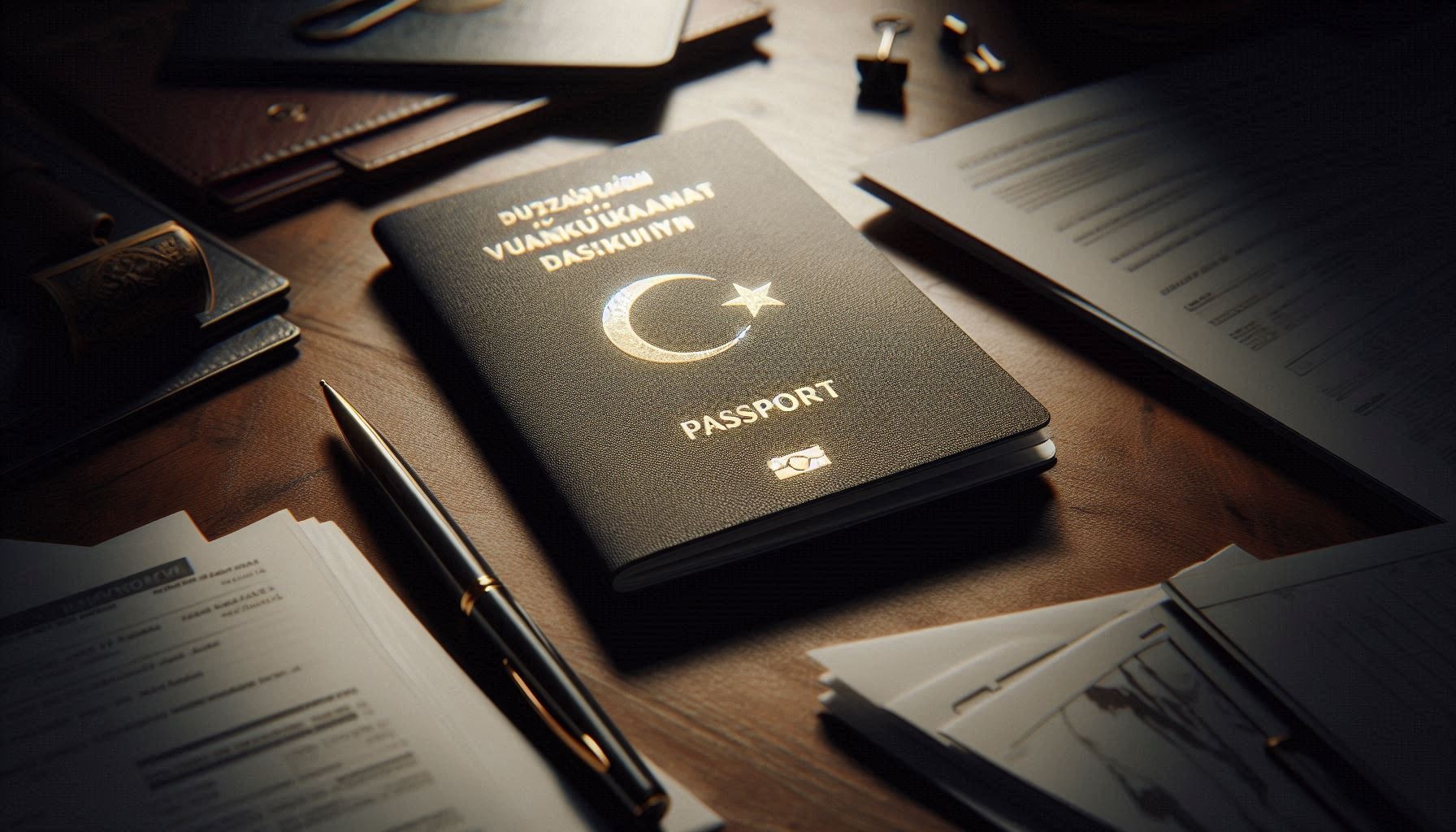
How Turkish municipal officials and intermediaries allegedly used official service passports to move would-be migrants into Europe under false pretenses, turning a state travel document into one of the country’s most embarrassing migration scandals.
WASHINGTON, DC
The Turkish “grey passport” scandal hit with such force because it exposed a corruption method that was at once simple, bureaucratic, and devastatingly effective, taking an official state document meant for public-duty travel and turning it into a quiet visa-evasion channel for people who wanted to disappear into Europe.
That is what made the story so politically toxic from the beginning, because the scheme did not rely on forged passports, clandestine border crossings, or fake identities in the classic criminal sense. It allegedly relied on real passports, real municipal paperwork, real outbound delegations, and a fake official purpose. In other words, the route into Europe was hidden inside the state’s own administrative machinery.
The passport at the center of the scandal was the so-called grey passport, Turkey’s service passport, which is supposed to be issued to people sent abroad on official duty but who are not entitled to diplomatic or special-status passports. In ordinary use, it is a facilitation document for state-linked travel. In scandal use, according to investigators, journalists, and opposition politicians, it became a mobility tool that allowed non-civil servants to enter Schengen-area countries under municipal cover and then disappear.
The reason it mattered so much is that a service passport was not simply another travel booklet. It could open visa-free access for official trips to parts of Europe and lend an aura of legitimacy that ordinary migrants, smugglers, and border officials all immediately understood. A traveler arriving as part of a municipal delegation on a state-backed service passport looked very different from a person trying to enter Europe through an ordinary asylum or work route.
The scandal began with a trip that looked official until most of the travelers never came home.
The public explosion started in spring 2021, when reports emerged that a group sent from Yeşilyurt municipality in Malatya to Germany under the cover of an environmental project had largely failed to return to Turkey. The original story was so startling precisely because it did not look like clandestine migration at first glance. It looked like a municipal project.
The municipality had reportedly organized the trip under an “environmentally conscious individuals” initiative and worked with associations and Germany-based interlocutors to send participants abroad. But once the travelers arrived in Germany, most did not come back.
That pattern turned a local embarrassment into a national scandal almost overnight. What had looked like a workshop or exchange suddenly appeared to be something much more troubling, a municipal route for irregular migration where public-office paperwork was allegedly being used to obtain service passports for people who were not genuine public-duty travelers at all.
The Turkish Interior Ministry itself was forced to respond quickly in April 2021, acknowledging the seriousness of the Malatya allegations, assigning inspectors, and temporarily suspending the issuance of service passports to non-public employees sent abroad by local authorities. That step mattered because it showed the central government understood immediately that the scandal was bigger than one rogue municipal excursion. If the ministry had to suspend the practice nationally, then the real fear was obvious: the loophole may have been systemic.
The mechanics of the scheme were bureaucratic enough to be plausible.
That is what made the grey-passport affair so dangerous. The alleged scheme did not require sophisticated document forgery or exotic intelligence tradecraft. It required a municipal or quasi-official sponsor, an event or project that looked credible enough on paper, participants presented as part of an official delegation, and a passport category designed to smooth state-related travel.
Once the participants arrived in Europe, many allegedly melted away.
Investigative and opposition accounts described a pattern in which people paid thousands of euros to intermediaries in exchange for inclusion in these delegations. The stated reasons for travel ranged from environmental workshops to cultural or civic exchange events. The real purpose, according to the allegations, was migration.
This is where the scandal became more than a story about one municipality. If local governments, their intermediaries, or linked associations could effectively nominate people for official-duty travel and help secure a service passport, then a powerful channel existed for bypassing normal visa scrutiny.
The grey passport, or hizmet pasaportu, only works because it carries a state assumption built into it, namely that the holder is traveling for public business. The alleged smuggling network exploited that assumption. It did not fight the border system head-on. It hid inside the border system’s own categories.
Germany became the scandal’s most important proving ground.
Because the most prominent early trips went to Germany, and because Germany was where many of the participants vanished, the scandal quickly became transnational.
German authorities began looking at how Turkish nationals had entered the country under municipal-service passport cover and then remained. Turkish media and opposition figures said the numbers likely extended far beyond the first Malatya group. German investigators reportedly examined invitation chains, intermediaries, and local organizers who had played roles in receiving the delegations.
That mattered because the scandal was no longer just a Turkish domestic corruption story. It became a Schengen-border story as well, raising obvious questions for European governments about how many travelers had entered under official cover and how weakly municipal or service-passport routes had been screened.
The political sting inside Turkey deepened for another reason. Grey passports had not only allegedly carried migrants to Europe. They had done so using state prestige at a moment when many ordinary Turkish citizens were already struggling to get visas through regular routes.
That made the scheme feel doubly corrosive. It was not just smuggling. It was elite-enabled smuggling through a category of travel privilege that ordinary citizens could not access.
The scandal widened because it quickly stopped looking like a local one-off.
Once the Yeşilyurt case became public, the allegations spread outward fast. Opposition politicians said similar methods had been used in other municipalities and provinces, including places governed by the ruling AKP as well as some under opposition control.
The core public impression was devastating. This did not look like one bad event. It looked like a broader municipal ecosystem where loosely supervised “projects,” association links, and official paperwork could be combined to create a migration route that was not legal in substance even if it was dressed in legal form.
The Interior Ministry’s widening investigations reflected that reality. So did the growing political fight in parliament, where opposition parties demanded a deeper inquiry and accused the government of minimizing the scale of the scandal.
At the center of the political argument was a question that still has not been answered cleanly enough for many Turks, namely, how such passports were issued repeatedly to people who were not public officials without a larger institutional tolerance for the practice.
That is the issue that turned the scandal from a migration story into a governance story.
A service passport is not supposed to be a casual document.
It rests on authorization, duty, and state trust.
If dozens, hundreds, or more people were able to obtain them under false pretenses, then the scandal implicated not just smugglers and municipal middlemen, but the quality of state oversight itself.
The government’s response was half-crackdown, half-containment.
The official reaction in 2021 was serious enough to show alarm but limited enough to leave critics dissatisfied.
The Interior Ministry suspended grey-passport issuance for non-civil servants sent abroad by local authorities, launched investigations, reassigned or suspended some officials, and insisted that inspectors were pursuing the truth. At the same time, the ruling bloc and its allies resisted broader parliamentary pressure for a wider political reckoning.
That tension defined the scandal from then on.
On one hand, Ankara could pretend nothing had happened. The facts were already too public, the German dimension too embarrassing, and the abuse of a formal state document too obvious.
On the other hand, a truly expansive reckoning risked exposing how deeply the misuse may have run across municipal structures, party networks, and the approval chain around service-passport issuance.
This is why the scandal has remained politically resonant even after the first wave of outrage faded. The public was given enough evidence to understand the basic scheme, but not enough transparency to feel fully confident that the entire mechanism had been mapped and dismantled.
The courtroom record has been weaker than the scandal’s public impact.
This is one of the most important and least satisfying parts of the story.
For an affair that caused such an uproar, the judicial outcomes have felt patchy, narrow, and in some cases anticlimactic. Turkish reporting in late 2024 and early 2025 said three defendants in a Malatya grey-passport migrant-smuggling case were acquitted after the court found the elements of the offense had not been established, while prosecutors later objected to the acquittals.
That does not mean nothing happened. It means the public scandal was much larger than the legal closure.
And that gap matters.
It is a familiar pattern in political-bureaucratic scandals. Investigative reporting and public outrage sketch a system. Trials narrow it back down to individual counts, specific defendants, and strict evidentiary thresholds. The result can be a strange split-screen effect, where a country clearly saw a real abuse but struggled to turn the full scope of that abuse into durable courtroom accountability.
For critics, that has been the final insult of the grey-passport affair. A scheme dramatic enough to implicate state prestige, migration pressure, and Europe-bound human smuggling ended not with a sweeping public reckoning, but with a much messier record of partial investigations and contested legal outcomes.
The service passport itself became a symbol of something larger.
By now, the “grey passport” is bigger than the original Malatya case.
It has become a symbol inside Turkey for a broader breakdown of administrative trust, where documents meant for public duty can be converted into instruments of private escape, and where local authority can be leveraged for personal migration opportunity under a patriotic or civic-looking cover story.
That symbolism is why the case still resonates years later. It sat at the intersection of several of Turkey’s deepest sensitivities at once: corruption, municipal patronage, migration pressure, visa inequality, European access, and the public perception that people with the right political or bureaucratic connections could still reach routes ordinary citizens could not.
It also landed at a moment when many Turks were already looking abroad for economic and social reasons, which made the scandal feel less like a technical passport abuse and more like a distorted mirror of the country’s wider distress.
People were not allegedly paying thousands of euros for a grey-passport slot out of whimsy. They were paying because Europe had become both harder to enter lawfully and more desirable to reach by any available means.
That larger context does not excuse the scheme. It explains why it found a market.
This is also why the grey-passport affair still connects so strongly to wider discussions of mobility, document privilege, and cross-border legal risk at Amicus International Consulting and in its work on passport misuse and extradition exposure, where the central issue is often not only whether a document is genuine, but whether it is being used for the purpose the state claims it represents.
What the scandal really revealed.
At its core, the grey-passport ring was not a story about fake papers. It was a story about real papers carrying a false story.
That is what made it so difficult for Turkey and so unsettling for Europe.
The service passport itself was legitimate. The trip documents could look legitimate. The municipal delegation could look legitimate. The destination event could sound legitimate.
The alleged fraud lay in the purpose.
And once purpose is the thing being faked, the whole border system becomes much easier to game because officials are no longer screening only a traveler. They are screening a narrative backed by the state.
That is the deepest lesson of the scandal. It showed how human smuggling can evolve beyond forged visas and border-fence crossings into something quieter and more bureaucratically elegant, where the state’s own categories do the opening work and the disappearance happens later, after arrival, when the delegation dissolves, and the cover story no longer matters.
The result was one of Turkey’s most revealing migration scandals of the last decade, a case in which municipalities, associations, intermediaries, and service passports allegedly formed a pipeline to Europe disguised as public duty. The political shock was immediate. The institutional damage was real. The final accountability, as so often happens in scandals that pass through official channels, has been murkier than the original facts. But the core truth has never really changed. The grey passport was supposed to certify service. In this scandal, it allegedly became a ticket out.
