

I’ll never forget the day my phone rang at 8:03 a.m. It was Sarah, a Toronto-based Shopify seller who’d just received a CRA notice demanding $18,400 in uncollected GST/HST from the past 18 months. Her crime? She’d been tagging “nonprofit” customers as Shopify tax-exempt without ever asking for a single CRA registration number. One well-meaning charity had even sent her a thank-you card for “always supporting our cause with tax-free pricing.” That card became Exhibit A in the audit.
If you’re running an ecommerce store in Canada—especially one selling to charities, exporters, wholesalers, or First Nations buyers—you must understand Shopify tax exemptions inside and out. Done right, they save your customers thousands and protect your reputation. Done wrong, they trigger audits, penalties, and sleepless nights.
At SAL Accounting, Shopify store accountants help Canadian sellers avoid these nightmares every week. This long-form guide is everything we wish every merchant knew before hitting that “0% tax” button. Let’s walk through it step by step—no fluff, just what actually works in 2025.
First: Who Actually Qualifies for Shopify Tax-Exempt Status in Canada?
Not every buyer who says “we’re a charity” gets to skip GST/HST. The CRA is crystal clear on this. Here are the only groups that legally qualify:
| Buyer Type | Country | Required Form | Tax Skipped |
| Resellers | U.S. | State tax form (e.g., CDTFA-230) | State sales tax |
| Nonprofits | U.S. | IRS 501(c)(3) letter | State sales tax |
| Government Buyers | U.S. | Government exemption form | State sales tax |
| Exporters | Canada | CRA GST/HST number | GST/HST |
| Nonprofits/Charities | Canada | CRA GST/HST number | GST/HST |
| Indigenous Buyers | Canada | Indigenous status card | GST/HST |
Pro Tip: A buyer saying “we’re a nonprofit” means nothing without the CRA number. I’ve seen sellers accept school purchase orders as “proof”—they’re not. Always verify.
The 9-Step System Shopify Store Accountants Use (Zero Audit Risk)
This is the exact process they follow for every client. Follow it, and you’ll sleep easy.
Step 1: Create a “Tax Exemption Request” Form in Your Store
Add a simple Google Form or Typeform to your checkout flow:
- “Are you tax-exempt? Upload your CRA GST/HST number or status card.”
- Auto-reject orders without proof.
Step 2: Log into Shopify Admin
Go to yourstore.myshopify.com/admin → Settings → Taxes and duties.
Step 3: Enable Manual Tax Overrides
Under Tax overrides and exemptions, turn on “Customers can be exempt from taxes”.
Step 4: Create Customer Tags
Use a consistent naming system:
- TAX-EXEMPT-CA-CHARITY
- ZERO-RATED-EXPORT
- FN-STATUS-CARD
- WHOLESALE-GST
Step 5: Link Tags to 0% Tax Rates
In Manage tax exemptions, map each tag to a 0% rate for Canada. Leave U.S. taxes untouched unless you’re registered there.
Step 6: Collect and Verify Proof
- CRA numbers: Verify instantly at canada.ca GST/HST registry
- Status cards: Check photo, name, and expiry (some expire every 10 years)
- Export proof: Require tracking number showing delivery outside Canada
Step 7: Store Documents Securely
Use Avalara, TaxJar, or a password-protected Google Drive folder. Name files: CustomerName_CRA_2025.pdf
Step 8: Test with a $100 Draft Order
Create a draft order for a tagged customer. Confirm:
- GST/HST = $0
- Order note shows “Exemption: CRA #123456789RT0001”
Step 9: Automate with Apps (Optional but Worth It)
- Avalara AvaTax: Auto-validates CRA numbers, stores forms, flags expirations.
- A2X: Syncs exempt sales to QuickBooks/Xero without tax errors.

Real Canadian Case Studies: What Happens When You Get It Wrong (Hypothetical scenario)
Case Study 1: The $18,400 Audit (What Not to Do)
Client: Vancouver-based gift basket store
Mistake: Tagged 47 “nonprofit” buyers as Shopify tax-exempt based on email requests. No forms collected.
Result: CRA assessed $18,400 in uncollected HST + $3,200 interest. Had to pay from personal savings.
Fix: We rebuilt their customer list, collected retroactive forms for 12 valid charities, and filed a Voluntary Disclosure to reduce penalties by 80%.
Case Study 2: The Exporter Who Saved $42,000/Year
Client: Calgary electronics wholesaler shipping to the U.S.
Setup: Used Shopify VAT exemptions (zero-rated) for all U.S.-bound orders with UPS tracking.
Result: $42,000 in annual GST/HST savings. Zero audit flags in 3 years.
Secret: Automated proof collection via Avalara + monthly export report.
One-Off Orders? Here’s the 60-Second Fix
Got a charity placing a single $5,000 order? Don’t tag their account permanently.
- Go to Orders > Draft Orders
- Add items
- Click “Collect tax” → uncheck all
- Add order note: Tax exempt per CRA #BN123456789 – Form attached
- Upload PDF to order
- Send invoice
Done. No risk of future orders slipping through untaxed.
2025 CRA Red Flags: What Triggers an Audit?
The CRA’s algorithm flags stores that:
- Apply Shopify tax-exempt status to >15% of Canadian orders without documentation
- Have mismatched GST/HST collected vs. reported on T2125
- Tag customers “tax-exempt” but still charge shipping tax (should be zero-rated too)
Avoid this: Run a monthly “Exemption Health Check” report in Shopify Analytics.
Smart Ways to Master Shopify No Tax Setup in 2025
You’re handling tax exemptions like a champ. Still, these ideas help you save time and stay legal with Shopify B2B tax exemptions.
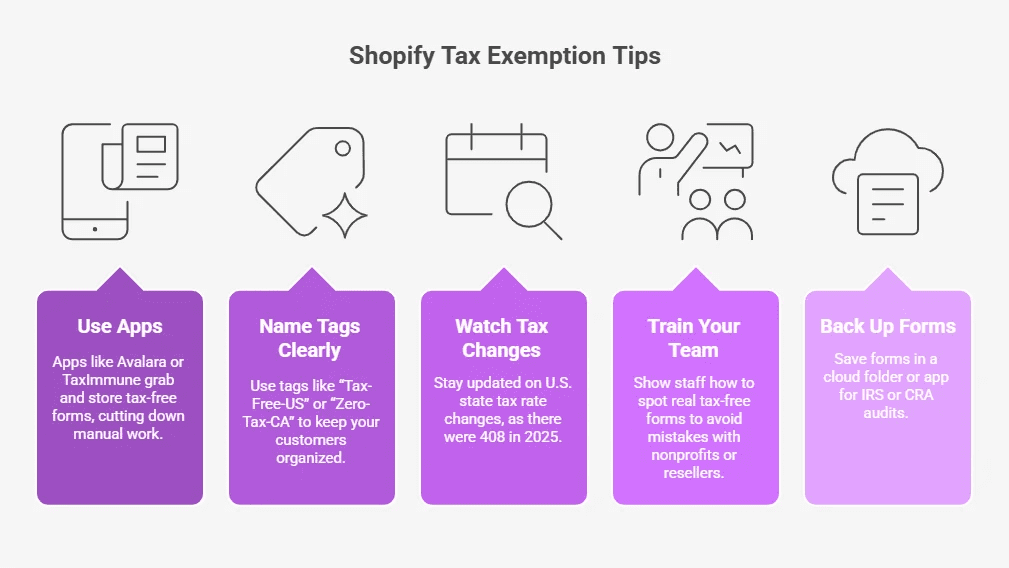
- Use Apps for Forms: Apps like Avalara or TaxImmune grab and store tax-free forms. This cuts down manual work.
- Name Tags Clearly: Use tags like “Tax-Free-US” or “Zero-Tax-CA.” It keeps your customers organized.
- Watch 2025 Tax Changes: U.S. states made 408 rate changes in 2025.
- Train Your Team: Show staff how to spot real tax-free forms. It avoids mistakes with nonprofits or resellers.
- Back Up Forms: Save forms in a cloud folder or app. You’ll need them for IRS or CRA audits. Connect with the SAL Accounting team for Shopify accounting services today.
Final Thoughts: Tax Exemptions Are a Feature, Not a Bug
When handled correctly, Shopify tax exemptions are one of the most powerful tools in your ecommerce arsenal. You keep customers loyal, stay CRA-compliant, and avoid five-figure surprises.
But let’s be real—most sellers don’t have time to become tax experts. That’s where our Shopify store accountants in Toronto come in. They handle the setup, verification, filing, and audit defense so you can focus on growing your store.
About SAL Accounting

SAL Accounting is dedicated to assisting Canadian businesses and e-commerce owners in avoiding tax mistakes. Ready to make tax exemptions work for you, not against you? Book a free call with SAL’s team in Toronto or Mississauga.
For the complete technical walkthrough with screenshots, read SAL Accounting’s full blog post: Shopify Tax Exemption Explained in 2025.
📧 Email: tax@salaccounting.ca
📍 Location: 330 Bay St. Unit 1401, Toronto, ON M5J 0B6 | 55 Village Centre Pl, Suit 734, Mississauga, ON L4Z 1V9, Canada