
Lynnwood, WA
Siding replacement in Lynnwood, WA has moved from a discretionary upgrade to a practical necessity for a growing number of homeowners across Snohomish County. As properties built during the construction boom of the 1970s through 1990s reach the end of their original exterior lifespan, the consequences of postponing full replacement have become difficult to ignore. Failed siding materials allow moisture to enter wall assemblies, compromise insulation performance, and in some cases damage structural components that are far more expensive to repair than the original siding would have been to replace. For Lynnwood homeowners weighing their options, understanding when repair is no longer sufficient and full replacement becomes necessary is one of the most financially significant decisions in residential maintenance.
Siding Replacement in Lynnwood, WA Driven by Material Failures Unique to the Pacific Northwest
The Seattle metro region experiences some of the most demanding conditions for exterior building materials in the continental United States. Annual precipitation averages above 37 inches, humidity levels remain elevated for much of the year, and temperatures fluctuate enough to produce regular freeze-thaw cycling in exposed exterior materials. These conditions accelerate the failure of moisture-sensitive siding products far faster than manufacturers’ expected lifespans would suggest in drier climates.
Hardboard lap siding, which was widely installed on Lynnwood homes through the 1990s, has been the subject of multiple class action settlements due to premature moisture-related failure. LP Inner-Seal siding, manufactured by Louisiana-Pacific, was the subject of a settlement that paid out to hundreds of thousands of homeowners across the country after widespread reports of delamination, swelling, and rot in climates similar to western Washington. Homes in Lynnwood that still carry this product, or similar hardboard materials from the same era, are operating with siding that has in many cases already exceeded its functional lifespan.
When siding failure reaches a certain threshold, localized repairs no longer address the underlying problem. Replacing isolated boards while leaving adjacent compromised panels in place extends the replacement timeline but does not eliminate the moisture risk. At that stage, full siding replacement becomes the more cost-effective path.
How Homeowners Can Identify When Replacement Outweighs Repair
A qualified exterior contractor can assess whether a property has crossed the threshold from repair-appropriate to replacement-appropriate based on several observable indicators. Widespread paint failure across multiple elevations of the home, rather than isolated peeling at specific joints or trim areas, suggests that moisture vapor is escaping consistently through the wall assembly and compromising adhesion across large surface areas. This pattern typically indicates that the siding substrate itself has absorbed enough moisture to prevent stable paint adhesion regardless of preparation quality.
Siding panels that produce a hollow sound when tapped, flex when pressed, or show visible separation from the wall surface indicate substrate deterioration that has progressed beyond surface treatment. In these cases, replacing the visible panel without addressing what is behind it leaves wet or damaged sheathing and building paper in place, which continues to cause problems after the new material is installed.
When more than 25 to 30 percent of a home’s siding surface requires repair in any given assessment, most building professionals recommend evaluating full replacement. Partial repairs on a failing system tend to require follow-up work at shorter and shorter intervals as the remaining original material continues to deteriorate, ultimately costing more in aggregate than a single full replacement would have.
What a Full Siding Replacement Project Involves
A complete siding replacement in Lynnwood project involves several sequential phases that go well beyond removing old panels and installing new ones. The process begins with a full exterior inspection to document existing conditions, identify areas of substrate damage, and determine whether the existing house wrap or building paper requires replacement in any zones.
Substrate preparation is one of the most consequential phases of the project. Any sheathing that has absorbed moisture must be dried or replaced before new siding is installed over it. Installing new siding over wet or compromised sheathing traps moisture against the new material from the first day, accelerating deterioration and potentially voiding manufacturer warranties on the new product.
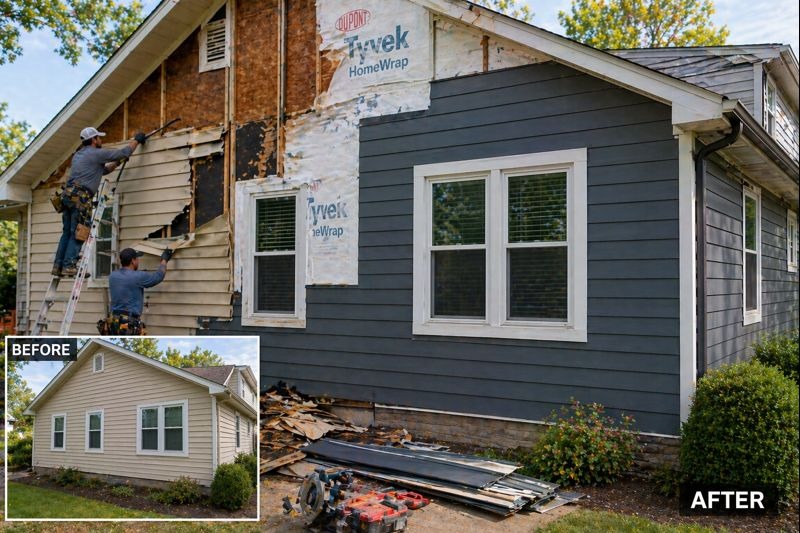
New moisture barrier installation follows substrate preparation. Modern homes typically use a housewrap product such as Tyvek or a similar permeable membrane that allows vapor to escape outward while preventing liquid water from entering. Homes built before 1990 often used kraft-faced building paper, which degrades over time and loses its water-resistance properties. Replacing old building paper with a current-generation housewrap product during a full siding replacement improves long-term moisture management for the entire wall assembly.
Flashing installation at windows, doors, roof-to-wall transitions, and utility penetrations is the final critical step before siding panels are installed. Properly lapped and sealed flashing directs water away from vulnerable intersections that are statistically the most common entry points for moisture infiltration in western Washington homes.
Material Selection for Siding Replacement in the Pacific Northwest
Fiber cement siding has become the leading material choice for full siding replacement in the Lynnwood market for reasons that are directly connected to regional climate conditions. Unlike wood-based products, fiber cement does not absorb moisture, does not provide a food source for mold or insects, and maintains dimensional stability through the freeze-thaw cycles that cause wood and hardboard products to swell and crack over time.
James Hardie’s HardieZone HZ10 product line is specifically engineered for high-humidity, freeze-thaw environments and is the product most frequently specified by siding replacement companies operating in western Washington. The product carries a 30-year non-prorated warranty when installed by a certified contractor according to published installation guidelines.
Engineered wood siding products, such as LP SmartSide, represent an alternative that costs less than fiber cement while offering better moisture resistance than the original LP Inner-Seal hardboard it replaced. LP SmartSide is treated with a zinc borate preservative that resists fungal decay and insect damage, making it more appropriate for the Pacific Northwest climate than untreated wood products.
Premier Siding and Exteriors Guides Lynnwood Homeowners Through Full Replacement Projects
Premier Siding and Exteriors brings structured project management to siding replacement in Lynnwood, WA, beginning with a documented exterior assessment that defines scope before any contract is signed. The firm works with fiber cement and engineered wood products and holds manufacturer certifications that support warranty coverage for completed installations.
Siding replacement companies in Lynnwood that combine diagnostic expertise with correct installation practice give homeowners the most durable and cost-effective outcome available in this market.
Questions Every Homeowner Should Ask Before Signing a Siding Replacement Contract
Before committing to a full replacement project, homeowners should ask the contractor specifically whether substrate inspection and sheathing replacement are included in the bid, whether new house wrap will be installed across the full project area, how flashing at windows and doors will be handled, and what warranty the manufacturer provides for the selected product when installed by this specific contractor.
A siding replacement company that cannot answer these questions with specificity is not approaching the project with the diagnostic and technical depth the Pacific Northwest climate demands.
Washington State requires all residential contractors to carry an active license through the Department of Labor and Industries. License status, insurance verification, and complaint history are all publicly accessible through the L and I contractor lookup portal, and homeowners are encouraged to use it before signing any exterior work agreement.
For information about siding replacement services in the Lynnwood area, contact a licensed exterior contractor directly.
Contact: Premier Siding and Exteriors Lynnwood, WA
