
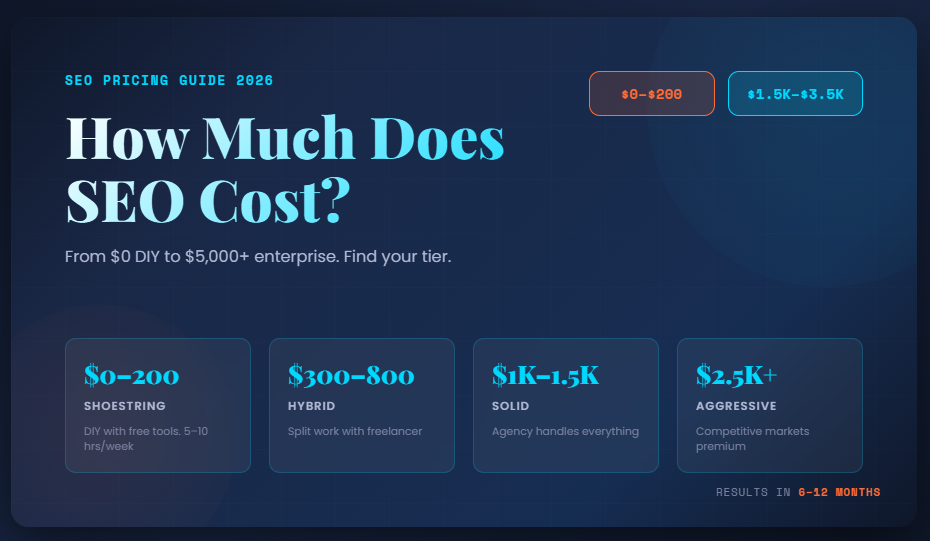
SEO costs for small businesses typically range from $500 to $3,500 per month, depending on your budget, industry competition, and which services you need. If you’re looking to upskill, consider a best SEO course. The real answer isn’t a single number—it’s figuring out what actually works for your specific situation.
If you’re reading this as a student thinking about starting a business, or a business owner trying to understand what SEO investments make sense, this guide cuts through the confusion. We’ll show you real price ranges, what you actually get, and honest paths forward without the sales pitch.
The Basic Price Breakdown
Let’s start with what most agencies actually charge:
Most common range for small business SEO: $1,500–$3,000 per month
This is what a reputable agency will quote you for a comprehensive, ongoing package. It covers keyword research, content optimization, technical site improvements, and basic link building. The $1,500 is the realistic floor where an agency isn’t cutting corners.
But “most common” doesn’t mean “what you should pay.” Here’s the full picture:
Monthly Retainer Model:
- Budget agencies and freelancers: $500–$1,000/month
- Mid-level agencies: $1,500–$3,000/month
- Premium agencies: $3,000–$10,000+/month
- Enterprise agencies: $10,000–$50,000+/month
Hourly Consulting:
- Junior consultants: $50–$100/hour
- Experienced freelancers: $100–$150/hour
- Established consultants: $150–$300/hour
One-Time Project Work:
- Website audit: $500–$2,500
- Content strategy development: $1,000–$5,000
- Technical SEO overhaul: $2,000–$10,000
The massive price range exists because SEO is a service, not a product. A $500/month package and a $5,000/month package are doing different things—different scope, different depth, different results timeline.
The Pricing Model Question: Choose Wisely
Understanding which model fits your situation saves money and frustration.
Monthly Retainer (Most Popular)
You pay a fixed amount each month for ongoing work. The agency handles keyword research, content creation, technical improvements, and performance tracking continuously.
Why it makes sense: SEO isn’t a “set it and forget it” thing. Your website needs consistent attention—new content, competitor monitoring, algorithm adjustments, link building. A retainer keeps momentum going.
Best for: Businesses that want reliable, predictable results and can commit to at least 6 months.
Hourly Consulting
You hire someone for specific hours, like bringing in an expert on-call. They advise, you implement, or you handle some tasks while they handle others.
Why it makes sense: It’s flexible. You pay only for the time you use. Great for specific problems or if you’re doing some SEO yourself and need expert guidance on tough issues.
Best for: Startups with tight budgets, businesses handling some SEO in-house, or when you need one specific problem solved.
Hidden reality: Most hourly consultants will end up costing you $1,200–$1,800/month anyway if you’re getting meaningful help. The “flexibility” often just means unpredictable billing.
Project-Based Pricing
One-time payment for a defined deliverable: a website audit, content strategy, technical fixes, etc.
Why it makes sense: You know the price upfront and what you’re getting. No surprises.
Best for: First-time optimization work before committing to ongoing services. Helps you understand what your site needs without the long-term commitment.
Real talk: A project-based audit tells you what’s broken, but it doesn’t implement fixes or create content. You’re paying for a diagnosis, not the treatment.
What Affects Your Price?
These factors make a $500/month quote and a $5,000/month quote both legitimate—they’re just solving different problems.
1. Business Size and Website Complexity
A single-location plumbing business with 20 pages needs different work than a multi-location HVAC company with 200 pages. More pages = more optimization needed.
Single location, small site: $500–$1,500/month Multiple locations or larger site: $1,500–$3,500/month Enterprise-level complexity: $3,500–$10,000+/month
2. Industry Competition
Some industries have brutal competition. A personal injury lawyer in a major city is competing against firms spending $10,000+ per month on SEO. A small-town financial advisor with almost no local competition has it easier.
Low competition (plumber in town of 5,000): $500–$1,200/month Medium competition (regional business): $1,500–$2,500/month High competition (lawyer, dentist in major city): $2,500–$5,000+/month
This is one of the most misunderstood factors. Your competitor’s budget directly affects yours.
3. Geographic Reach
Local SEO (one city or area) costs less than regional SEO, which costs less than national SEO.
Local only (one service area): $300–$1,500/month Regional (multiple nearby cities): $1,500–$3,500/month National: $3,500–$10,000+/month International: $5,000–$50,000+/month
Why? Targeting “plumber in Denver” is easier than “plumber anywhere in the U.S.”
4. Specific Services Included
This is where $1,500 can look very different from another $1,500. Ask what’s included:
- Keyword research and planning
- On-page content optimization
- Technical SEO audits and fixes
- Content creation (how many pieces per month?)
- Link building strategy
- Monthly reporting and analysis
- Local SEO (Google Business Profile, citations)
- Competitive analysis
A package that includes 4 new blog posts per month costs more than one that includes 0. Link building costs more than not doing it. A full technical audit costs more than basic optimization.
5. Your Business Goals
Do you need brand visibility, or do you need customers in your door right now? That changes the strategy.
Quick lead generation: Higher cost, more aggressive tactics Long-term organic growth: Lower entry cost, slower build International expansion: Much higher cost
6. Agency Experience and Location
An agency in San Francisco charges more than one in Philippines—but the U.S. agency probably has more local knowledge and proven results for American businesses.
U.S.-based agency: $1,500–$5,000+/month International freelancers/agencies: $300–$1,500/month In-house hiring: $60,000–$180,000/year (full salary + benefits + tools)
Experience jumps matter but less than you’d think. A 10-year SEO expert charges about $45 more per hour than a 2-year veteran. That’s one of the best deals in professional services.
The Real Student’s Question: Can I Afford This?
Honest answer: maybe not the premium agency version right now, but there are paths forward.
Tier 1: The Shoestring Budget ($0–$200/month)
You do the SEO yourself using free tools.
What you pay:
- $0 to maybe $50/month for one paid tool like Ahrefs ($99/month) or cheaper alternative
What you do:
- Use Google Search Console (free, shows what people search to find you)
- Use Google Analytics (free, shows visitor behavior)
- Research keywords using free tools like Ubersuggest free version, Google Keyword Planner
- Create content yourself
- Optimize your site basics yourself
- Optimize your Google Business Profile if you’re local
Time investment: 5–10 hours per week
Realistic timeline to results: 3–6 months of consistent work
When it works: You have more time than money. You run a local business with low competition. You’re willing to learn and tolerate some mistakes.
When it fails: You pick wrong keywords, miss technical issues, or burn out because it’s too much work on top of running your business.
Real example: A student running a local dog-walking service in a small town could absolutely do this tier alone and see Google Business Profile rankings within months.
Tier 2: The Hybrid Approach ($300–$800/month)
You do some work. A freelancer or cheap agency handles the hard parts.
What you pay:
- $300–$500/month for freelance support + $100–$200/month for tools
How they do:
- Technical SEO audit and fixes
- Keyword research and strategy
- Content outline creation
- Link building strategy
What you do:
- Write content based on their outlines
- Manage Google Business Profile and local citations yourself
- Respond to reviews and customer feedback
- Implement some on-page optimization (they guide you)
Time investment: 3–5 hours per week on your end
Realistic timeline: 2–4 months to initial results, 6–12 months for solid rankings
When it works: You can commit some time but not full-time. You understand your industry voice better than anyone else (so your content is better). You want expert guidance without the premium price.
Real example: A dental practice owner could hire a freelancer for $500/month to do technical SEO and create content outlines, then have their hygienist write some service pages and respond to reviews. Total investment: $600–$700/month, part-time effort, much better content because it’s from someone who knows the practice.
This hybrid approach is criminally underrated. It’s where a Georgetown dental practice in the 2025 study got a 100% ROI—they paid for strategy ($2,400/month), handled their own Google Business Profile updates and review responses, and went from zero to 40 new leads per month in a year.
Tier 3: The Solid Investment ($1,000–$1,500/month)
A real agency or experienced freelancer handles everything.
What you get:
- Keyword research and strategy
- Monthly content creation (usually 2–4 blog posts)
- Technical SEO audits
- On-page optimization
- Basic link building
- Monthly reporting
- Local SEO management if needed
What you do: Approve decisions, provide business info when they need it, run your business
Time investment: 2–3 hours per month for meetings/feedback
Realistic timeline: 3–4 months to see traction, 6–12 months for meaningful rankings
When it works: You have steady revenue and can invest in growth. You’re tired of DIY. You’re competing in a medium-competition market.
This is the sweet spot for most small businesses. It’s expensive enough that agencies take you seriously, affordable enough that ROI is realistic within a year.
Tier 4: The Aggressive Campaign ($2,500–$5,000+/month)
Full-service premium agency tackling everything comprehensively.
What you get:
- Everything in Tier 3
- More content (8+ pieces monthly)
- Aggressive link building
- Competitor intelligence and strategy updates
- Conversion optimization
- Sometimes paid ads management too
What you do: Run your business, check in monthly
Realistic timeline: 4–6 months to see solid traction, 6–12 months to dominate your market
When it works: You’re in a competitive industry. You need results fast. You have the revenue to justify the spend.
Example: A personal injury law firm in a major city probably needs this level to compete. The investment pays for itself with 2–3 new cases per month.
The Hidden Costs of DIY SEO (Why Cheap Isn’t Free)
Before you think “I’ll just do it myself and save thousands,” calculate what you’re actually spending.
Tool subscriptions for serious DIY work:
- Keyword research tool (Ahrefs, Semrush): $100–$140/month minimum
- Site auditing tool: $50–$100/month
- Rank tracking tool: $50–$100/month
- Content optimization tool: $50/month
- Link analysis tool: Part of Ahrefs or separate $50+/month
Realistic DIY tool stack: $250–$400/month just for tools.
Your time
This is where DIY gets expensive fast.
If you spend 10 hours per week on SEO at $30/hour, that’s $1,200/month of your own labor value. At $100/hour? That’s $4,000/month. If you’re an accountant billing clients at $200/hour, every hour on SEO is literally costing you $200 you didn’t earn.
The “DIY saves money” narrative only works if your time is worth nothing or nearly nothing.
Learning curve mistakes
Bad decisions cost more than good advice upfront. A misplaced “noindex” tag can hide your entire site from Google for months. Keyword stuffing can trigger a Google penalty. Poor site architecture decisions ripple for years.
Agencies have made these mistakes on someone else’s dime. You’ll make them on yours.
Competitive disadvantage
While you’re learning, your competitors with agency support are ranking above you and collecting the leads. You’re not just losing the deal—you’re losing it to someone spending money on SEO while you’re “saving money.”
The ROI Timeline: What to Actually Expect
This is where a lot of business owners get frustrated. They expect fast results and get slow ones.
Months 1–2: The Foundation
Not much visible improvement. The agency is:
- Auditing your site for technical problems
- Doing keyword research
- Creating a strategy
- Maybe fixing major issues
You might feel like you’re paying for nothing. You’re not. Imagine remodeling a kitchen—the first month is permits, electrical work, and structural fixes. Not glamorous, but essential. Skip this and your SEO house falls apart later.
Months 3–4: Early Signals
You start seeing movement. New content might start ranking for easier keywords. Google Business Profile visibility improves (if you’re local). Traffic might increase 10–30%.
This is when you start thinking “okay, this might actually work.”
Months 5–6: The Inflection Point
This is where it gets real. If your strategy was solid, you’re seeing 30–100% traffic increases. Rankings on competitive keywords start appearing on page 2, then page 1. Leads start coming in.
By month 6, you should clearly see whether SEO is working for you. If you see nothing, something’s wrong—wrong strategy, wrong agency, or unrealistic target keywords.
Months 7–12: Compounding Growth
SEO builds on itself. Better rankings mean more clicks. More content means more entry points. More backlinks mean more authority. Growth accelerates if the strategy is right.
By month 12, businesses usually see 2–4x traffic increase and meaningful lead flow.
Critical reality: These timelines assume your SEO work is actually good. Bad SEO takes just as long and produces nothing. The timeline difference between paying $500/month and $3,000/month often isn’t “faster results”—it’s better results at the same speed.
Red Flags: Avoid These Pricing Traps
Some agencies quote low for a reason. Here’s what to watch:
“Guarantee we’ll rank you #1”
Google doesn’t answer to anyone. No legitimate SEO company can guarantee rankings. This is a fraud indicator. If someone promises results, walk away.
Price seems too good to be true
If an agency charges $300/month and says they’ll do full SEO, they’re either:
- Using automated/low-quality tools
- Cutting corners (light content, no link building)
- Not actually doing the work
- Using black-hat tactics that could get your site penalized
The minimum for legitimate small business SEO isn’t $250/month. The tools and time alone don’t support it.
Vague about what’s included
Ask specifically: “How many pieces of content per month? What link building strategy? What’s the audit?” Vagueness often means the service doesn’t exist or is minimal.
No contract or exit option
Reputable agencies will let you leave with 30 days’ notice if things aren’t working out. If they lock you in for a year with penalties, that’s not confidence in their work—that’s trapping you.
No reporting or transparency
You should get a monthly report showing: Google rankings for target keywords, organic traffic changes, lead/conversion data, what work was done. No transparency = no accountability.
Selling you expensive add-ons
Good agencies bundle what you need. Cheap ones quote a low base price then tell you content creation, link building, and technical work are “extras.” Ask upfront what’s included.
Small Business vs. Startup SEO Costs
Startups often have this thinking: “We have no money, zero brand recognition, zero traffic. How much should we invest?”
Realistic answer: $500–$1,000/month, probably DIY or hybrid.
Startups benefit from SEO, but you don’t have revenue yet to justify a $3,000/month agency. Focus on:
- Building a solid website technically
- Creating genuinely useful content
- Getting basic local visibility (if applicable)
- Building early authority through guest posting or partnerships
Once you have revenue, scale to $1,500/month.
Established small businesses (5+ years, stable revenue) can afford $1,500–$3,000/month and should, because the ROI works. You have customers, revenue, and a few leads per month from SEO probably justifies the cost 10x over.
When NOT to Pay for SEO
Be honest: sometimes SEO isn’t your problem.
Don’t hire SEO if:
- You have no website or a site that’s actively broken (fix it first)
- You can’t commit to at least 6 months (SEO takes time)
- Your business model doesn’t support customer acquisition (not everyone needs SEO)
- You’re bleeding money and need leads this month (try paid ads instead)
- You don’t have revenue to reinvest (save money first, then invest)
Do hire SEO if:
- You have customers but not enough of them
- You’ve tried a few things and aren’t seeing traction
- Your competition is ranking above you
- You have revenue and can view SEO as a growth investment
- You’re willing to think in terms of 6+ months
Questions Small Businesses Actually Ask About SEO Cost
“What if I start with DIY and switch to an agency later?”
Perfect approach. No shame in starting with what you can afford. Many successful businesses did. Start with Tier 1 or Tier 2, get a feel for what SEO is, then upgrade when you have revenue to justify it. Agencies prefer clients who understand SEO basics anyway.
“How do I calculate if SEO ROI makes sense for my business?”
Simple math:
- One new customer is worth: _______ (your average customer value)
- If one customer costs you $500 in SEO investment and brings you $2,000 in revenue, that’s 4:1 ROI
- Most businesses need 2–4 new customers per month from SEO to justify a $1,500/month investment
Example: A plumber gets an average $1,500 job. If SEO brings one $1,500 job per month, and the investment is $1,500/month, you’re breaking even. Month 2 you profit. That’s acceptable ROI.
A dentist getting $800 routine cleanings might need SEO to bring 3–4 customers monthly to justify $1,500/month agency cost.
Work backwards from your numbers.
“How much cheaper are international freelancers?”
Much cheaper upfront (often 50–70% less), but with caveats:
- Time zone communication challenges
- Possible language/cultural gaps
- Less understanding of your local market (important for U.S. businesses)
- Quality varies wildly
- You might save $500/month but get worse results, which costs you more in lost business
International freelancers work great for:
- Content writing (if English-focused)
- Technical SEO implementation
- Basic optimization
They’re riskier for:
- Strategy (needs to understand your market)
- Link building (often relies on networks that may not apply to you)
- Competitive analysis
The Hybrid Path Forward (What Actually Works)
Here’s what works best for most small businesses starting out:
Month 1: Get a Technical Audit ($500–$1,500 one-time)
Hire someone for one project: comprehensive technical SEO audit. Find out what’s actually broken on your site.
Months 2–6: Do the Basics Yourself
Use what you learned. Fix issues. Create some content. Optimize what you have. Use free tools.
Month 6: Hire Strategy ($800/month or one-time $2,000)
Either hire a consultant for 5–10 hours of strategic guidance, or hire an agency for one month to build a 6–12 month plan.
Months 7–12: Hybrid Execution ($500–$1,000/month)
You handle content and basic tasks. They handle technical SEO, link building, and strategy adjustments.
Year 2: Scale Up
If it’s working, move to $1,500–$2,000/month retainer. The agency now has baseline knowledge and momentum.
This path costs $4,000–$6,000 in year one and produces much better results than struggling with full DIY or overpaying for an agency when you don’t need it yet.
Final Reality Check
SEO is expensive because it works, and companies spend serious money on it. But “expensive” is relative.
For a business owner:
- $1,500/month SEO that brings 5 new customers worth $1,000 each = $5,000 revenue for $1,500 investment. That’s a home run.
- $300/month in DIY tools and 10 hours/week of your time might produce nothing, because you’re making mistakes and not strategic.
The money isn’t the issue. Strategy and execution are.
Spend $0 and get zero results, or spend $1,500 and get real results. The difference isn’t the money—it’s knowing what to do.
Start where you are, with what you can afford. Scale as you see results. Every tier has a path to success if you commit to it.