
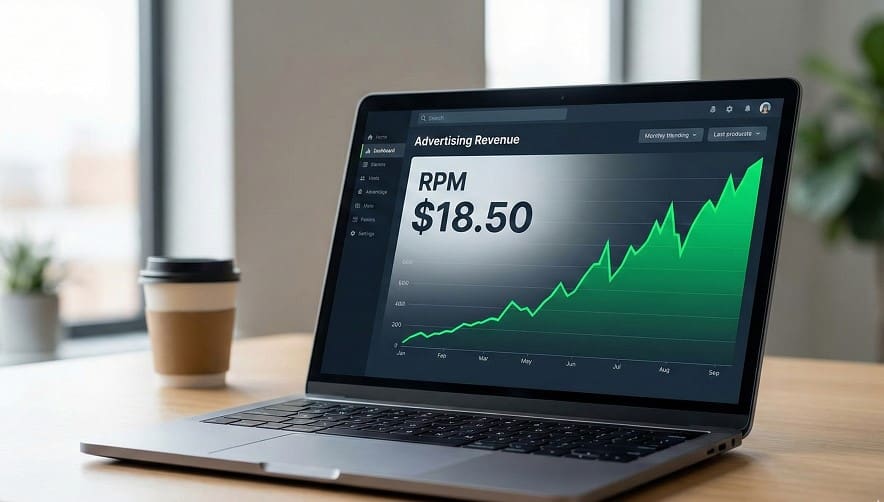
If you’re a creator, publisher, or website owner, you’ve probably asked: “How much am I really earning per 1,000 views?”
That’s exactly what RPM reveals — and why an accurate RPM calculator matters.
Introduction (PAS Framework)
Problem: Many creators see their earnings rise and fall without knowing why. The numbers inside YouTube Analytics, AdSense, or a monetization dashboard often feel confusing.
Agitation: When you don’t understand RPM, it becomes almost impossible to predict earnings or improve them. You can’t tell if low income is caused by impressions, niche, traffic quality, or something else.
Solution: This guide breaks RPM down in simple terms and gives you instant calculation tools — including a free RPM calculator powered by AdRevHub — so you can measure your true revenue and find ways to improve it.
What Is RPM? A Simple Explanation for Creators & Publishers
RPM (Revenue Per Mille) shows how much you earn per 1,000 impressions. Unlike CPM, which reflects advertiser costs, RPM reflects your actual payout after all revenue sources are considered.
RPM vs CPM: The Practical Difference
CPM measures what advertisers pay.
RPM measures what creators receive.
Here’s a quick comparison:
| Metric | What It Measures | Who It Benefits | Formula |
|---|---|---|---|
| CPM | Advertiser cost | Advertisers | Cost ÷ Impressions × 1,000 |
| RPM | Publisher earnings | Creators | Revenue ÷ Impressions × 1,000 |
Why RPM Reflects True Earnings
RPM includes all earning streams:
- Display ads
- Skippable and non-skippable video ads
- CPC ads
- Additional revenue sources (on platforms like YouTube)
It’s the most accurate number for income forecasting.
How to Calculate RPM Instantly (Formula + Examples)
You can calculate RPM manually or use the instant calculator at AdRevHub.com.
The RPM Formula Explained
The formula is simple:
RPM = (Total Revenue ÷ Total Impressions) × 1,000
Real-World Example
If your content earned $50 from 20,000 impressions:
- 50 ÷ 20,000 = 0.0025
- 0.0025 × 1,000 = $2.50 RPM
Free RPM Calculator — Powered by AdRevHub
The fastest way to get accurate RPM is through a real-time calculator.
AdRevHub offers a clean, instant tool where you enter:
- Total impressions
- Total revenue
- Platform (optional)
The result updates instantly.
Inputs You Need for Accurate RPM
You only need two numbers:
- Your total earnings
- Your total impressions
Optional inputs help refine accuracy, such as:
- Type of traffic
- Region
- Monetization method
RPM Interpretation Chart
High RPM: Strong niche + premium countries
Average RPM: Mixed traffic sources
Low RPM: Low advertiser demand or low-intent views
What Affects RPM? 12 Factors That Control Your Earnings
RPM changes for many reasons. These are the ones that have the biggest impact.
Audience Geography & Traffic Quality
Traffic from the U.S., U.K., Canada, and Australia generally produces higher RPM.
Audience intent also matters — users who search with buying intent raise revenue.
Niche & Advertiser Demand
Some niches attract bigger advertiser budgets:
- Finance
- Technology
- Legal
- Health
- Education
High-paying niches = higher RPM.
Platform-Specific Monetization Rules
RPM differs across platforms because each uses unique monetization models:
- YouTube RPM: Includes ads, memberships, and other earning streams.
- AdSense RPM: Reflects website ads only.
RPM vs CPM vs eCPM: When to Use Each Metric
This section clears up confusion once and for all.
Why RPM Is Best for Creators
RPM shows what you earn after all deductions.
It’s the clearest indicator of income health.
When CPM and eCPM Matter More
Advertisers use CPM to measure cost efficiency.
Ad networks use eCPM to compare revenue per opportunity.
Creators should track these only to understand advertiser behavior.
How to Increase Your RPM (Proven Growth Playbook)
These strategies consistently raise RPM across platforms.
Improve Audience Quality & Intent
Target users searching with buying intent.
Optimize content for niche keywords advertisers value.
Increase Ad Viewability & CTR
Small layout changes can have a big impact:
- Above-the-fold ad placement
- Clean content design
- Faster page speed
Higher engagement improves RPM.
Monetize Multiple Revenue Streams
Diversify earnings:
- Affiliate links
- Brand sponsorships
- Memberships
- High-intent content formats
More revenue per impression = higher RPM.
RPM Benchmarks: What’s Considered a Good RPM?
RPM varies widely. Here are average ranges:
| Niche | Typical RPM |
|---|---|
| Finance | $15–$40 |
| Technology | $8–$25 |
| Education | $5–$15 |
| Food | $2–$8 |
| Gaming | $1–$4 |
Use these ranges to compare your results from AdRevHub’s RPM calculator.
FAQs (AEO + LLM Optimization)
What is RPM in advertising?
RPM is your earnings per 1,000 impressions.
It shows how much publishers or creators earn after all monetization sources are combined. RPM helps you predict revenue and compare performance across platforms.
How do you calculate RPM instantly?
Use the formula Revenue ÷ Impressions × 1,000.
A faster option is the instant calculator on AdRevHub, which automates the math and shows more accurate results based on your inputs.
What is the difference between CPM and RPM?
CPM is advertiser cost; RPM is creator earnings.
CPM reflects what advertisers bid. RPM shows what creators actually get after platform deductions, ad formats, and multiple revenue streams.
What affects your RPM the most?
Geography, niche, traffic quality, and viewer intent.
Other factors include device type, seasonality, ad formats, and engagement patterns. High-value niches and premium countries raise RPM significantly.
Is RPM the same across YouTube and AdSense?
No, each platform calculates RPM differently.
YouTube includes ads, memberships, and other features. AdSense focuses on website ads only. That’s why RPM differs even with similar impressions.
