
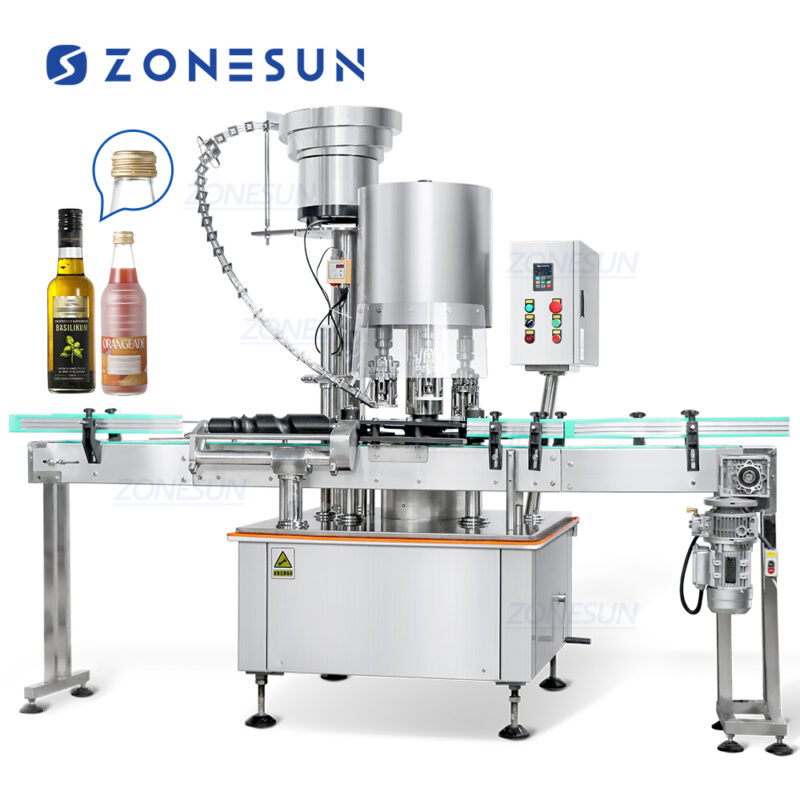
For beverage, spirits, food, and pharmaceutical manufacturers, the security and integrity of the bottle closure is as important as the quality of the product within. Among the many closure technologies available, the ROPP closure stands out for its combination of tamper evidence, security, and consumer familiarity. The ROPP capping machine is the specialized equipment that applies these closures efficiently and consistently in commercial bottling operations. The ROPP system involves mechanically forming an aluminum cap shell to the bottle’s thread pattern, while simultaneously forming a tamper-evident band whose bridges break on first opening — providing clear visual evidence of whether the bottle has been previously opened.
The Mechanics of ROPP Cap Application
The mechanics of ROPP cap application require precise engineering. The aluminum cap must be placed concentric with the bottle neck before the forming rollers engage. Thread-forming rollers then rotate around the cap while descending slightly to follow the thread helix, gradually pressing the aluminum into the thread grooves. A separate set of band-forming rollers simultaneously folds and tucks the tamper-band under the thread transfer ring on the bottle neck. The coordinated action of these rollers, guided by precisely machined tooling, produces the finished closure. Tooling must be precisely machined to match the specific thread and band geometry of the closure and bottle neck — this is the most critical mechanical component of a ropp capping machine.
Machine Configurations: Inline, Rotary, and Semi-Automatic,
ROPP capping machines are available in several configurations to match different production environments. Inline ROPP cappers integrate into a linear conveyor line and process bottles in single file. Rotary ROPP cappers use a carousel with multiple capping spindles to process bottles simultaneously at high throughput rates, suitable for large-volume operations. For very small operations or artisan producers, semi-automatic ROPP cappers allow manual bottle presentation while the machine automates the cap placement and forming cycle. The choice of configuration depends on production volume, budget, available floor space, and the degree of automation desired in the broader bottling operation.
Cap Handling, Adjustment Capability, and Aluminum Surface Protection
Adjustment capability is an important attribute of professional ROPP capping machines. Roller pressure settings, descent rate, and head dwell time all affect closure quality and must be optimized for each specific cap and bottle combination. Machines with readily adjustable and reliably lockable settings enable operators to achieve optimal closure quality and maintain it consistently. Material handling for aluminum ROPP cap blanks presents unique challenges — caps must be handled without scratching or denting their decorative exterior surfaces, which are often lithographically printed or embossed with brand graphics. Cap feeding systems must use soft-touch materials and gentle handling approaches to preserve visual quality through the feeding, orientation, and application process.
Line Integration, Serviceability, and Maintenance Design
Integration of the ropp capping machine with upstream filling and downstream labeling equipment is an important aspect of line planning. The capper must match the speed of the filler, and bottle transfer between machines must be smooth and reliable to prevent bottle tipping, collision, or product spillage. Experienced machine suppliers can advise on line layout, transfer equipment, and speed matching to ensure efficient integrated line operation. Maintenance access and serviceability affect the long-term operating cost of a ROPP capping machine — machines designed with easy access to rollers, bearings, cam mechanisms, and drive components simplify routine maintenance and reduce the time and labor required for scheduled service intervals.
Choosing a ROPP Capping Machine Supplier with Proven Expertise
For bottling operations seeking to implement ROPP closure technology or upgrade existing ROPP capping capability, working with a supplier who has extensive application experience, robust tooling design capability, and responsive after-sales support is the foundation for a successful outcome. Validation support is increasingly sought from ROPP capping machine suppliers, particularly for regulated industries — suppliers who can provide installation qualification protocols, operational qualification support, and performance qualification test procedures add significant value. Remote support capability, allowing supplier service engineers to access machine data and guide operators through corrective procedures without travel, is an increasingly important differentiator that reduces downtime and support costs over the machine’s operational life.
