
China’s 2025 laser satellite communication breakthrough is returning to the spotlight as governments and technology companies race to build faster, more efficient space-based internet systems.
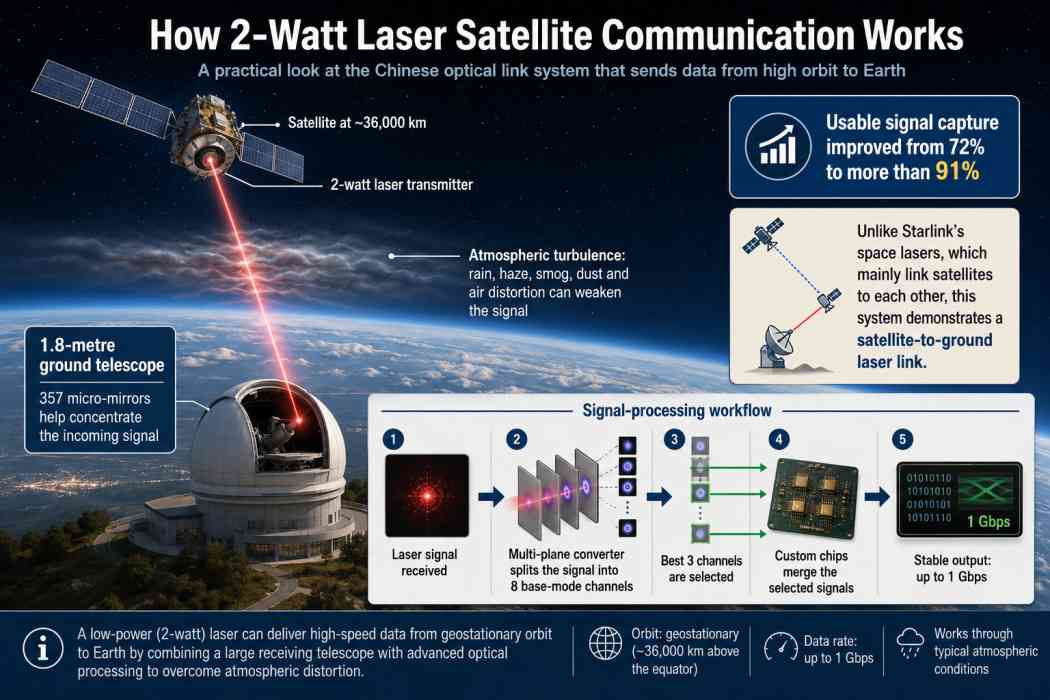
Researchers from China demonstrated a satellite-to-ground optical link capable of transmitting data at up to 1Gbps using a 2-watt laser from about 36,000km above Earth.
The result has drawn renewed interest because it suggests future satellite networks may be able to move large amounts of data with far less power than conventional transmission systems require.
The system used a method known as AO-MDR synergy, combining adaptive optics with mode diversity reception to improve signal recovery as the laser passed through atmospheric turbulence.
Why The 2-Watt Laser Test Matters
Satellite communication has usually been judged by scale: more satellites, more coverage, more bandwidth and more ground infrastructure.
This test shifts the focus to efficiency.
A 2-watt laser is low power by satellite communication standards. Yet the Chinese team reportedly used it to maintain a gigabit-class link across a geostationary-style distance.
That is significant because every watt on a satellite matters. Power, heat, weight and hardware size all affect what a spacecraft can carry, how long it can operate and how expensive it is to launch.
The system was reportedly developed by researchers from Peking University of Posts and Telecommunications and the Chinese Academy of Sciences.
According to the South China Morning Post report, the breakthrough relied on a wireless optical link method known as AO-MDR synergy, combining adaptive optics with mode diversity reception.
The achievement has also raised fresh questions about the future of satellite internet competition. Starlink remains the global leader in low Earth orbit broadband, but China’s test points to a different model: high-capacity satellite-to-ground laser links operating from much higher orbit.
It is not a direct replacement for Starlink, and it is not yet a consumer internet service. However, the public interest is clear.
If low-power laser links can be made reliable, they could play a major role in future broadband, defence communications, Earth observation and deep-space relay networks.
The 2025 test now looks less like a one-off experiment and more like an early signal of where the next satellite communications race is heading: sharper beams, lower power use and faster data from orbit.
