

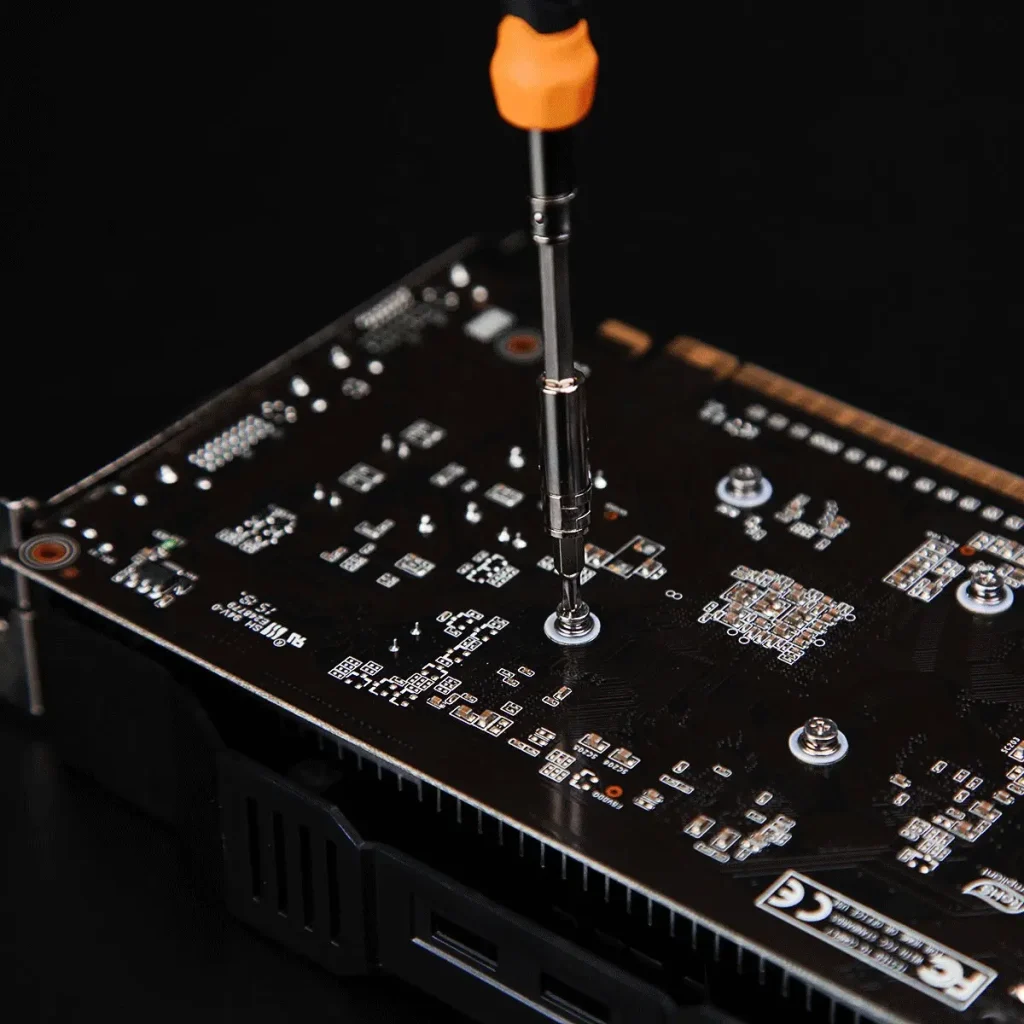
If you have ever stripped a tiny Pentalobe screw trying to open an iPhone, you already understand why a proper screwdriver set for electronics is not optional — it is essential. The fasteners inside modern smartphones, laptops, tablets, and wearable devices are engineered to microscopic tolerances. Using the wrong tool, even once, can mean a ruined screw head, a cracked housing, or a fried circuit board.
Consumer electronics repair is one of the fastest-growing DIY markets in the world. According to data published by the iFixit Repair Manifesto and industry market research, the global electronics repair services market was valued at over USD 100 billion in 2023, and that figure continues to climb as right-to-repair legislation spreads across North America and Europe. More people are opening their own devices, upgrading aging hardware, and cutting down on e-waste — and every single one of them needs the right tools.
This guide covers everything you need to know about choosing the best precision screwdriver set for electronics in 2026 — from why standard screwdrivers fail, to which bit types you actually need, to a hands-on look at the top kits on the market today. Whether you are repairing a cracked smartphone screen, rebuilding a gaming console, or assembling a custom PC, this is the resource you need before you pick up a single tool.
Why Standard Screwdrivers Fail at Electronics Repair
Most people own a basic screwdriver set. A flat-head, a couple of Phillips sizes, maybe a hex key or two. For furniture, plumbing, and general household tasks, these work perfectly well. But the moment you turn one on a laptop motherboard or a smartphone chassis, you are working outside its design parameters — and the damage can be significant.
The Risk of Using Oversized Tips on Micro Fasteners
Electronics manufacturers use fasteners as small as M0.8 (0.8 millimeter diameter), particularly in smartphones and smartwatches. A standard Phillips #1 screwdriver tip, which feels tiny in the hand, is typically four to six times wider than the recess on a micro fastener. When you try to torque a screw with an oversized tip, the tool engages only the outer edge of the recess. The result is cam-out — the tip slips and rounds out the corners of the screw head.
Cam-out is catastrophic in electronics repair. A stripped screw inside a laptop chassis may require a screw extractor, ultrasonic removal, or complete component replacement. Professional repair technicians rank stripped screws as the single most common reason that a DIY repair escalates into a costly professional job. The fix? Using a precision screwdriver set with accurately sized micro tips — typically ranging from 0.8 mm to 3 mm — that seat fully in the recess and transfer torque cleanly without slip.
How Static Discharge Damages Circuit Boards
There is a second hazard that most casual repair guides overlook: electrostatic discharge, or ESD. The human body can carry a static charge of up to 35,000 volts under dry winter conditions, according to data cited by the ESD Association (ESDA). You cannot feel a discharge below roughly 3,000 volts — but modern CMOS logic chips can be permanently damaged by discharges as low as 100 volts.
A standard screwdriver handle made from glossy ABS plastic or polished chrome can accumulate and conduct static electricity directly into the circuit board you are working on. Anti-static (ESD-safe) screwdriver handles are made from dissipative materials — typically TPR or specially formulated polypropylene — that bleed off static charge slowly and safely rather than letting it discharge in a spike. Any precision electronics screwdriver set worth buying in 2026 should include ESD-safe handles as a baseline feature, not an upgrade.
Features That Define a Professional Precision Screwdriver Set
Not all electronics screwdriver sets are built to the same standard. The difference between a premium kit and a budget impulse buy is visible in the specifications — once you know what to look for.
Tip Accuracy and Hardness Rating
Precision screwdriver tips must be machined to exact dimensional tolerances. For electronics work, a well-made tip should match the ISO 8764 or DIN 5260 tolerance standards, meaning the tip geometry deviates by no more than ±0.05 mm from nominal. Beyond geometry, tip material hardness matters enormously. Quality tips are typically made from S2 tool steel or chrome vanadium (Cr-V) steel, heat-treated to 58–62 HRC on the Rockwell C scale.
Softer tips — common in budget kits — deform after a small number of uses, especially when working on tight, thread-locked fasteners. A hardened S2 tip retains its shape over thousands of engagements and resists the torsional stress of hard-to-break screws. When evaluating a mini screwdriver set, always look for explicit material and hardness specifications from the manufacturer.
Rotating End Cap for One-Handed Operation
A rotating end cap — sometimes called a spinning top or swivel cap — is a feature that sounds minor until you use it. When applying fine torque to a micro fastener, you typically hold the handle between your index finger and thumb while spinning with two fingers. A freely rotating cap on the top of the handle means your palm or index finger can press down for alignment while the handle rotates independently. This gives you far more torque control on delicate fasteners and reduces the risk of cam-out and over-tightening.
High-quality precision screwdriver sets — including several from IRONCUBE’s screwdriver range — incorporate bearing-assisted rotating end caps that spin with virtually no resistance, making single-handed precision work genuinely ergonomic.
Magnetic vs Non-Magnetic Tips for Circuit Board Work
Magnetic tips are incredibly practical for most electronics work. Losing a 1 mm screw inside a laptop is a frustrating experience that a magnetized tip largely prevents. However, magnetic tips carry a small but real risk when working near certain components: spinning hard disk drives (HDDs), degaussing coils, and some legacy magnetic sensors can be affected by direct contact with a strong magnet.
For the vast majority of modern electronics repair — smartphones, SSDs, tablets, Bluetooth devices — magnetized tips are safe and recommended. If you regularly work with vintage hard drives or sensitive magnetic media, keep one set of non-magnetic tips on hand. Many premium phone repair screwdriver kits now include interchangeable magnetic and non-magnetic versions of common tips for exactly this reason.
Anti-Static Handle Materials
ESD-safe handle materials are graded by their surface resistivity, measured in ohms per square. Industry standard for ESD-dissipative materials falls between 10⁶ and 10⁹ ohms/sq — high enough to prevent sudden discharge, low enough to bleed charge off slowly over time. Conductive materials (below 10⁵ ohms/sq) are actually too conductive and can still allow dangerous current flow. Look for handles labeled ESD-safe or anti-static, preferably with a certification from the ESD Association or equivalent body. The 6-piece TPR handle screwdriver set from IRONCUBE uses thermoplastic rubber handles specifically formulated for grip and static dissipation — a sensible choice for anyone doing regular circuit board work.
Best Precision Screwdriver Sets for Electronics in 2026
Below are the top-performing precision screwdriver kits this year, evaluated across bit variety, tip accuracy, ergonomics, ESD safety, and value for money.
IRONCUBE 56-in-1 Magnetic Bits and Sockets Set Review
The IRONCUBE 56-in-1 Ratcheting Screwdriver Set is a flagship multi-tool kit that combines a professional ratcheting handle with an extensive bit library covering the most common fastener types across consumer electronics, automotive, and household applications.
The handle features a 72-tooth ratcheting mechanism, which means each click advances the socket just 5 degrees — critical when you are working in tight spaces with limited swing arc. The bit set includes Phillips #00, #0, and #1 (the three sizes most common in smartphones and laptops), as well as Torx T3 through T15, flathead sizes, and both standard and deep-reach sockets for PC building.
Bits are made from S2 tool steel and magnetized for retention. The handle uses a comfortable bi-material grip that reduces hand fatigue during extended repair sessions. The full kit packs into a blow-mold case with labeled compartments, making it fast to find the bit you need mid-repair.
For price-to-value ratio, this set is difficult to beat. It covers the tool requirements of roughly 90% of consumer electronics repair jobs, from basic iPhone screen swaps to full laptop motherboard servicing. You can find it on Amazon with Prime shipping, and IRONCUBE backs it with a manufacturer warranty. See full details and more IRONCUBE screwdriver products here.
Best Screwdriver Kit for iPhone and Smartphone Repair
Smartphone repair demands the most specialized bit selection of any electronics category. Apple devices alone use four proprietary fastener types: Pentalobe P2 (external case screws), Torx T2 (internal), Tri-Point Y000 (battery connector), and Phillips #000 (display assembly). Android devices from Samsung, Xiaomi, and Oppo mix T3 Torx, PH00 Phillips, and proprietary screws that vary by model generation.
The best phone repair screwdriver kit for 2026 includes at minimum: Phillips #000, #00, and #0; Torx T2, T3, T4, and T5; Pentalobe P2 and P5; Tri-Point Y000 and Y0.6; and at least one plastic spudger tool for prying bezels without scratching. A kit that includes a magnetizing/demagnetizing pad is also a significant practical advantage.
The IRONCUBE 21-in-1 Magnetic Multi-Ratcheting Screwdriver Set covers the core smartphone bit sizes and adds a ratcheting mechanism that dramatically speeds up repetitive screw removal — a genuine quality-of-life improvement when you are removing twelve identical screws from a battery housing.
Best Screwdriver Set for Laptop and PC Building
Laptops and desktop PCs use a more standardized fastener system than smartphones, which is good news for buyers. The dominant fastener types are Phillips #1 and #0, Torx T6 and T8, and hex M3 for standoffs. However, ultrabooks and gaming laptops from manufacturers like Asus ROG, MSI, and Dell XPS increasingly use Torx Plus TP10 and security Torx variants with a center post — requiring dedicated bits not found in generic kits.
For laptop screwdriver set buyers, the key additional features to seek are: a long shaft (100–150 mm) to reach recessed screws in deep chassis compartments; a flexible extension for angled access; and a handle with sufficient diameter to generate the torque needed for thread-locked case screws without straining your wrist.
PC builders also benefit from a magnetic parts tray, an anti-static wrist strap, and a set of hex standoff drivers for installing motherboard standoffs — details that separate a purpose-built PC building screwdriver set from a generic electronics kit. Visit the IRONCUBE product page or watch tool reviews and tutorials on the IRONCUBE YouTube channel for detailed guidance.
Quick Comparison: Top Precision Screwdriver Sets for Electronics
| Kit | Bit Count | Handle Type | Best For | ESD Safe |
| IRONCUBE 56-in-1 Ratcheting Set | 56 | Bi-material Ratchet | General electronics + PC | Yes |
| IRONCUBE 21-in-1 Magnetic Set | 21 | Magnetic Ratchet | Smartphone repair | Yes |
| IRONCUBE 6-pc TPR Set | 6 | TPR Anti-static | Circuit board work | Yes |
Precision Screwdriver Bit Types Explained — Torx, Tri-Point, Pentalobe, Y-Type
Knowing which bit does what is genuinely useful knowledge for anyone building or expanding their electronics screwdriver set. Here is a concise breakdown of the specialized bit types you will encounter most often in consumer device repair.
Torx (Star) Bits — Developed by Camcar Textron in the 1960s, Torx fasteners feature a six-point star-shaped recess that distributes torque evenly, preventing cam-out. They are ubiquitous inside laptops, gaming consoles, hard drives, and Apple Mac computers. Sizes T3 through T10 cover the vast majority of electronics applications.
Pentalobe Bits — Apple’s proprietary five-point fastener, introduced on the iPhone 4 in 2010 specifically to deter unauthorized repair. Pentalobe P2 (also labeled PL1 or iPhone size) secures the external case screws on all iPhones from the 4 onward. P5 (PL4) is used on MacBook Air and MacBook Pro base screws. A quality phone repair screwdriver kit must include both.
Tri-Point (Y-Type) Bits — A triangular recess with three lobes, used by Nintendo on the Switch, 3DS, and Wii, as well as Apple on AirPods and some iPhone battery connectors. The Y000 size (0.6 mm) is the most common. These bits are not interchangeable with Tri-Wing drivers — a common and expensive mistake.
Tri-Wing Bits — A different triangular pattern with swept wings, used on some Nintendo handheld consoles and certain Sony devices. Easily confused with Y-type bits visually, but not functionally interchangeable.
JIS (Japanese Industrial Standard) Phillips — Visually identical to a standard Phillips, but with a non-camming design that prevents tip slip. Japanese-made electronic devices from Sony, Panasonic, Canon, and Yamaha commonly use JIS fasteners. Using a standard Phillips tip on a JIS screw strips the head almost immediately. A dedicated JIS bit is a small but critical addition to any micro screwdriver for electronics collection.
| Bit Type | Shape | Common Devices | Typical Sizes |
| Phillips | 4-point cross | Universal electronics | #000, #00, #0, #1 |
| Torx | 6-point star | Apple Mac, laptops, HDD | T3–T10 |
| Pentalobe | 5-point star | iPhone, MacBook | P2, P5 |
| Tri-Point Y | 3-lobe triangle | Nintendo, AirPods | Y000, Y0.6 |
| JIS Phillips | 4-point cross (non-cam) | Japanese electronics | #0, #1 |
| Hex / Allen | 6-sided hex | PC standoffs, SSD | 1.5–4mm |
Step-by-Step Guide to Safely Disassembling Electronics
Having the right precision screwdriver set for electronics is only part of the equation. Following a safe, methodical disassembly process protects both the device and the technician. Here is a professional workflow to follow every time.
Step 1: Power down and disconnect. Turn off the device completely. Remove any external batteries. For laptops, disconnect the power cable and, where accessible, unplug the internal battery connector before doing anything else. Live components can spark, arc, and damage circuits during disassembly.
Step 2: Ground yourself. Put on an anti-static wrist strap connected to a grounded surface, or touch a bare metal chassis for several seconds before touching any circuit board. Working on an ESD mat adds another layer of protection. Remember: you cannot feel static discharge at the voltages that damage chips.
Step 3: Photograph before you touch. Take detailed photographs of the device from every angle before removing a single screw. Pay special attention to cable routing, connector orientation, and any ribbon cables. These photos will be invaluable during reassembly.
Step 4: Organize your fasteners. Electronics devices often use multiple screw lengths and diameters in different locations. A screw placed in the wrong hole during reassembly can punch through a circuit board. Use a labeled screw mat, a sheet of white paper with a drawn layout, or dedicated compartment trays to keep fasteners in exact positional order.
Step 5: Select the correct bit. This is where your micro screwdriver set pays for itself. Seat the bit fully in the screw recess before applying any torque. If it wobbles or sits proud of the surface, you have the wrong size. Never use force to compensate for a wrong tip — you will strip the fastener.
Step 6: Apply gentle, controlled torque. Most electronics fasteners require far less torque than mechanical intuition suggests. Apply downward pressure to seat the tip, then rotate slowly with even force. If the screw does not break free after firm pressure, apply a small amount of penetrating lubricant and wait 60 seconds before trying again.
Step 7: Handle ribbon cables with care. Ribbon (FPC) cables connect displays, cameras, and sensors to motherboards. They tear easily and are expensive to replace. Use a plastic spudger — never a metal tool — to lift connector locks and detach cables. Pull along the cable axis, never at an angle.
For more product-specific tutorials and live repair demonstrations, the IRONCUBE YouTube channel publishes regular content covering tool use, repair techniques, and product comparisons. Explore the full IRONCUBE screwdriver and wrench range for complementary professional tools.
Why Choose IRONCUBE for Your Electronics Screwdriver Set
IRONCUBE is a professional hand tool brand built on the principle that quality tools should not cost a fortune. The brand’s screwdriver sets for electronics are engineered with the same materials and tolerances demanded by professional repair technicians, at pricing that makes them accessible to serious hobbyists and small repair shops alike.
Every IRONCUBE precision screwdriver set is manufactured to ANSI and DIN standards where applicable. The brand invests in S2 tool steel tips with verified hardness ratings, precision-ground tip geometry, ergonomic handle designs tested for grip and torque efficiency, and ESD-safe materials on models designed for circuit board work. For a detailed look at the specific benefits of magnetic screwdriver designs, see the IRONCUBE in-depth article: Magnetic Screwdriver Set Benefits and Top Picks 2026.
Whether you are equipping a professional bench, building out a home repair kit, or sourcing tools for a mobile repair operation, IRONCUBE offers a solution. Browse the complete product library at ironcubeworks.com or reach the team directly through the IRONCUBE contact page for bulk pricing, OEM inquiries, or technical support.
FAQ — Precision Screwdriver Set for Electronics
1. What makes a screwdriver set for electronics different from a regular screwdriver set?
A dedicated screwdriver set for electronics differs in three fundamental ways: tip size range, tip accuracy, and handle material. Electronics fasteners range from M0.8 to M3 in diameter — far smaller than the M4–M10 range typical of household screws. A precision electronics set includes tips machined to ISO or DIN tolerances in those micro sizes, preventing cam-out on tiny recesses. Additionally, electronics sets typically use ESD-safe handle materials to prevent static discharge from damaging sensitive circuit components, and many include specialized bit profiles like Pentalobe, Tri-Point, and JIS Phillips not found in standard household kits.
2. Which screwdriver bits do I need to repair an iPhone?
To fully disassemble a modern iPhone, your phone repair screwdriver kit needs at minimum: a Pentalobe P2 for the two external case screws (present on all models from iPhone 4 onward), Phillips #000 for internal assembly screws, Torx T2 for logic board fasteners, and a Tri-Point Y000 for the battery connector screws. Newer iPhone models also use Torx T3 and T4. The exact bit requirements vary by iPhone generation, so it is worth checking a model-specific guide on iFixit before starting. A magnetic tip holder helps prevent losing the tiny P2 screws, which are among the smallest fasteners in consumer electronics.
3. Is a magnetic screwdriver safe to use on circuit boards?
For the vast majority of modern electronics repair, a magnetic screwdriver for electronics is completely safe. CMOS chips, flash storage, and modern solid-state components are not affected by the weak magnetic field of a magnetized screwdriver tip. The risk applies primarily to spinning hard disk drives (HDDs), where strong magnets placed directly on the drive can theoretically affect the magnetic platters — though even this risk is minimal with a screwdriver tip rather than a bulk magnet. If you work regularly with HDDs or sensitive magnetic sensors, keep a set of non-magnetic tips available, but for standard smartphone, laptop, tablet, and gaming console work, magnetized tips are safe and strongly recommended for preventing lost fasteners.
4. How many pieces does a good electronics screwdriver kit need?
The practical answer depends on your scope of repair. A mini screwdriver set of 20–30 bits covers the vast majority of smartphone and tablet repair jobs, including the specialized Pentalobe, Tri-Point, and Torx profiles that generic kits omit. A broader electronics screwdriver set of 50–60 bits adds coverage for gaming consoles, laptops, cameras, and RC electronics. Beyond 60 bits, you are typically adding niche sizes that see very infrequent use. The IRONCUBE 56-in-1 set sits in an ideal range — comprehensive enough for professional-level coverage without the bulk and confusion of 100+ piece kits that include sizes you will never touch.
5. What is the difference between a Tri-Point and a Tri-Wing screwdriver?
This is one of the most common and costly mistakes in electronics repair. A Tri-Point (Y-type) screwdriver has a three-lobe symmetrical profile used by Apple on AirPods and battery connectors (sizes Y000 and Y0.6) and by Nintendo on Switch cartridge contacts. A Tri-Wing screwdriver has a different three-blade swept profile used on older Nintendo handhelds and some Sony hardware. The two are not interchangeable — using the wrong one will strip the screw head instantly. Any quality precision screwdriver set for electronics should clearly label and separate these two bit types to avoid confusion during a repair.
6. Can I use a precision screwdriver set for PC building as well as smartphone repair?
Yes — with the right laptop screwdriver set or multi-purpose precision kit, you can handle both tasks. PC building primarily uses Phillips #1 and Torx T6/T8, while smartphones add Pentalobe, Tri-Point, and smaller Phillips sizes. A comprehensive 50+ piece electronics screwdriver set like the IRONCUBE 56-in-1 covers both domains effectively. The main practical difference is handle ergonomics: PC building benefits from a larger-diameter handle for generating torque on case screws and motherboard standoffs, while smartphone repair favors a slimmer precision handle for fine control. Some technicians keep both a precision pen-style handle and a standard ratchet handle in their kit for exactly this reason.
Summary: Choosing Your Precision Screwdriver Set for Electronics
Electronics repair rewards preparation. The right precision screwdriver set for electronics does more than tighten and loosen fasteners — it protects micro-scale components from mechanical damage, prevents electrostatic discharge from destroying circuits, and gives you the bit variety to handle every proprietary fastener type from Apple, Nintendo, and the rest of the consumer electronics ecosystem.
The core requirements are clear: S2 or Cr-V hardened tips machined to micro tolerances, ESD-safe handle materials, a rotating end cap for fine torque control, and a bit library that includes Torx, Pentalobe, Tri-Point, JIS, and Phillips across the size ranges actually used inside modern devices. Beyond that, the best kit is the one that balances comprehensiveness with usability — a 300-piece set that requires a 10-minute search for each bit is worse than a focused 56-piece set with clear labeling and a well-organized case.
IRONCUBE delivers precisely that balance across its screwdriver range. From the 56-in-1 ratcheting set on Amazon to the 21-in-1 magnetic multi-bit set and the ESD-safe 6-piece TPR handle set, the brand offers a solution for every level of electronics repair — from first-time screen replacement to professional bench work. Start with the right tools, and the repair takes care of itself.