
The mobile gaming industry is filled with ambitious ideas. Every week, dozens of game concepts are discussed, pitched, and prototyped. Yet only a fraction of them make it to the market successfully. The difference often lies not in the idea itself, but in the execution, speed, scalability, and the experience of the team behind the product.
Our journey into Ludo game development taught us exactly that.
What started as a simple idea to build a multiplayer board game quickly evolved into a large-scale product launch that attracted thousands of active players. Along the way, we faced critical decisions around development timelines, multiplayer architecture, player engagement, feature prioritization, and market readiness.
Looking back, one of the biggest contributors to our success was partnering with a team that had already solved many of the challenges we were about to face.
This is the story of how our Ludo game went from concept validation to launch, what challenges we encountered, and why experience in Ludo game development matters far more than most businesses realize.
The Initial Challenge: Validating the Idea
Like many gaming entrepreneurs, we were confident about the popularity of Ludo.
The game already had massive recognition across India, the Middle East, Southeast Asia, and several international markets. Millions of players were actively engaging with digital Ludo games daily, proving that demand existed.
However, the key question wasn’t whether people liked Ludo.
The real question was:
Could we launch a competitive Ludo platform quickly enough to capture market opportunities before competitors moved ahead?
Our primary objectives were clear:
- Launch an MVP as quickly as possible
- Support multiplayer gameplay from day one
- Ensure scalability for future growth
- Include social engagement features
- Enable cross-platform compatibility
- Create a user experience that encouraged repeat play
After evaluating several development approaches, we realized building everything from scratch would significantly increase costs, timelines, and technical risks.
We needed a partner that understood the market, had existing expertise, and could move fast without compromising quality.
Finding the Right Development Partner
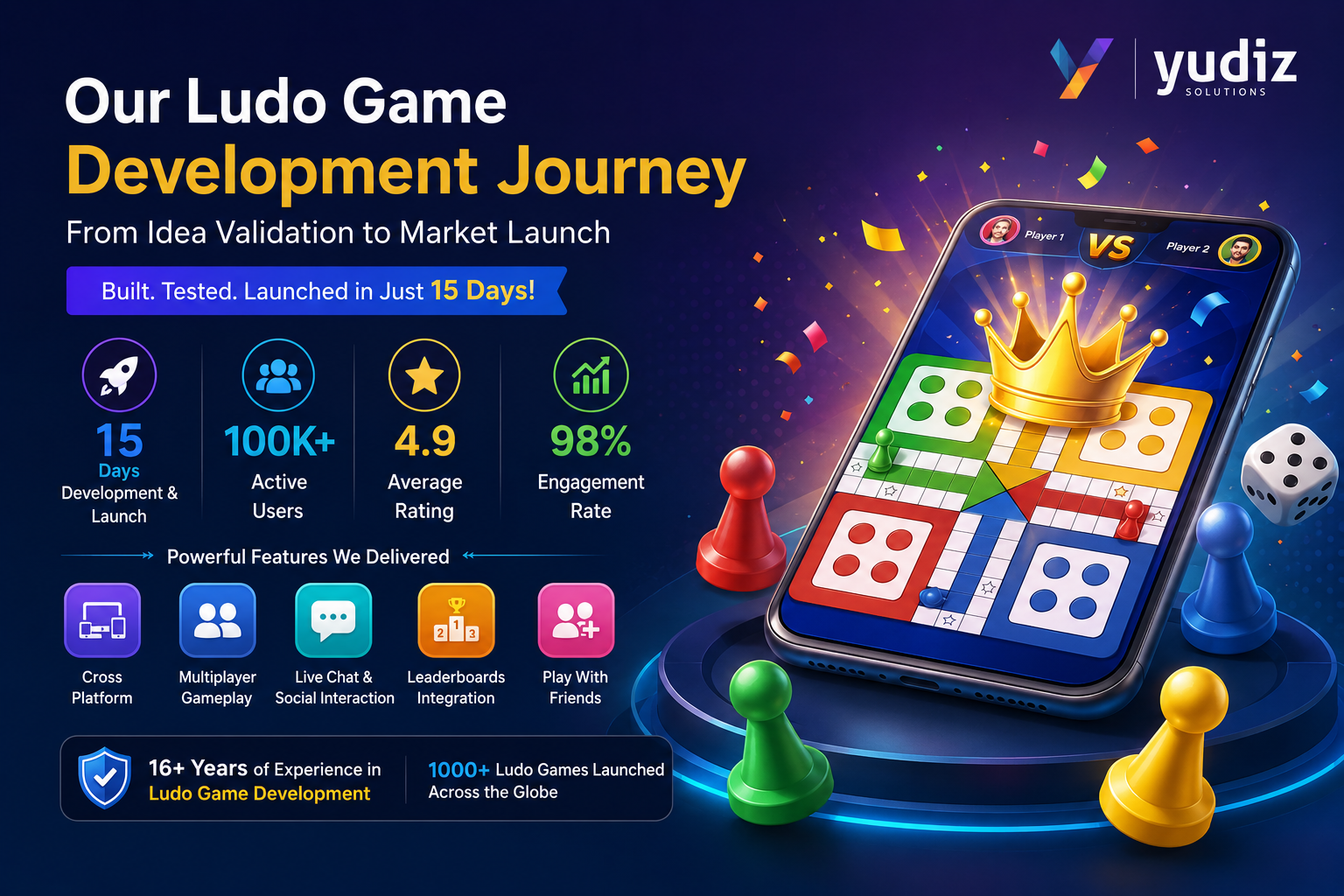
During our research, we came across Yudiz Solutions, a Ludo development company with more than 16 years of experience in game development and interactive digital products.
What immediately stood out wasn’t just their portfolio—it was the scale of their Ludo expertise.
Their team had already launched more than 1,000+ Ludo games across different business models and regions.
Even more impressive were the numbers behind those deployments:
- 1000+ Ludo game launches
- 100,000+ active users across deployed platforms
- 4.9-star average user ratings
- 98% engagement rate
- 16+ years of development experience
At that point, it became clear that we weren’t simply hiring developers.
We were working with a team that had repeatedly solved the exact challenges we were preparing to face.
The Biggest Surprise: Launching in Just 15 Days
One of our major concerns was time-to-market.
Traditional game development projects often stretch across several months. By the time a product launches, market conditions may have changed entirely.
What surprised us most was how quickly the project moved.
Yudiz Solutions helped develop and launch the initial version of our Ludo platform in just 15 days.
For anyone familiar with multiplayer game development, that timeline sounds almost impossible.
Yet the speed was achieved because many technical foundations had already been refined through years of previous implementations.
Instead of spending months solving common problems, the team focused on customization, optimization, and deployment.
This accelerated approach gave us a significant competitive advantage.
Rather than waiting months to validate our assumptions, we were collecting real user data within weeks.
Building Beyond Basic Ludo Gameplay
One lesson we learned early was that players no longer expect basic gameplay.
Modern users compare every gaming experience with the best products available in app stores.
Simply creating a digital version of the board game isn’t enough anymore.
The platform needed features that increased retention, social interaction, and engagement.
The development roadmap focused heavily on user behavior rather than just gameplay mechanics.
Multiplayer Architecture
Multiplayer functionality became the foundation of the platform.
The team implemented real-time multiplayer systems capable of supporting smooth gameplay with minimal latency.
This allowed players to:
- Join public matches
- Create private rooms
- Compete with friends
- Participate in competitive gameplay sessions
The result was significantly longer session durations and improved player retention.
Cross-Platform Accessibility
One major requirement was ensuring players could access the game from multiple devices.
Cross-platform support eliminated barriers between users.
Whether players joined through Android, iOS, or other supported environments, the experience remained consistent.
This decision expanded our potential audience immediately and simplified future scaling efforts.
Play-With-Friends Functionality
One feature that generated remarkable engagement was the ability to invite friends directly into matches.
While it sounds simple, this functionality became a powerful growth driver.
Instead of relying solely on paid acquisition, existing users naturally introduced new players into the ecosystem.
This created a sustainable user acquisition loop that reduced marketing dependency.
Social Features That Increased Retention
A common mistake in game development is focusing exclusively on gameplay while ignoring community-building features.
The team emphasized social engagement from the beginning.
Live Chat Integration
Players wanted more than competition.
They wanted interaction.
Live chat functionality allowed users to communicate during matches, celebrate wins, and engage with friends in real time.
This seemingly small addition created a stronger sense of community around the game.
As engagement metrics increased, we began seeing players returning not only for gameplay but also for social interaction.
Leaderboards and Competitive Motivation
Leaderboards introduced another important behavioral driver.
Competitive users naturally seek recognition.
By displaying rankings and achievements, players became motivated to:
- Play more matches
- Improve performance
- Challenge friends
- Maintain rankings
The impact on retention was noticeable.
Many returning users cited leaderboard progression as one of their primary motivations for continued gameplay.
Solving Scalability Before It Became a Problem
One of the most valuable decisions made during development was designing for scale from the beginning.
Many gaming startups optimize only for launch.
The problem emerges when growth arrives.
Server instability, matchmaking issues, and performance bottlenecks quickly damage user trust.
The experience of the development team became particularly valuable here.
Because they had already delivered over 1,000 Ludo game projects, they anticipated scaling challenges before they appeared.
Instead of reactive fixes, the platform was designed proactively.
As user activity increased, the infrastructure remained stable and responsive.
This prevented costly redevelopment cycles later.
Understanding the Metrics That Matter
Many game founders focus heavily on download numbers.
What we learned is that downloads alone tell very little about product success.
Engagement metrics provide a much clearer picture.
Some of the benchmarks we observed from Yudiz Solutions‘ broader portfolio were particularly impressive:
98% Engagement Rate
Engagement remains one of the most difficult metrics to improve in mobile gaming.
A high engagement rate typically indicates:
- Strong user experience
- Effective game mechanics
- Meaningful social interactions
- Consistent player retention
Seeing engagement levels approach 98% demonstrated the effectiveness of the feature framework being implemented.
4.9-Star User Ratings
App store ratings significantly influence organic growth.
Maintaining a 4.9-star average across deployed products reflects consistent attention to user satisfaction.
High ratings often lead to:
- Better visibility
- Increased trust
- Higher conversion rates
- Improved retention
100,000+ Active Users
Active users represent real-world validation.
Many products achieve downloads.
Far fewer maintain active communities.
The ability to support over 100,000 active users demonstrated that the underlying systems were built for long-term growth rather than short-term launches.
Lessons We Learned During the Development Process
Several insights emerged from this experience that may help other businesses considering Ludo game development.
Speed Creates Opportunity
Launching faster allowed us to collect user feedback earlier.
Instead of debating assumptions internally, we observed actual player behavior and adjusted accordingly.
Experience Reduces Risk
Every technical challenge seems unique until you work with a team that has solved it hundreds of times before.
Prior experience dramatically reduced uncertainty throughout development.
Features Drive Retention
Gameplay attracts users initially.
Social features, multiplayer systems, leaderboards, and community interactions keep them returning.
Scalability Should Never Be Delayed
Planning for growth during development is far less expensive than rebuilding systems after launch.
Why We Recommend Experienced Ludo Development Teams
If there’s one takeaway from our journey, it’s that specialized expertise matters.
Many developers can build a game.
Far fewer understand the nuances of multiplayer architecture, retention mechanics, player engagement systems, social interactions, matchmaking, scalability, and monetization strategies specific to Ludo.
Working with a team that had spent over 16 years refining these systems accelerated every stage of our project.
Instead of reinventing proven solutions, we focused on creating a product that delivered value to players from day one.
Final Thoughts
Our Ludo game development journey reinforced an important principle:
Success rarely comes from having a great idea alone.
It comes from validating quickly, executing efficiently, learning from user behavior, and partnering with people who have already navigated similar challenges.
From idea validation to a successful market launch, the ability to leverage proven expertise significantly shortened our learning curve and reduced development risks.
Looking back, the decision to work with an experienced game development company made a measurable difference in speed, quality, and scalability.
When a team can help launch a Ludo platform in just 15 days, bring experience from over 1,000 game launches, support 100,000+ active users, maintain a 4.9-star rating, achieve 98% engagement, and deliver advanced features such as multiplayer gameplay, cross-platform compatibility, live chat, leaderboards, and play-with-friends functionality, the results speak for themselves.
For businesses exploring opportunities in Ludo game development, choosing a partner with proven execution experience can be one of the most important decisions in the entire journey.