

OpenRouter positioned itself as a leader in 2024 and 2025. Developers needed a single endpoint through which they could reach GPT, Claude, Gemini, and a long list of open-source models. OpenRouter provided that endpoint. But once development teams start scaling from prototypes to production, problems arise. Enter stage left: the AI API gateway platforms of 2026 ready to step into OpenRouter’s upcoming gaps.
Let’s Start with What OpenRouter Does
At a high level, OpenRouter excels as a proof of concept platform. Teams can get up and playing with multiple LLMs via API very quickly. Where OpenRouter starts to lose functionality, however, is at scale. First, OpenRouter has no self-hosting capability. All requests are routed through OpenRouter’s own infrastructure which presents problems for companies that need to meet data residency requirements, SOC 2 compliance, or private network mandates.
Additionally, OpenRouter marks up all credit purchases with a small fee. That surcharge applies against all dollars spent in the API, quickly becoming expensive as API volume grows. Thirdly, the platform does not provide semantic caching. Every request, whether unique or not, traverses all the way back to the provider’s API without any caching or cost savings for high-volume teams.
Governance features are also weak. There is no ability to enforce per-team budgets, manage virtual keys per consumer, or provide role-based access controls around who can access which models. This isn’t ideal for enterprise customers that need to enforce permissions around data access.
Stepping into the Breach with Open Router Alternatives
The best OpenRouter alternatives being released in 2026 focus on providing more than API aggregation. These platforms add value via governance, caching, monitoring, and control of requests in addition to routing them. What sets these OpenRouter alternatives apart is their focus on production-scale needs like automatic failover, latency optimization, unified billing, and compatibility with existing OpenAI SDK codebases.
Compatibility with the OpenAI Software Development Kit is critical. While OpenRouter doesn’t technically lock customers into using it, teams are required to manage separate sets of credentials, not to mention rewrite URL pathing. But for APIs that are OpenAI-SDK compatible, switching costs are almost nonexistent. Developers can point their existing codebase to a new provider by swapping only two values: the API key and base URL.
MixRoute Steps into the Ring
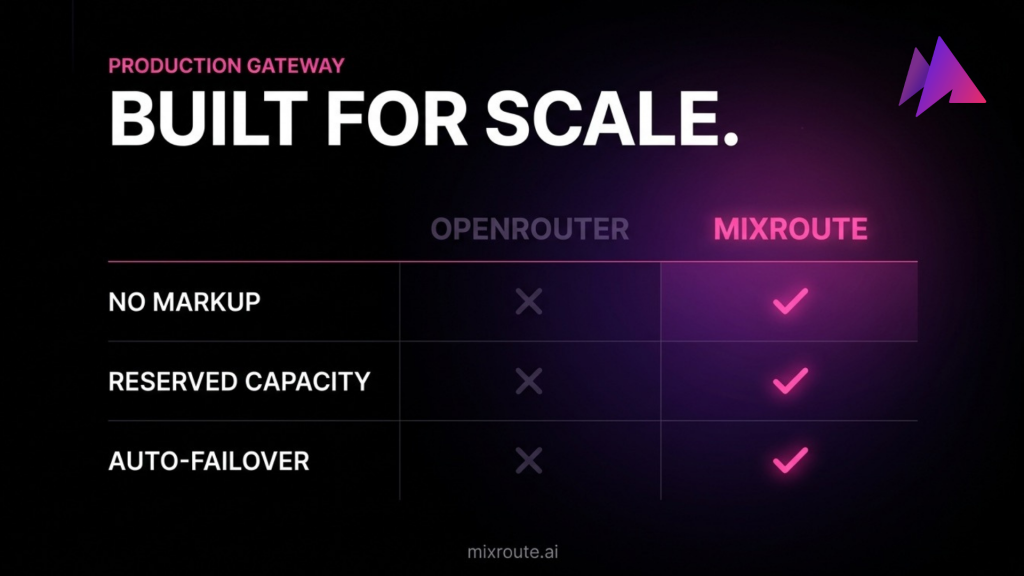
MixRoute.ai is launching directly into this space. The MixRoute API provides users access to 200+ AI models via a single API key, with no added markup on cost. While OpenRouter applies a 5.5% fee to all credits purchased through their platform, MixRoute bills users directly at provider cost.
MixRoute’s cloud reseller agreements with AWS, GCP, and Azure also means the platform has access to reserved capacity and automatic failover. Production-ready API gateway tools need to be able to handle sudden spikes in traffic and MixRoute has built those tools into the platform. Developers trust MixRoute for scheduler-spanning, failover-ready AI requests. Plus, a single billing dashboard makes cost tracking easy.
MixRoute API is also fully compatible with OpenAI’s SDK. Switching away from OpenRouter is as simple as changing API keys and the endpoint URL. No code refactoring required.
OpenRouter Alternatives? Think Large Scale
Small differences in API gateway platforms tend to hide at low volume. But once you start sending hundreds of requests per second or managing access for multiple teams, those gaps widen. API latency is an amplifying cascade on long chain-of-thought prompts or large agentive workflows. Price differentials that seemed insignificant become budget casualties when factored at scale. And self-governing development teams are one thing; scaling permissions into enterprise tier compliance requirements is quite another.
That’s why the conversation around OpenRouter alternatives is changing this year. It’s not about who supports the most models anymore. It’s about which platforms can support production AI systems.