
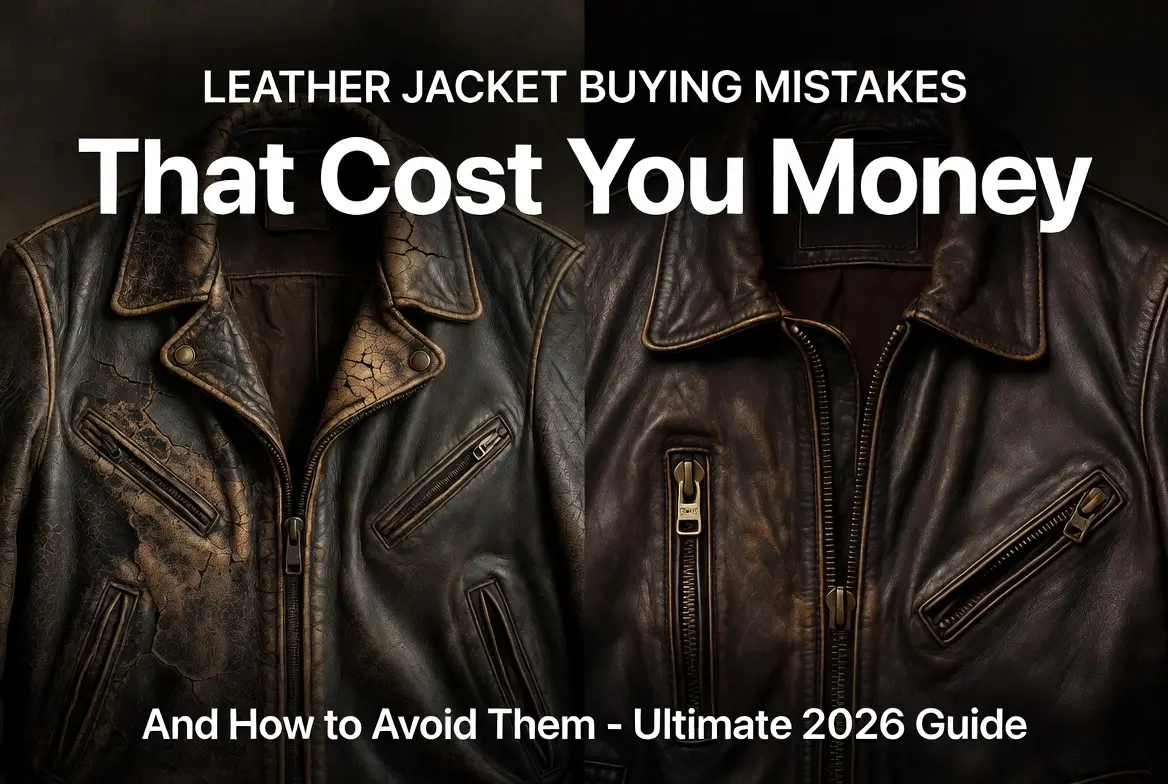
Buying a leather jacket isn’t just a simple purchase; it’s a worthwhile investment. Good jackets last you for decades; they age beautifully, and become your wardrobe staple. Bad ones fray after two seasons, do not fit properly, and leave you wishing you could get every penny back from your wallet. The sad thing is that a vast majority of these mistakes could have been easily avoided.
Even if it’s your first time buying a leather jacket or second time after having made the mistake previously, knowing how to spot mistakes will save you money. This article will discuss 10 of the most common mistakes people make when purchasing leather jackets and how to avoid them in order to protect your hard-earned money.
Mistake 1: Not Understanding the Difference Between Leather Types
This is the costliest mistake a consumer could make. Entering the process of purchasing a leather jacket without first learning about the different types of leather would be equivalent to buying a vehicle without first knowing the differences between sedans and trucks. There are four basic types: full-grain leather, top-grain leather, genuine leather, and bonded leather; and the difference among them is huge.
Full-Grain Leather
The full-grain leather refers to the skin’s surface layer, which still has all its natural markings on it. It is the strongest, the most porous, and the most costly leather type. As it ages, full-grain leather will develop its natural patina, making the piece more and more beautiful with each passing year. If you find yourself paying a hefty price for a leather jacket, chances are it uses full-grain leather.
Top Grains Leather
This kind of leather is buffed and sanded to make it smooth and have a consistent look. This leather is not very tough, but its durability is less than the full grains one. This type of leather is commonly used for middle to upper range leather jackets. This is the best choice among others when it comes to cost and quality.
Genuine Leather and Bonded Leather
This is one leather type that can mislead you. Genuine leather, although its name suggests otherwise, is one of the worst types of leather. The skin used to manufacture genuine leather is obtained from the inside of the hide once the outside layers are stripped off. Bonded leather, on the other hand, is obtained from the leather scraps glued together using polyurethane. Both types of leather are not durable, are prone to cracking and are generally a disappointment to customers.
Bottom line
Whenever you are shopping for leather products, ask for information about the leather grade first before purchasing.
Mistake #2: Focusing Too Much On Cost
Money does make a difference to most consumers, but you don’t need to be stingy about spending money on a piece of clothing you plan on wearing frequently. The mistake comes from making the cost more important than the quality of the garment, not taking into account future expenses related to its use.
It is best to apply a simple cost-per-wear ratio when shopping for jackets or any other product. Let’s say that you are looking for a great leather jacket, one that you’ll be able to wear for the next ten years, with an initial investment of 500 dollars. Now, imagine you find a similar jacket with a different material at a lower price. It seems to cost less money. However, it is only going to last for two years. In total, it will end up costing you way more money. A quality jacket is going to be more expensive, while a cheap one will make you pay more for repairs or replacement.
Determine your budget limits and set boundaries in which you can afford to shop comfortably. Inside this range, look into materials used to make a jacket, its construction, and hardware used.
Mistake #3: Getting a Poor Fit
Fit is no trifling matter in leather jacket selection; rather, fit is everything. While an out-of-fit cotton blazer can be adjusted by any competent tailor at little cost, a leather jacket can be a very costly and complicated thing to customize. Having the sleeves of a leather jacket shortened, for instance, can cost almost as much as the jacket itself.
The most frequent fit mistake made is to get a too-large leather jacket, thinking that it needs to be big to accommodate a bulky appearance in the shoulders and chest. Let me tell you something: a good leather jacket should actually feel a bit tight when first put on because, over time, the jacket will conform to your physique.
Important fit factors to consider before purchase:
1. Shoulder line: Your shoulder seams should rest at the very top of your shoulder blade, not down onto the arm.
2. Chest size: There should be room for two fingers, not three or four.
3. Sleeve length: Arm resting by your side, your sleeve should extend to the wrist-bone.
4. Length: Ideally, your jacket will come up only to or slightly below your natural waist.
Mistake #4: Neglecting Lining Quality
It’s not visible from outside, but the lining determines your comfort when wearing the jacket. A bad lining will rip easily, bunch, retain water, and make it difficult to put the jacket on top of an arm. The good one ensures smooth movement and temperature regulation. It also tells you that the maker cared about making the whole product instead of just showing off on the exterior.
When purchasing a quality leather jacket, make sure it features a lining made of viscose or silk blend materials. Polyesters are more common in cheaper versions, and this material itself isn’t necessarily bad, yet poor quality plastic-feeling polyesters tell you all about the same quality of other parts of the jacket. To make sure you purchase a quality leather jacket, feel its lining when buying one.
Mistake #5: Not Considering the Quality of the Zippers and Hardware
Your leather jacket’s zipper is going to go up and down many, many times throughout its lifetime. It will open and close in all kinds of weather conditions, whether it’s freezing outside or sweltering hot or even raining. Hardware is not something that is just added for looks – it is vital to the structure of the piece of clothing you are buying.
The YKK name on a zipper is what you want to see when you are buying a quality garment. Brass or zinc alloy zippers and hardware on D-rings and snaps indicate a company that did not skimp on details when putting together your jacket. Light zippers that have a hollow sound to them should be avoided no matter how nice the leather may look.
Mistake 6: Buying the Right Style That Doesn’t Fit Your Real Life
There is a wide variety of leather jacket styles available – there is the traditional motorcycle style, the bomber style, the trucker style, the racer style, and also the cafe-racer style. There are several factors associated with each style, which makes them suitable for various occasions. However, the problem here is that buyers choose the style just because it looks amazing in pictures or when hung on a hanger – but forget to consider whether this style matches their real life.
A jacket covered with numerous studs may seem like a great choice until you put it on for a business trip, which requires being more professional. Similarly, a tailored smooth leather blazer may be the right choice for work but look rather bland for streetwear. So, before buying a jacket, there are three important questions that should be asked. Where will I mostly use this jacket? What clothes already do I have that match this one? Is this style suitable for me?
Mistake No.7: Not Accounting for Break-in Time
It comes as no surprise that new leather jacket buyers are dismayed when they buy an excellent leather jacket only to discover that it’s not soft but very rigid. However, this is how high quality leather jackets behave initially. Leather needs time to break down into something softer, more flexible and more suited to the individual wearer’s form.
What buyers do wrong is that they return their jackets after wearing them for a few days only because they find them too stiff or go even further to purchase a very soft leather jacket thinking that this one is more suitable than the previous one. Soft leather jackets right from the get-go are usually bonded leather or poor quality leather.
Mistake 8: Lack of a Leather Jacket Maintenance Strategy
Natural leather demands regular upkeep. If you choose a leather jacket without any idea of how you will maintain it, you are inviting early cracking and fading problems. Of all types of regrets concerning leather jackets, this is one of the easiest to avoid.
The minimum care that should be given to your leather jacket should include:
- Regular conditioning of the jacket every three to six months to protect against drying and cracking using good quality leather conditioner.
- Storing the leather jacket on a wide leather hanger and not folding it as this results in creasing and damaging the jacket.
- Keeping the jacket away from sources of heat or light since both of these contribute to drying and fading.
- Addressing any case of moisture from rain by gently blotting it until completely dry.
Mistake #9: Putting Marketing Language Ahead of Materials
Leather fashion products contain plenty of marketing buzzwords meant to elevate common products into extraordinary items. Words such as premium, genuine, real, authentic, and hand-crafted are thrown around so frequently, especially by brands without any regulatory oversight, that they have lost all of their meaning. An authentic leather jacket that is affordable tells you very little about what you are purchasing.
Educate yourself in the art of looking past marketing to ask direct questions. Questions regarding the leather grade, type of animal skin used, location of tanning process, and material composition such as whether or not it is full-grain or top-grain leather should be asked. Quality brands using quality materials should be able to answer these questions easily and specifically. Marketing brands are unable to answer these questions precisely, so they rely on buzzwords.
If researching online, it is important to focus on resources that offer an honest description of the product. Resources such as Black Leather Jacket are informative in providing information about materials used and manufacturing processes, and such resources will ensure that you will not spend too much money on a marketing ploy.
Mistake 10: Not Checking Return Policy and Warranties
Even if you follow every tip and suggestion, the leather jacket you purchase online might not look or feel like how you wanted. It’s hard to get colour consistency through computer screens. Different leather batches vary in texture. Even if you’ve followed the sizing guidelines, it could still turn out to be off just a little bit. All of this isn’t because you made a mistake. Buying leather products is a gamble.
When making purchases, take some time to carefully read the return policy. When must you return the jacket within? Is the cost of returning it going to be covered? Will there be any fees for returning the product? Will there be any warranties offered against manufacturing problems? Reliable brands with faith in their product tend to have excellent policies when it comes to refunds and warranties.
Additional Insight: Type of Hide Also Makes a Difference Beyond What Most Consumers Understand
Not only does the quality of leather make a difference, but the animal from which it comes matters too. Cowhide is the strongest leather material available. The leather from cow is thick, durable, and ages beautifully. It is the leather of choice for motorcycle-style and everyday rugged clothing.
Lambskin leather is smooth and lightweight with a very high level of softness and suppleness right out of the box. For individuals who are looking for something more stylish and fashion-forward, it is unmatched. The main difference between lambskin leather and cowhide is that the former is more fragile.
Goatskin leather lies somewhere between these two. Its natural pebbly surface is extremely water-resistant and durable, and it is softer than cowhide. It is not widely known among consumers, but it is greatly loved by leather aficionados.
To Conclude This:
A quality leather jacket is among the most valuable investments you can make into your wardrobe. Such a garment surpasses fashion and time itself. It ages well. It speaks volumes about you. However, that is all conditional upon buying a good quality jacket to begin with.
The avoidance of these ten mistakes not only prevents you from spending unnecessary money on low-quality leather jackets in the short term but will fundamentally alter your perception of owning such garments altogether. The leather jacket you purchase should not be something you will dispose of in two years but rather have with you for decades to come.
Be knowledgeable of the different leather grades. Be mindful of the fit and finish. Pay attention to the hardware used. Know the differences between the hides. Be informed about the return policies. Make sure you are purchasing your leather jacket from sources who share the same regard for the craft as you do.