
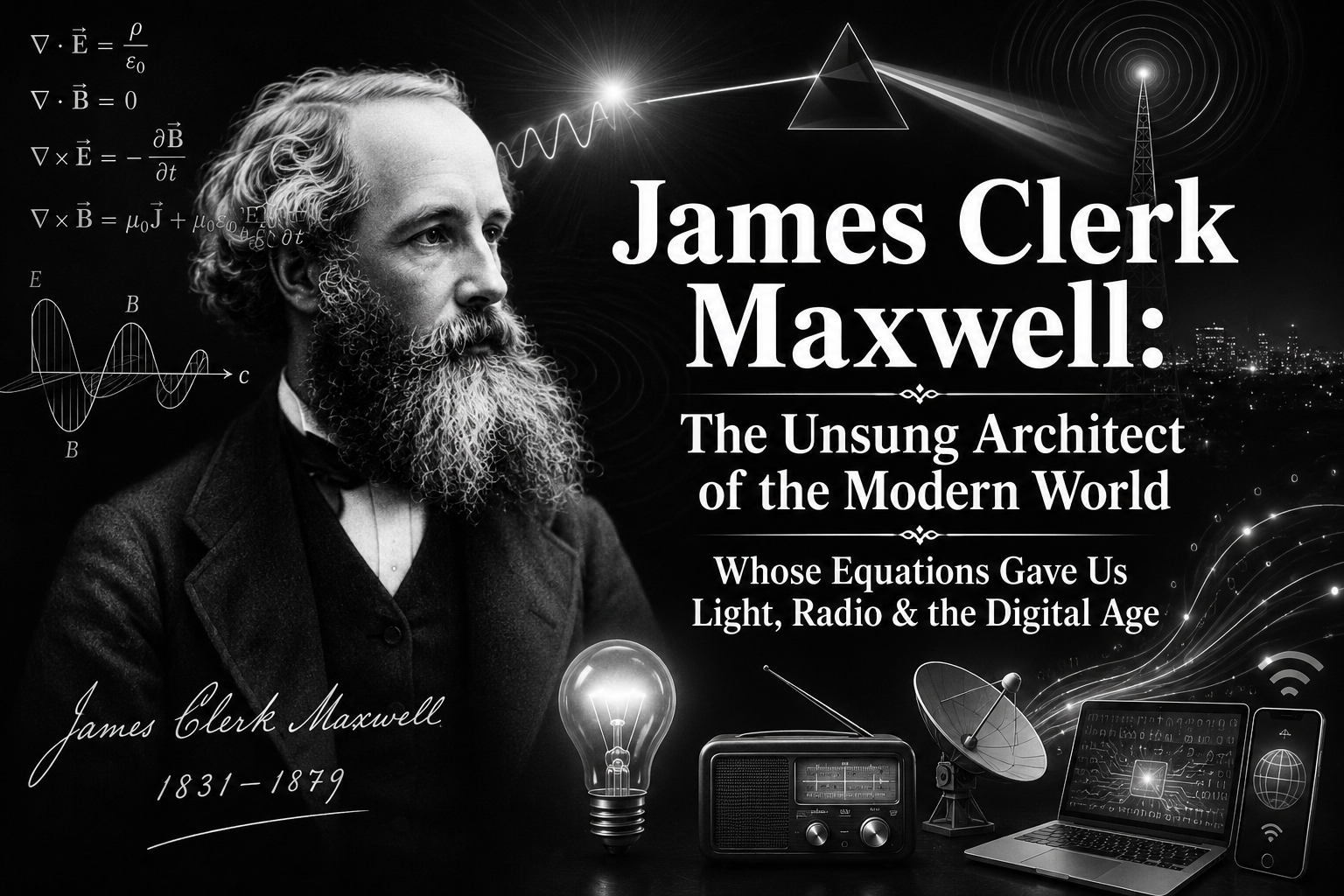
Every time you make a phone call, stream a video, or connect to WiFi, you are living proof of one man’s extraordinary genius. James Clerk Maxwell, the brilliant Scottish physicist born in Edinburgh in 1831, is arguably the most underrated scientist in all of human history. While Newton and Einstein stand as household names, james clerk maxwell built the very mathematical and scientific foundation upon which our entire modern technological world rests. His revolutionary contributions to classical electromagnetism, thermodynamics, color photography, and mathematical physics reshaped science so profoundly that Albert Einstein openly called him his greatest hero. This is the powerful, inspiring, and long overdue story of that remarkable man and the timeless ideas that continue to light our world today.
The Making of a Brilliant Mind (1831-1850)
James Clerk Maxwell was born on June 13, 1831, in Edinburgh, Scotland, into a well-educated family with a deep love of inquiry and science. From his earliest childhood, he displayed an insatiable hunger to understand how the physical world worked. At the astonishing age of just 14, he published his first scientific paper on the geometry of oval curves at the University of Edinburgh, drawing genuine admiration from professors twice his age.
He went on to study at Trinity College, Cambridge, graduating with distinction in the Mathematical Tripos in 1854 and establishing himself as one of the finest mathematical minds of his generation. His deep command of mathematics would prove to be his most powerful weapon. Where other scientists saw confusing physical phenomena, james clerk maxwell saw patterns, symmetries, and equations waiting to be written. This rare combination of physical intuition and mathematical mastery set the stage for discoveries that would outlast his tragically short life.
Maxwell’s Equations: The Four Laws That United the Universe (1861-1865)
The supreme achievement of james clerk maxwell is his four electromagnetic equations, first published in complete form in 1865 in his landmark paper “A Dynamical Theory of the Electromagnetic Field.” These equations represent the most elegant and powerful synthesis in the history of classical electromagnetism. In their modern differential form, they are:
∇ · E = ρ/ε₀
∇ · B = 0
∇ × E = −∂B/∂t
∇ × B = μ₀J + μ₀ε₀ ∂E/∂t
The first equation is Gauss’s Law, describing how electric charges create electric fields. The second states that magnetic monopoles do not exist in nature. The third is Faraday’s Law of induction, showing that a changing magnetic field generates an electric field. The fourth is the Ampere-Maxwell Law, where maxwell electromagnetic theory makes its boldest and most original statement: a changing electric field generates a magnetic field even in empty space. This addition of the displacement current term μ₀ε₀ ∂E/∂t was Maxwell’s own groundbreaking contribution and the master key that unlocked the entire universe of electromagnetic waves.
Together, these four laws achieved the unification of electricity and magnetism into a single breathtaking theory, completing one of the greatest intellectual achievements in the history of modern physics. Every radio antenna, every fiber optic cable, and every wireless device on Earth operates on the principles contained in these four lines of mathematics.
The Electromagnetic Wave and the Speed of Light
From his four equations, james clerk maxwell derived one of the most stunning predictions in all of science. He demonstrated mathematically that electric and magnetic fields could propagate through empty space as a wave. He then calculated the speed of that wave using two known physical constants:
c = 1/√(μ₀ε₀)
Substituting the measured values of the permeability of free space μ₀ and the permittivity of free space ε₀, Maxwell arrived at approximately 3 × 10⁸ meters per second. This was precisely the known speed of light. Maxwell made the electrifying conclusion that light itself is an electromagnetic wave, a discovery that united optics and electromagnetism in a single stroke. This result also predicted the existence of the entire electromagnetic spectrum, including radio waves, microwaves, infrared radiation, ultraviolet light, X-rays, and gamma rays, all of which were later confirmed experimentally. Heinrich Hertz verified the existence of radio waves in 1887, directly validating Maxwell’s prediction.
Faraday and Maxwell: The Greatest Scientific Partnership in History (1855-1865)
The history of electromagnetism cannot be told without honoring both pillars that support it. Faraday and Maxwell represent one of the most iconic and productive relay races in the entire history of science. Michael Faraday, the brilliant self-educated experimentalist, spent decades uncovering the physical reality of electric and magnetic fields through meticulous hands-on work. He developed the concept of lines of force, sensing deeply that electricity and magnetism were profoundly connected, but he lacked the mathematical language to express this connection in a universal and predictive form.
James Clerk Maxwell stepped in and provided exactly that language. He transformed Faraday’s physical intuitions into precise mathematical equations with extraordinary skill, writing that his primary goal was simply to give rigorous mathematical form to the ideas Faraday had uncovered experimentally. The partnership was perfect and historic: Faraday supplied the experimental truth, and james clerk maxwell supplied the mathematical framework that made that truth universal. Without this partnership, the foundations of modern physics might have taken decades longer to emerge. Together, they built the entire edifice of classical electromagnetism that engineers and physicists still rely on today.
The First Color Photograph: Maxwell’s Brilliant Visual Discovery (1861)
The genius of james clerk maxwell was never confined to a single field. In 1861, he produced the world’s first color photograph, a landmark moment that beautifully demonstrated his groundbreaking color vision theory. Maxwell proposed that human color perception results from three types of receptors in the eye, each sensitive to red, green, or blue light. To prove this experimentally, he photographed a tartan ribbon three times using three different colored filters: red, green, and blue. He then projected all three images simultaneously, combining them into a single full-color composite image.
This experiment confirmed his theory of additive color mixing and laid the direct foundation for color photography, color film, color television, and the RGB color model used in every digital screen in the world today. Maxwell’s color vision theory remains the essential basis of all modern imaging technology, from cinema cameras to the screen on which you are reading these words.
The Maxwell-Boltzmann Distribution and the Kinetic Theory of Gases
Beyond electromagnetism and optics, james clerk maxwell transformed the science of thermodynamics and laid the groundwork for statistical mechanics. Working alongside Ludwig Boltzmann, he developed a complete statistical description of how molecules in a gas move and distribute their speeds at a given temperature. The result was the maxwell boltzmann distribution, expressed as:
f(v) = 4π (m/2πkT)^(3/2) v² e^(−mv²/2kT)
In this equation, m is the molecular mass, k is Boltzmann’s constant, T is the absolute temperature, and v is the molecular speed. This powerful distribution function revealed that gas molecules do not all travel at the same speed but follow a precise and predictable statistical pattern determined entirely by temperature. This was a revolutionary and daring application of probability theory to physics.
The kinetic theory of gases developed by james clerk maxwell explained macroscopic properties such as pressure and temperature directly in terms of the microscopic behavior of atoms and molecules. It laid the essential foundation for statistical mechanics and made crucial contributions that later fed into the development of quantum mechanics.
Maxwell’s Demon: The Thought Experiment That Shook Thermodynamics (1867)
In 1867, James Clerk Maxwell conceived one of the most celebrated and influential thought experiments in the entire history of physics, now universally known as the maxwell demon. He imagined a tiny intelligent being controlling a small door between two chambers filled with gas. By selectively allowing only fast-moving molecules to pass in one direction and only slow-moving molecules in the other, this demon could theoretically reduce the entropy of the system without performing any work, appearing to violate the second law of thermodynamics.
This deceptively simple but devastatingly clever puzzle captivated physicists for well over a century. The resolution finally came in the 20th century, when scientists demonstrated that the process of measuring and storing information about each molecule must itself generate entropy, thereby preserving the second law. Maxwell’s demon became a foundational concept in information theory and the thermodynamics of computation, influencing everything from the physics of black holes to the theoretical limits of modern computing.
Saturn’s Rings and the Power of Mathematical Physics (1859)
One of the most impressive and underappreciated demonstrations of james clerk maxwell’s mathematical genius came in 1859, when he tackled the long-standing scientific mystery of Saturn’s rings. At the time, scientists were genuinely uncertain whether the rings were solid, liquid, or composed of countless separate particles. Maxwell applied vector calculus and rigorous mathematical analysis to prove conclusively that a solid or liquid ring would be gravitationally unstable and would inevitably shatter. The only stable configuration was a vast collection of small, independent particles each orbiting Saturn separately.
More than a century later, when NASA’s Voyager probes reached Saturn, they confirmed Maxwell’s mathematical prediction in complete and precise detail. It was a triumphant and humbling vindication of the extraordinary power of mathematical physics applied with courage and rigor.
Why Einstein Called Maxwell His Greatest Hero
Albert Einstein kept only three portraits on the wall of his personal study: Isaac Newton, Michael Faraday, and James Clerk Maxwell. Einstein was explicit and eloquent in his admiration, stating that Maxwell’s work represented the most profound and fruitful transformation that physics had experienced since the time of Newton. This was no empty praise from a man who chose his words carefully.
Einstein recognized that the unification of electricity and magnetism achieved by james clerk maxwell contained the seeds of his own greatest discovery. Maxwell’s equations predicted that the speed of light is constant for all observers regardless of their state of motion. This result was fundamentally and irreconcilably incompatible with Newton’s classical mechanics. Einstein spent years wrestling with this breathtaking contradiction, and resolving it led him directly to the special theory of relativity in 1905. In the deepest and most literal sense, james clerk maxwell handed Einstein the central problem that changed physics forever, and Einstein was wise and honest enough to acknowledge it completely.
FAQs About James Clerk Maxwell
What are Maxwell’s four equations and why do they matter?
Maxwell’s four equations are the mathematical laws governing how electric and magnetic fields are created, interact, and propagate through space. They are Gauss’s Law for electricity, Gauss’s Law for magnetism, Faraday’s Law of induction, and the Ampere-Maxwell Law. Together they form the complete theory of classical electromagnetism, predict the existence of electromagnetic waves including light, and underpin every modern communication technology from radio to WiFi.
Why is James Clerk Maxwell called the father of modern physics?
James clerk maxwell is frequently described as the father of modern physics because his unification of electricity, magnetism, and light created the first complete field theory in science. His equations directly inspired Einstein’s special theory of relativity, and his statistical mechanics contributed decisively to the foundations of quantum mechanics, making him the critical intellectual bridge between classical and modern physics.
How did Maxwell’s equations directly lead to Einstein’s special relativity?
Maxwell’s equations embedded within them the extraordinary fact that the speed of light is constant for all observers regardless of their motion. This finding was irreconcilable with Newtonian mechanics. Resolving this fundamental contradiction was precisely the challenge that drove Albert Einstein to formulate the special theory of relativity in 1905.
What is the significance of the Maxwell-Boltzmann distribution?
The Maxwell-Boltzmann distribution describes statistically how molecules in a gas distribute their speeds at a given temperature. It was the first successful application of probability theory to physics, forming the cornerstone of statistical mechanics and directly contributing to the later development of quantum mechanics and modern thermodynamics.
What was Maxwell’s contribution to color science?
James clerk maxwell demonstrated in 1861 that all colors can be produced by combining red, green, and blue light in different proportions, a principle known as additive color mixing. He proved this by creating the world’s first color photograph. This discovery is the direct scientific foundation of all modern color imaging, from photography and cinema to digital screens and television.
Conclusion
The legacy of james clerk maxwell is written permanently and deeply into every corner of the modern world. His four equations unified electricity, magnetism, and light. His color vision theory gave birth to color photography and all digital imaging. His kinetic theory of gases transformed thermodynamics and seeded statistical mechanics. His thought experiments like Maxwell’s demon reshaped the boundaries of physics and information theory. And his mathematical framework gave Einstein the foundation for the theory of relativity. James Clerk Maxwell lived only 48 extraordinary years, yet the world he built with his equations and ideas has endured for over a century and will continue to endure for centuries more. If the history of science has one unsung hero who deserves to stand beside Newton and Einstein in every classroom and every conversation, it is this quietly magnificent man from Edinburgh whose brilliant, restless mind changed everything we know.