
Starting a food business is one of the most rewarding ways to become your own boss. But before you preheat the oven or sketch out your first menu, one question tends to stop people in their tracks: how much money do I actually need?The honest answer is that it depends on the kind of food business you want to build. A home bakery has very different startup costs than a full restaurant or a packaged snack brand. This guide takes the guesswork out of launching, breaking down every major expense so you can build a realistic budget and get going with confidence.
Why 2026 Is a Strong Year to Launch
To start the right way, though, you need a clear picture of your costs from day one. Let’s walk through them.
The 7 Major Startup Costs for a Small Food Business
1. Business Registration and Legal Fees
You must legally register your business before you can sell a single product. Prices vary by location, but here’s a general breakdown:
- Business name registration: $50 to $150
- LLC or sole proprietorship filing: $50 to $500, depending on your state or country
- Food handler’s permit: $15 to $100
- Food business license: $100 to $500 per year
- Cottage food permit (for home-based businesses): Free to $200
Estimated total: $200 to $1,500
This cost is non-negotiable. Operating without the right permits can result in fines or forced closure, so get it done first.
2. Commercial Kitchen Setup or Rental
Your kitchen is where your product comes to life, so it has to meet food safety standards. You have three realistic paths:
Home kitchen upgrade. If your local cottage food laws allow home-based production, you may only need minor improvements such as a dedicated prep area, proper storage, and a commercial-grade mixer or oven. Budget $500 to $3,000.
Commercial kitchen rental. Many founders rent shared commercial kitchen space by the hour, typically for $15 to $40 per hour. At 20 hours a month, that’s $300 to $800 monthly.
A full kitchen buildout. Constructing your own small commercial kitchen runs $10,000 to $50,000 or more, depending on equipment and location.
Estimated total: $500 to $50,000, depending on your model
For most new food businesses, starting in a home kitchen or rented shared space is the smartest financial move.
3. Equipment and Supplies
Equipment costs depend heavily on what you’re making. Here are typical ranges by business type:
| Business Type | Equipment Needed | Estimated Cost |
| Home bakery | Mixer, oven, baking tools | $500 – $3,000 |
| Meal prep service | Commercial pots, sealer, refrigeration | $1,000 – $5,000 |
| Frozen food brand | Freezer, vacuum sealer, blast chiller | $2,000 – $10,000 |
| Snack food brand | Packaging machine, mixing equipment | $1,500 – $8,000 |
| Takeout restaurant | Full commercial kitchen equipment | $10,000 – $50,000 |
Buy second-hand commercial equipment wherever you can. Restaurant supply auctions and used equipment dealers can cut these costs by 40 to 60 percent.
4. Food Packaging — One of Your Smartest Investments
Packaging is crucial for new food entrepreneurs; it can determine whether they win or lose customers even before anyone takes a bite. Plain, generic boxes can make even the best food look unappealing. In contrast, professional packaging that features your logo, brand colors, and a printed design conveys that you are a serious business. This positive perception helps build trust and encourages repeat orders.
What does custom packaging cost?
Pricing is determined by the quantity, material, and print options. Below is a clear breakdown of approximate costs per box based on order quantity:
| Order Quantity | Cost Per Box (Approximate) |
| 100 units | $1.50 – $3.00 per box |
| 500 units | $0.80 – $1.50 per box |
| 1,000 units | $0.50 – $1.00 per box |
| 5,000+ units | $0.25 – $0.60 per box |
For a startup order of 500 boxes featuring your logo printed in full color, budget between $400 and $750 total. This works out to less than $1 per box, making it a small investment that can significantly enhance how customers perceive your brand.
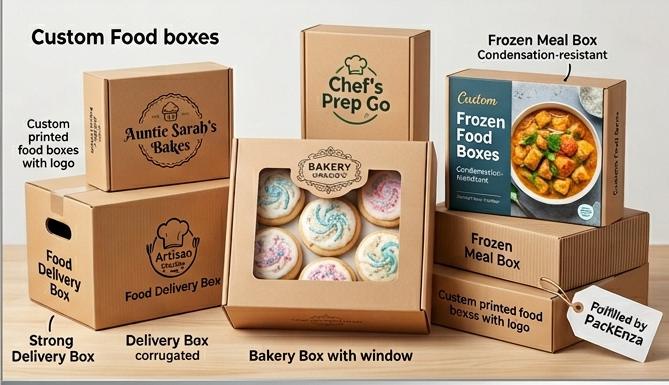
Packaging options worth trying out:
- Custom Food Boxes with logo – great for bakeries, snack brands, and retail products
- Custom frozen food boxes – moisture-resistant material for frozen meal brands
- Custom food delivery boxes – corrugated structure for takeout and delivery
- Custom Chinese food boxes – the classic folding takeout design for restaurants
- Custom printed food boxes – full-color designs that stand out on shelves and in deliveries
One advantage for newcomers: suppliers like PackEnza offer Custom Food Boxes with no minimum order quantity. You can start with 100 boxes, test your design, and increase your order as sales grow, all without spending thousands of dollars upfront.
Estimated Packaging Budget for a New Business: $300 to $1,000 for Your First Run
5. Raw Ingredients and Initial Inventory
Your first production run will need raw ingredients and the cost will depend on your product and how much you order.
- Home bakery — flour, butter, sugar, flavorings: $100 to $500 for a starter batch
- Snack food brand — nuts, spices, packaging materials: $300 to $1,500
- Frozen meals — proteins, vegetables, sauces: $500 to $2,000
- Specialty food product — varies widely: $200 to $3,000
Always calculate your cost per unit before setting a selling price. A good rule of thumb: ingredient costs should stay between 25 and 35 percent of your retail price.
Estimated total: $200 to $3,000 for initial inventory
6. Branding and Marketingr
You could make the best food on the planet, but if no one knows you exist, you won’t sell a thing. Set aside a realistic budget to put your brand in front of the right people.
Branding costs:
- Logo design — freelancer $50 to $500 / agency $500 to $2,000
- Brand identity package — colors, fonts, packaging guidelines: $200 to $1,000
- Product photography — essential for online sales: $100 to $600 per session
Marketing costs:
- Website — Shopify or WordPress with a food-friendly theme: $30 to $100 per month
- Social media ads — Instagram and Facebook for local targeting: $100 to $500 per month to start
- Farmers market or pop-up fees — $50 to $300 per event
- Delivery platform fees — Uber Eats and DoorDash charge 15 to 30 percent commission
Estimated budget: $500 to $3,000 for the first three months
7. Insurance
Food businesses carry specific risks, from product liability to kitchen accidents and delivery mishaps. Insurance protects you when something goes wrong.
- General liability insurance – $300 to $800 per year for a small food business
- Product liability insurance – $400 to $1,200 per year for packaged brands
- Commercial kitchen insurance – varies by coverage level
Estimated total: $300 to $2,000 per year
Total Startup Cost Summary
Here’s a realistic look at what different food business models cost to launch in 2026:
| Business Model | Estimated Startup Cost |
| Home bakery (small scale) | $1,500 – $5,000 |
| Meal prep or catering | $3,000 – $10,000 |
| Packaged food brand | $5,000 – $20,000 |
| Cloud kitchen | $10,000 – $30,000 |
| Small takeout restaurant | $25,000 – $75,000 |
These are estimates. Your actual numbers will depend on your location, the scale you choose, and how lean you’re willing to run in the early months.
How to Reduce Your Startup Costs
Starting lean doesn’t mean starting cheap. It means being strategic about where you spend and where you save.
Start from home if your laws allow it. Cottage food laws in many regions let you produce and sell certain products directly to consumers from a home kitchen. This eliminates your single biggest expense: commercial kitchen rental or buildout.
Order packaging with no minimum. You don’t need 5,000 boxes on day one. Suppliers like Packenza let you order in small quantities, so you get professional branded packaging without a heavy upfront commitment.
Buy used equipment. A second-hand commercial mixer or oven performs just as well as a new one at a fraction of the cost. Check restaurant supply auctions, Craigslist, and Facebook Marketplace.
Sell before you scale. Take pre-orders or sell at local markets before sinking money into inventory. Validate the demand before you spend big on production.
Lean on free tools. Canva for design, Google Business Profile for local visibility and Instagram for marketing are all free and very effective for early-stage brands.
The One Cost You Shouldn’t Cut: Packaging
When you’re watching every dollar, it’s tempting to save money with plain, generic boxes. Here’s why that’s a mistake.
Packaging is your brand’s first impression. A customer who receives a product in a plain brown box with a printed sticker feels very differently from one who opens a professionally designed box featuring your logo, your colors, and your brand story.
That second customer is more likely to reorder, more likely to recommend you to a friend, and more likely to share your product on social media.
The Bottom Line: Is 2026 a Good Year to Start a Food Business?
Yes, if you plan it right.
The food industry is huge and growing, and that means tons of opportunities for small, independent brands. It’s more accessible to get into than many people think. You don’t need a huge budget to start a real business that draws real customers and makes consistent money.You need a plan, realistic cost expectations, professional and a willingness to start small and grow from there.