
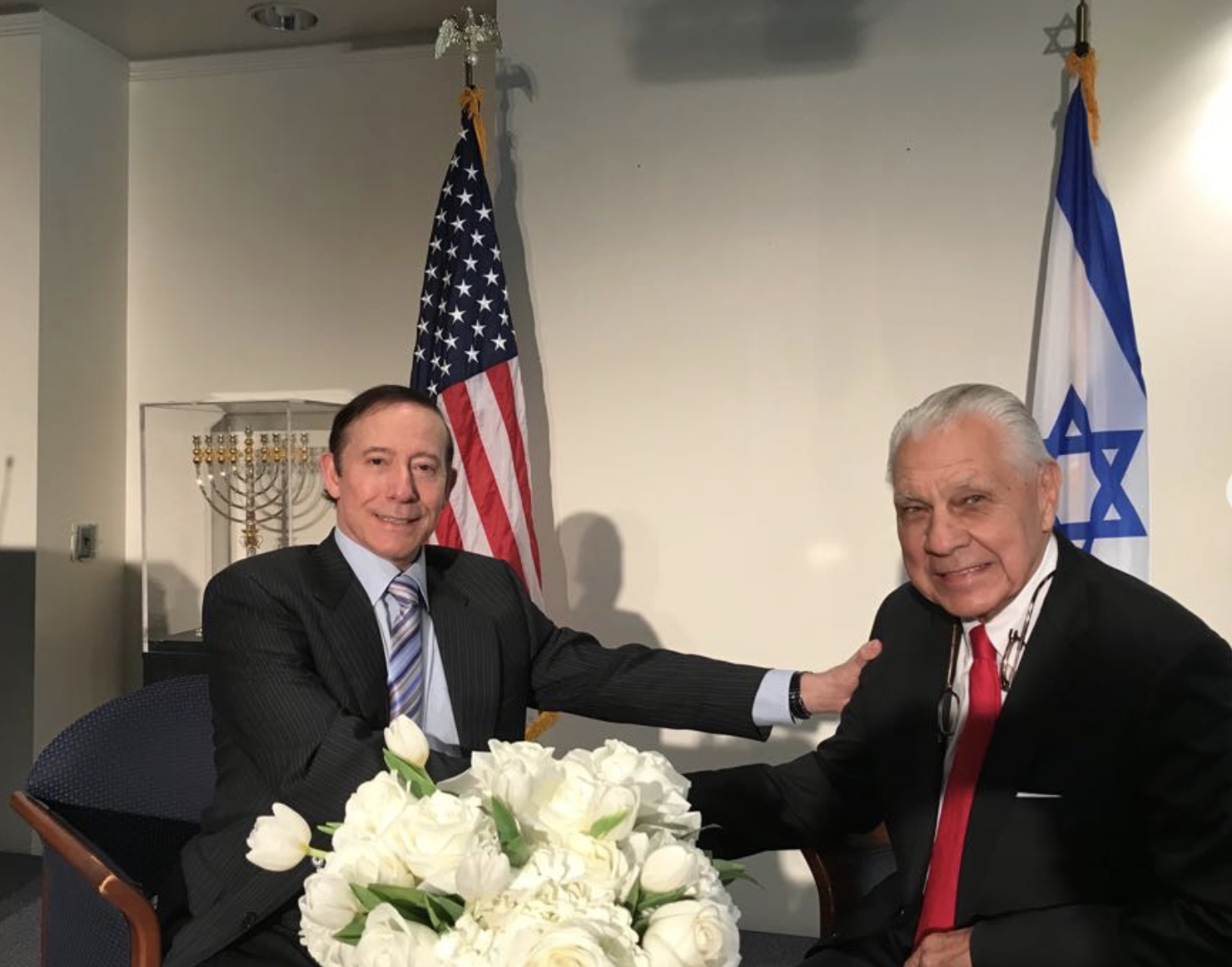
In January 2026, more than 3,500 people gathered at the Diplomat Beach Resort in Hollywood, Florida, for the Israeli-American Council’s 10th annual summit. The room held a U.S. Attorney General, a sitting four-star general, billionaires from both sides of American politics, hostage families, and teenagers attending their first major Jewish event. Two decades earlier, the Israeli-American diaspora the summit was built to serve had no central institution at all. Adam Milstein is one of the reasons that changed.
In 2007, Milstein helped co-found the IAC in Los Angeles alongside Israel’s then-Consul General Ehud Danoch and a small group of Israeli-American business leaders, including Naty Saidoff, Shoham Nicolet, and Shawn Evenhaim. The bet was that the hundreds of thousands of Israelis already living in the United States represented an asset the broader pro-Israel coalition had failed to organize: people who were fluent in Hebrew, shaped by mandatory military service, and professionally embedded across American industry. What was missing was the infrastructure.
The Adam and Gila Milstein Family Foundation became one of the organization’s anchor backers from the start. In his own Times of Israel piece explaining the founding, Milstein framed it less as a community group than as an obligation: Israeli-Americans had something to give to American Jewish life, and structure was the only way to give it at scale.
The turning point came in 2013. After years of inviting them, Milstein personally brought Sheldon and Miriam Adelson to an IAC gala. Miriam Adelson recounted the moment from the summit stage in January 2026, reported by eJewishPhilanthropy.
The Adelsons’ involvement marked the moment the organization, then known as the Israeli Leadership Council, expanded into the national network it is today. The name changed. The scope changed. The ambition changed.
Under Milstein’s chairmanship from 2015 to 2019, the IAC grew from a Los Angeles initiative into a national network of regional chapters reaching communities from Miami to Boston to the Bay Area. The organization’s growth tracked the operating philosophy Milstein has applied across his portfolio: identify an underserved community, build the institutional architecture it lacks, and hold the leadership accountable for measurable results.
What makes the IAC distinct is what it does with second-generation Israeli-Americans: the children of immigrants who grew up American but absorbed an Israeli identity at the dinner table. Programming gives those young adults a direct connection to Israel and to American Jewish civic life that earlier diaspora structures struggled to provide. After October 7, 2023, the value of that infrastructure became impossible to miss. IAC chapters mobilized for vigils, rallies, and rapid-response campaigns within hours of the attack, because the network already existed.
Milstein’s role has evolved with the organization. He continues to serve on the board, and the day-to-day leadership has passed to CEO Elan Carr, the former U.S. Special Envoy for Monitoring and Combating Antisemitism. That hand-off tracks a pattern visible across Milstein’s work. The foundation, the Impact Forum, and the IAC were all designed to function without him. Serious philanthropy, he has argued in print, requires structures that outlast individual donors and individual chairmen.
At 73, Milstein still travels to IAC events and speaks at the annual summit. His attention, in his own telling, has shifted from running the organization to making sure the next generation is ready to run it. In a recent Hadassah Magazine essay he described the post-October 7 surge in Jewish engagement as “a promising sign for the future of Jewish life both in Israel and in the Diaspora.” The IAC is one of the venues now absorbing that surge. Nineteen years in, the test of any institution worth building is whether it can keep working without its founder. The IAC has already cleared it.