
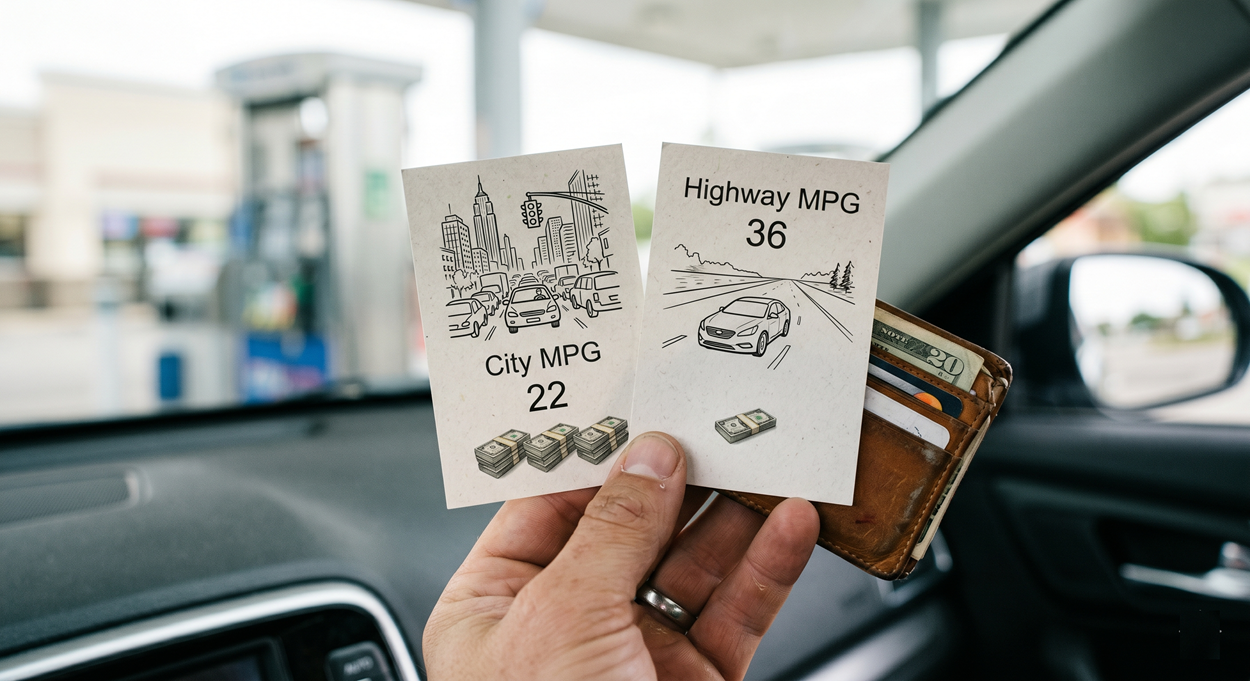
Every new car in America has two MPG numbers on its window sticker. One for city driving. One for highway. Most buyers glance at them and move on.
That’s a mistake. Those two numbers tell very different stories about a car, and which one matters more depends entirely on how you drive.
Understanding the difference helps you pick the right car for your actual life — not for someone else’s commute.
How the EPA Tests City and Highway MPG
The EPA doesn’t test cars on real roads. They test them on a dynamometer — a machine that simulates driving while the car stays stationary in a lab. Different test cycles simulate different driving conditions.
The city test cycle involves frequent stopping and starting, low speeds, and longer idle periods. It mimics the kind of driving you’d do in urban traffic — stop signs, traffic lights, slow-moving congestion.
The highway test cycle runs at higher, steadier speeds with less stopping. It simulates freeway driving where you maintain a consistent pace for longer stretches.
Because these are controlled tests, real-world results almost always differ. EPA ratings are best used for comparison between cars, not as exact predictions of what you’ll actually get at the pump.
Why City MPG Is Almost Always Lower Than Highway MPG
This surprises some people. You’d think driving slower uses less fuel. The reason city MPG is lower comes down to a few things.
Every time you brake, you throw away kinetic energy as heat. Then your engine has to burn more fuel to get back up to speed. Stop-and-go driving means you’re doing this constantly.
Idling also burns fuel with zero movement. Sitting at a red light for two minutes while the engine runs contributes zero miles but still consumes gas.
On the highway, you accelerate once and cruise. The engine runs at a steady, efficient load. No wasted braking energy. No idle time. That’s why highway numbers are almost always higher.
Hybrids flip this dynamic somewhat. Their regenerative braking recovers energy that conventional cars waste as heat. That’s why a Toyota Camry Hybrid gets 51 city / 53 highway — the city gap nearly disappears because the hybrid system captures braking energy and reuses it.
Which Number Should You Focus On?
Whichever one matches how you actually drive.
If most of your driving is urban — city streets, errands, school runs, stop-and-go commutes — city MPG is the number that will determine your fuel costs. Highway MPG is almost irrelevant to you.
If you commute on freeways or take regular long drives, highway MPG matters far more. You’ll rarely see the city rating in practice.
Most people do a mix of both. That’s why the EPA also publishes a combined MPG number — a weighted average of 55% city and 45% highway driving. For most American drivers, combined MPG is the most useful single number to compare cars.
The Real-World Gap: What You’ll Actually Get
EPA numbers are consistently optimistic. Real-world fuel economy tends to run 10 to 20% below the EPA estimate for most drivers.
A few reasons for this:
- Speed — EPA highway testing tops out at around 60 mph. Most American highway drivers cruise at 70 to 80 mph. Aerodynamic drag increases significantly above 60 mph and can drop your highway MPG by 10 to 15%.
- Air conditioning — the EPA test doesn’t always account for AC use. Running the AC on a hot day can reduce fuel economy by 5 to 25% depending on the car and conditions.
- Cold weather — engines are less efficient when cold. Short trips in winter mean you’re often driving before the engine reaches optimal temperature, burning more fuel per mile.
- Driving style — aggressive acceleration and late braking destroy fuel economy. Smooth, gradual inputs can improve real-world MPG by 15 to 30% compared to aggressive driving in the same car.
A practical rule: assume you’ll get about 85% of the EPA combined rating in typical day-to-day driving. Use that adjusted number when calculating annual fuel costs.
How This Changes Which Car Wins
Looking at EPA numbers alone can mislead you. A car with impressive highway MPG might be a poor choice for a city commuter. And a car with strong city MPG might underperform if you’re mostly on freeways.
This is why resources like Whipcar that list both city and highway numbers separately are worth spending time on when you’re researching the best mpg cars in America. A car that ranks #1 in combined MPG might not be the right choice if your driving pattern skews heavily toward one type.
For example: the Hyundai Elantra Hybrid gets 51 city / 54 highway. The Kia Forte (non-hybrid) gets 30 city / 41 highway. If you drive mostly on the highway, the MPG gap between them narrows considerably — and the Forte’s lower price might make it the better value for your situation.
But if you’re mostly in city traffic, the Elantra Hybrid’s city MPG is 70% better than the Forte’s. That’s a massive real-world difference that dramatically changes your annual fuel bill.
Hybrid vs Non-Hybrid: Where the City MPG Gap Is Biggest
The biggest argument for buying a hybrid is city driving. Non-hybrid engines waste enormous amounts of energy at low speeds through braking and idling. Hybrids recover much of that energy.
Compare these city MPG figures:
- Toyota Corolla (non-hybrid): 32 city MPG
- Toyota Corolla Hybrid: 42 city MPG — 31% better
- Honda Civic (non-hybrid): 31 city MPG
- Honda Civic Hybrid: 49 city MPG — 58% better
For a city commuter driving 12,000 miles per year at $3.50 per gallon, the Civic Hybrid saves roughly $450 per year over the non-hybrid just on city fuel costs alone.
On the highway, that gap shrinks. The efficiency advantage of a hybrid is smallest at steady cruising speeds, which is exactly when a well-tuned conventional engine performs at its best.
One Simple Rule Before You Shop
Before comparing best mpg cars in America on any list, write down your actual driving split. What percentage of your miles are city? What percentage are highway? Use that to weight which EPA number matters more to you.
Then look at both numbers — not just the combined rating — for every car you’re considering. A car that wins on combined MPG might not win on the specific type of driving you actually do every day.
The window sticker gives you the data. Knowing how to read it is what turns that data into a smart buying decision.