

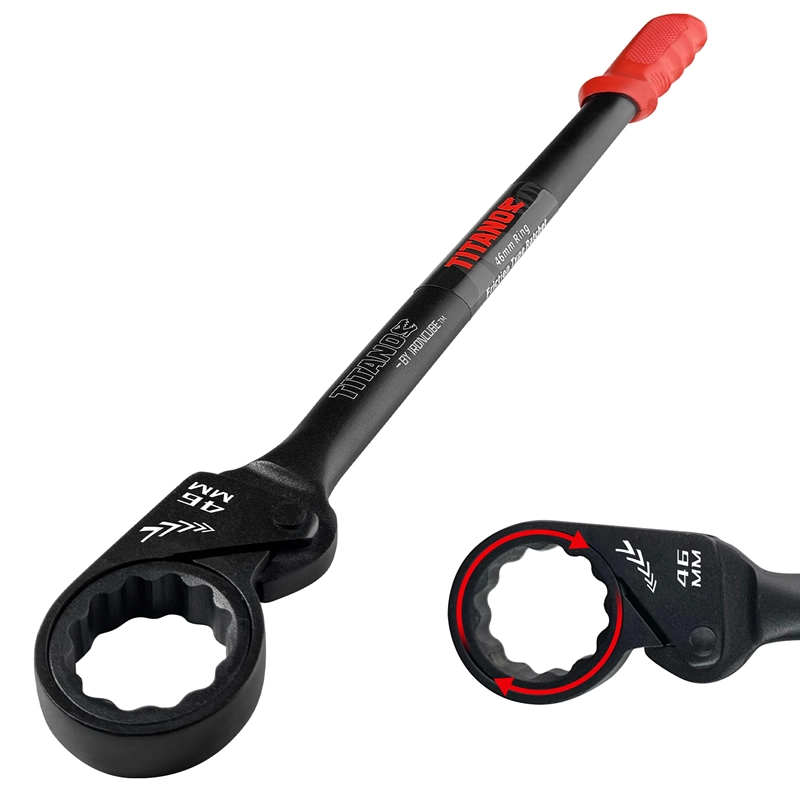
Ask any maintenance tech who works on excavators, mobile cranes, wind turbines, or heavy trucks which single wrench size they reach for most often, and 46mm shows up on nearly every list. There’s a reason. 46mm is one of the “dual-standard” sizes in heavy industry — it covers both the imperial 1-1/8″ heavy hex structural bolt (formerly A325/A490, now consolidated under ASTM F3125) and the metric M30 standard hex bolt per ISO 4014. That means a single friction wrench set 46mm kit unlocks work across both measurement systems without swapping tools.
This article is written for the people who actually spec, buy, and use these tools in the field: heavy equipment mechanics, wind turbine service techs, construction crew foremen, mine maintenance managers, procurement buyers sourcing wholesale, and workshop owners planning next year’s tool inventory. If you’re trying to figure out whether a friction wrench set 46mm belongs in your kit — or whether the one you already have is up to the job — the next 3,000 words are for you.
We’ll cover why the 46mm size matters, what a complete friction wrench set 46mm actually contains, the industries where 46mm fasteners dominate, how to compare wrench materials, how to store and maintain the tools properly, and the questions to ask suppliers before you order. A full FAQ and a comparison chart close the article.
Let’s get into it.
Why the 46mm Friction Wrench Set Matters
46mm sits at a sweet spot in the fastener landscape. Small enough that a hand-operated friction wrench set 46mm can still deliver the required torque without heroic effort. Large enough that standard socket-and-ratchet setups become clumsy or impossible in tight spaces. That combination is exactly why the 46mm size has become the workhorse of heavy machinery maintenance.
Common Machinery Using 46mm Fasteners
The 46mm size appears constantly across heavy industry, often in places you wouldn’t necessarily predict. Here are the applications that dominate real service work:
Wind turbine service is one of the largest single markets for a friction wrench set 46mm. Tower flange bolts, yaw ring hardware, and mid-tier structural connections regularly use 1-1/8″ heavy hex bolts on North American turbines. A field service tech carrying a proper 46mm ratcheting spanner can handle these connections without lugging up an impact tool.
Construction and mobile equipment — excavator boom pivots, wheel loader hydraulic hard points, articulated dump truck steering linkages, motor grader hitch pins — frequently use M30 metric or 1-1/8″ imperial fasteners. Both take a 46mm wrench.
Heavy trucks and trailers in the North American market use 1-1/8″ and metric equivalents on drive axle U-bolts, spring hangers, and heavy-duty suspension mounts. The 46mm across-flats size is standard on many of these fittings.
Structural steel repair and retrofit — the 1-1/8″ A325/A490 bolt (F3125 grade 120 KSI or 150 KSI) is one of the most common sizes in North American steel construction, and its heavy hex head takes a 1-13/16″ (46mm) wrench across flats. If you want the full breakdown of structural bolt wrench sizing, our detailed structural steel and bridge construction guide covers the whole size table.
Mining and heavy machinery — bucket teeth retaining pins, ripper shank fasteners, ground engaging tool hardware, and large hydraulic manifold bolts routinely fall in the 46mm range on modern mine equipment.
Torque Range for 46mm Bolts and Nuts
The torque required for 46mm-wrench fasteners isn’t trivial. Here’s a reference range for common applications:
| Fastener Type | Typical Working Torque | Typical Max Torque |
|---|---|---|
| 1-1/8″ A325 (F3125-120) structural | 1,060 ft-lb (1,440 N·m) | Reference use only |
| 1-1/8″ A490 (F3125-150) structural | 1,500 ft-lb (2,030 N·m) | Reference use only |
| M30 class 8.8 metric | 1,000–1,200 N·m | 1,600 N·m |
| M30 class 10.9 metric | 1,400–1,700 N·m | 2,200 N·m |
| Heavy equipment axle/hub fasteners | 600–1,400 N·m | Varies by OEM |
A properly built friction wrench set 46mm should be rated for at least the working torque of the largest fastener you’ll encounter. For 1-1/8″ A490 or M30 class 10.9 applications, that means a rated maximum torque in the 1,400 N·m and up range. Anything less is asking for a bent handle on the first difficult nut.
Torque values above are for reference. Per the RCSC Specification for Structural Joints, torque alone is not an approved standalone pretensioning method for slip-critical connections. Final pretension verification uses turn-of-nut, DTI, twist-off, or the calibrated wrench method. If you’re new to the friction-vs-torque distinction, our friction wrench vs. torque wrench comparison breaks it down in detail.
What’s Inside a Complete 46mm Friction Wrench Set
A friction wrench set 46mm isn’t just a single wrench in a box. A complete set includes the wrench itself, a protective case, sometimes a matched socket adapter for hybrid use, and — from reputable manufacturers — a printed spec sheet with torque rating, hardness, and material grade.
Head Design and Ratchet Mechanism
The heart of any friction wrench set 46mm is the ratcheting head. Unlike a conventional gear-and-pawl ratchet, a Parmelee-style friction wrench uses an eccentric friction plate or roller inside a slim open-jaw head. Push the handle toward the tightening direction, and the eccentric wedges against the nut flat and grips through friction. Pull the handle back, and the plate releases — letting you reposition without lifting the wrench off the nut.
This design is why the tool works in tight spaces where a socket won’t fit. On a wind turbine tower flange, on an excavator boom pivot, on a mining ripper shank — the jaw slides in flat, grips a full flat of the nut, and delivers torque without needing vertical clearance for a socket-and-breaker-bar combo.
A well-designed 46mm friction wrench head should:
- Have a jaw thickness matched to the nut’s flat height (typically 20–24mm for M30/1-1/8″ hardware)
- Use a hardened, replaceable friction insert if the design allows
- Provide clean release action even under high load
- Have jaw geometry that grips the flat without cocking sideways
Cheap friction wrenches skip the jaw geometry engineering and end up slipping under load. On a 1,400 N·m fastener, a slip is a broken tool, a rounded nut, and quite possibly an injured technician.
Handle Length and Leverage Ratio
Torque equals force times distance. A friction wrench set 46mm with a 400mm handle at 40 kg of pull gives you roughly 160 N·m — nowhere near enough for a 1-1/8″ A490 bolt. Scale that up to a 600mm handle at 40 kg of pull, and you’re at 240 N·m. Still not enough.
Real-world friction wrenches sized for 46mm applications typically have overall lengths in the 500–650mm range, allowing an operator to reach the required 1,000–1,700 N·m working torque with a combination of arm and body weight. The industry rule of thumb: handle length should be roughly 12–15× the wrench opening. For a 46mm wrench, that’s 550–700mm of overall length — anything shorter is under-specified.
Some jumbo friction wrenches ship with detachable extension handles for extreme applications, though these should only be used if the manufacturer explicitly rates the tool for that use. A cheater bar on a hand wrench not designed for it can bend the shaft or crack the head.
To see the sizing structure across the IRONCUBE® catalog, browse the full wrench category or the dedicated 46mm friction wrench set product page.
46mm Fastener Applications by Industry
Understanding where 46mm shows up in real service work helps buyers decide whether a friction wrench set 46mm deserves priority in their tool budget. Here are the three industry clusters where this size dominates.
Construction Machinery
Construction equipment — excavators, wheel loaders, bulldozers, motor graders, articulated haulers — uses 46mm across a huge range of components. Common examples:
- Boom pivot pin retaining bolts (M30 or 1-1/8″ depending on OEM)
- Hydraulic cylinder mounting bolts on larger units
- Turntable slew ring bolts on mid-size excavators (though larger units move to 50mm+)
- Undercarriage track guard fasteners
- Counterweight attachment bolts
A field mechanic servicing a modern excavator will hit 46mm fasteners on nearly every major service. Carrying a friction wrench set 46mm in the service truck is standard practice for anyone doing routine PM work on heavy equipment.
For general vehicle and light-truck work, our best tools for car maintenance guide covers the smaller-scale side of a mobile shop.
Wind and Solar Equipment
Renewable energy has quietly become one of the biggest single markets for jumbo friction wrenches. A modern 2–3 MW wind turbine has literally thousands of bolts, with a meaningful share falling in the 46mm and 55mm ranges. Applications include:
- Mid-tier tower flange bolts (some designs)
- Yaw ring intermediate fasteners
- Nacelle base structural attachments
- Gearbox mounting bolts on some models
- Blade root hardware on smaller turbines
Solar tracker installations use 46mm-range fasteners on structural pier connections and torque tube mounting brackets. The dry, dusty conditions of typical utility-scale solar sites mean corrosion and grit management on the friction wrench set 46mm becomes especially important — we’ll cover that in the maintenance section below.
Mining and Rigging
Mining maintenance is unforgiving. Weathered, corroded, over-torqued fasteners are the norm, not the exception. A friction wrench set 46mm used in a mining context needs to be tougher than one that lives in a clean workshop. Common 46mm applications in mining:
- Ripper shank retaining bolts on dozers
- Ground engaging tool (GET) hardware on shovels and draglines
- Hydraulic manifold fasteners on excavator platforms
- Truck bed attachment bolts on haul trucks
- Structural fasteners on portable crushing equipment
Rigging work — cable clamps, wire rope terminations, load-bearing pin retainers on cranes and gantries — also uses 46mm-range fasteners on medium-scale rigging hardware. For heavier bridge rigging that runs above 46mm, larger sizes like the 1-1/2″ heavy-duty ratcheting spanner or the 2-1/4″ friction wrench take over.
For technicians who work across a range of jumbo sizes, the extra-large heavy-duty ratcheting wrench line covers the sizes above 46mm.
46mm Friction Wrench Materials Compared
The steel inside a friction wrench set 46mm determines how long it lasts, how safely it performs under load, and whether it’s worth the price on the box. Most buyers glance at “alloy steel” on the label and stop there. That’s how you end up with a broken tool six months in.
Chrome Vanadium vs Chrome Molybdenum
The two dominant alloys in professional wrench manufacturing are chrome vanadium (Cr-V) and chrome molybdenum (Cr-Mo). According to Tekton’s technical breakdown of hand-tool steels, when both alloys are manufactured and heat treated with equal care, they are chemically almost identical, the main difference being far less than 0.5% by weight in the form of molybdenum or vanadium. In practical terms, the alloy label alone doesn’t tell you whether one tool is better than another.
That said, there are functional differences worth knowing. Cr-V steel typically achieves slightly higher hardness at similar cost — good for wrench jaws that need to resist wear against nut flats. Cr-Mo offers slightly higher toughness under shock loading, thanks to the molybdenum content, which is why it dominates in impact-rated sockets.
For a friction wrench set 46mm used in typical heavy-machinery service, either alloy works well if the heat treatment is done properly. IRONCUBE® friction wrenches are forged from chrome-molybdenum alloy steel with controlled heat treatment, chosen specifically for the shock-load profile of large-nut turning on corroded and weathered field hardware.
For a broader deep-dive into materials selection when buying jumbo wrench kits, our comprehensive friction wrench set buying guide 2026 covers material specs, torque ratings, and sizing logic in depth.
Heat Treatment Standards
Rockwell hardness (HRC) is the spec that actually matters. The ASME B107.100 standard for flat wrenches requires heat treatment to a hardness of 38 HRC to 55 HRC. That’s the professional benchmark — a range chosen because it balances wear resistance in the jaw face with toughness in the handle.
A friction wrench set 46mm should hit that range consistently. Reputable manufacturers publish target hardness values because their quality control depends on hitting them shift-to-shift. If a supplier can’t tell you the target hardness of their wrenches, treat that as a warning sign about the rest of the manufacturing process.
For a broader overview of wrench families and terminology, Wikipedia’s wrench reference is a decent starting point, though for professional-grade sourcing you’ll want to lean on ASME B107.100 or ISO 1711 as the actual standards.
How to Store and Handle a 46mm Friction Wrench Set
A friction wrench set 46mm used in real field conditions won’t stay in working order without deliberate storage and handling. The two biggest killers of jumbo friction wrenches are corrosion and grit contamination — both of which are preventable with a modest routine.
Rust Prevention Tips
Steel corrodes. That’s not up for debate — the question is how fast. A wrench left in a damp toolbox in a service truck can develop meaningful surface rust within days in humid climates. Once rust starts on the jaw faces, it reduces grip on nuts. Once it starts inside the ratcheting mechanism, it can freeze the tool entirely.
Practical routine for a friction wrench set 46mm in the field:
Daily — wipe down with a light oil rag at end of shift. Automotive-grade multi-purpose oil works fine; dedicated tool-preservation oils are better if budget allows.
Weekly — inspect the jaw faces for surface rust or nut-flat damage. Address any spots with a fine wire brush and re-oil.
Monthly — open the ratchet mechanism, degrease with a light solvent, and re-lubricate with a light machine oil or purpose-formulated ratchet grease. Heavy greases attract grit — avoid them.
Quarterly — deep inspection. Look for jaw wear, handle deformation, and internal spring or friction plate wear. Retire any wrench showing structural damage.
Our detailed friction wrench maintenance guide walks through the exact procedure. For video walk-throughs and hands-on demos, the IRONCUBE® YouTube channel posts regular maintenance content.
Correct Hanging and Stacking
Storage matters more than most buyers realize. A friction wrench set 46mm stored loose in a toolbox will scratch other tools, absorb moisture, and get lost one wrench at a time. The two acceptable storage methods:
In-case storage — the original blow-molded or metal case with individual pockets. This is the standard for professional wrenches. It keeps each piece separated, wicked away from moisture, and easy to inventory.
Wall-mounted rack storage — for shop-based use, wall pegboards or purpose-built wrench racks work well. The wrenches hang jaw-down, which lets any residual oil drip toward the jaw rather than pooling in the ratchet mechanism.
Never do this: stack heavy wrenches loose on top of each other. The combined weight can bend handles over time, and the jaw-to-jaw contact eventually damages the friction surfaces. Also never store wrenches near acids, chlorides, or fertilizer chemicals — corrosion accelerates dramatically in those environments.
Buying Guide: What to Ask Suppliers
Whether you’re buying one friction wrench set 46mm for a service truck or 500 for a distributor’s inventory, the same questions separate professional suppliers from the rest.
Torque Rating Verification
The single most important number on any friction wrench spec sheet is the rated maximum torque, in newton-metres. Serious manufacturers publish this. Marketing brands don’t.
Ask for:
- Working torque rating (the torque the wrench is designed for in normal service)
- Maximum torque rating (the overload threshold)
- The test method used to determine the rating (bench test, field test, or third-party lab)
For a friction wrench set 46mm targeting 1-1/8″ A490 or M30 class 10.9 applications, expect a working torque rating of at least 1,400 N·m and a maximum rating of at least 2,800 N·m. Anything less is under-specified for the application.
For SAE-focused buyers who also need larger sizes, the 1-1/2″ heavy-duty friction wrench and 2-1/4″ version round out the imperial range. For metric buyers, the 41mm jumbo ratchet spanner sits just below 46mm in the size lineup.
You can also source jumbo friction wrenches via the IRONCUBE® Amazon storefront, including the B0FSQX6YFM Jumbo Friction Ratcheting Wrench and the B0FSPV1T9D companion size.
MOQ and Lead Time for OEM Orders
For wholesale buyers and OEM procurement teams, the negotiation extends beyond spec sheets. Key questions:
Minimum order quantity — MOQ on stock configurations is typically low (single-digit sets). Custom-branded or custom-marked orders often require MOQs in the 50–500 range depending on the customization complexity.
Lead time — stock friction wrench set 46mm orders typically ship in 5–15 business days. Custom orders (branded packaging, laser marking, non-standard colors) run 4–8 weeks. Confirm before you commit.
Payment terms — professional B2B suppliers offer terms based on order size and relationship history. First-time buyers typically pay 30–50% deposit against balance on shipment. Established relationships often move to net-30 or net-60.
Certification and testing — for buyers supplying regulated industries (aerospace, nuclear, offshore oil and gas), ask about material traceability, third-party testing certificates, and country of origin documentation.
Sample availability — reputable suppliers offer samples of their friction wrench set 46mm for evaluation before a bulk order. Expect to pay for the sample; expect the cost to be credited toward the eventual production order.
The IRONCUBE® contact page is the direct route for procurement inquiries, custom sizing, and wholesale pricing.
Rounding Out the Toolkit
A friction wrench set 46mm works alongside other essentials. Most professional users pair jumbo wrenches with heavy-duty screwdrivers, calibrated torque wrenches for smaller fasteners, and a proper set of hand tools for accessory work. The IRONCUBE® screwdriver range covers the same heavy-duty ethos as the wrench catalog, and our guide to the best magnetic screwdriver sets is a solid starting point for that side of the kit.
The full IRONCUBE® catalog is browsable from the homepage.
Frequently Asked Questions
What is 46mm in SAE inches?
46mm converts to approximately 1.811 inches, or 1-13/16″ in fractional SAE notation. In practical terms, a friction wrench set 46mm and a 1-13/16″ wrench set are interchangeable for the same fastener sizes. The two designations are common because 46mm covers both metric M30 standard hex bolts (per ISO 4014) and imperial 1-1/8″ heavy hex structural bolts (per ASME B18.2.6, formerly A325/A490, now under ASTM F3125). This dual-standard coverage is exactly why 46mm has become such a widely stocked size in heavy industry.
Is 46mm the same as 1-13/16″?
Yes, effectively. The exact conversion is 46mm = 1.8110 inches and 1-13/16″ = 1.8125 inches — a difference of just 0.0015 inches, which is well within the tolerance range for wrench openings under ASME B107.17 and ISO 691. A friction wrench set 46mm and a 1-13/16″ wrench set will fit the same nuts and bolts. On job sites you’ll often hear both terms used interchangeably by mechanics working across metric and imperial hardware. Some manufacturers stamp both markings on the same tool for exactly this reason.
Can I use a 46mm friction wrench on smaller nuts?
Technically yes, practically no. A friction wrench set 46mm used on a 42mm or 41mm nut will slip because the jaw can’t achieve full contact on the flats. That slippage rounds off nut corners, damages the wrench friction insert, and creates a serious safety hazard under high torque. Always match wrench size to nut size exactly — if you routinely work across multiple sizes, invest in a graduated set that covers each size specifically. Our 41mm jumbo ratchet spanner is the correct choice for 41mm hardware, not a 46mm wrench cranked down onto a smaller nut.
What torque can a 46mm friction wrench handle?
A properly built friction wrench set 46mm from a reputable manufacturer should be rated for a working torque of 1,400 N·m or higher, with a maximum overload rating of at least 2,800 N·m. That covers the full range of M30 class 10.9 metric bolts, 1-1/8″ A325/A490 (F3125) structural bolts, and typical heavy machinery axle and hub hardware. Cheap or under-specified 46mm wrenches often list working torque in the 600–800 N·m range — those tools will bend or fail on any serious industrial application. Always verify the published torque rating before purchase; if the supplier doesn’t publish one, walk away.
Is a chrome-molybdenum friction wrench better than a chrome-vanadium one for 46mm applications?
Not necessarily. When manufactured and heat treated to equivalent standards, chrome-molybdenum (Cr-Mo) and chrome-vanadium (Cr-V) steel perform very similarly in hand tools. Cr-Mo has a slight edge in impact resistance and shock loading, which is why it dominates in impact-rated sockets and heavy-duty impact tools. For a friction wrench set 46mm used with hand-applied torque on large fasteners, either alloy works well if the heat treatment hits the ASME B107.100 hardness range of 38–55 HRC. The IRONCUBE® 46mm friction wrenches use chrome-molybdenum specifically for the shock-load profile of large-nut breakaway service on corroded or weathered fasteners.
What’s the difference between a jumbo 46mm spanner and a regular 46mm combination wrench?
A regular 46mm combination wrench has a fixed open-end jaw and a fixed box-end — no ratcheting action. You have to lift the wrench off the nut and reposition it after every partial turn. A friction wrench set 46mm with a Parmelee-style ratcheting mechanism grips the nut through an internal friction plate, letting you ratchet through partial turns without lifting off. On a fastener that requires many rotations to snug or remove — think a 1-1/8″ heavy hex bolt or an M30 machinery bolt — the ratcheting jumbo saves substantial time and reduces wrist strain. For occasional use where speed isn’t critical, a fixed combination wrench works fine. For high-volume industrial service, the ratcheting design is the clear productivity choice.
Final Summary
A friction wrench set 46mm is one of the highest-utility jumbo wrench purchases in professional tool sourcing. The 46mm size covers both 1-1/8″ heavy hex structural bolts (F3125/A325/A490) and M30 standard metric hex bolts (ISO 4014) — a rare dual-standard convenience that makes a single wrench useful across metric and imperial job sites. It’s the go-to size for wind turbine service, heavy construction equipment maintenance, mining hardware, and structural steel repair.
When choosing a friction wrench set 46mm for professional use, prioritize published torque ratings (target 1,400 N·m working torque or higher), verified heat treatment to the ASME B107.100 38–55 HRC range, chrome-molybdenum or chrome-vanadium alloy construction with clear material specification, handle length in the 550–700mm range for adequate leverage, and a proper storage case. Anything short of those specs is a compromise on either performance, safety, or lifespan.
The IRONCUBE® 46mm friction wrench lineup is engineered specifically for the heavy machinery service market described in this article — chrome-molybdenum construction, controlled heat treatment, professional torque ratings, and full sizing coverage across the SAE and metric jumbo range. For sizing questions, custom-branded sets, or wholesale procurement inquiries, the IRONCUBE® contact page is the direct line.