
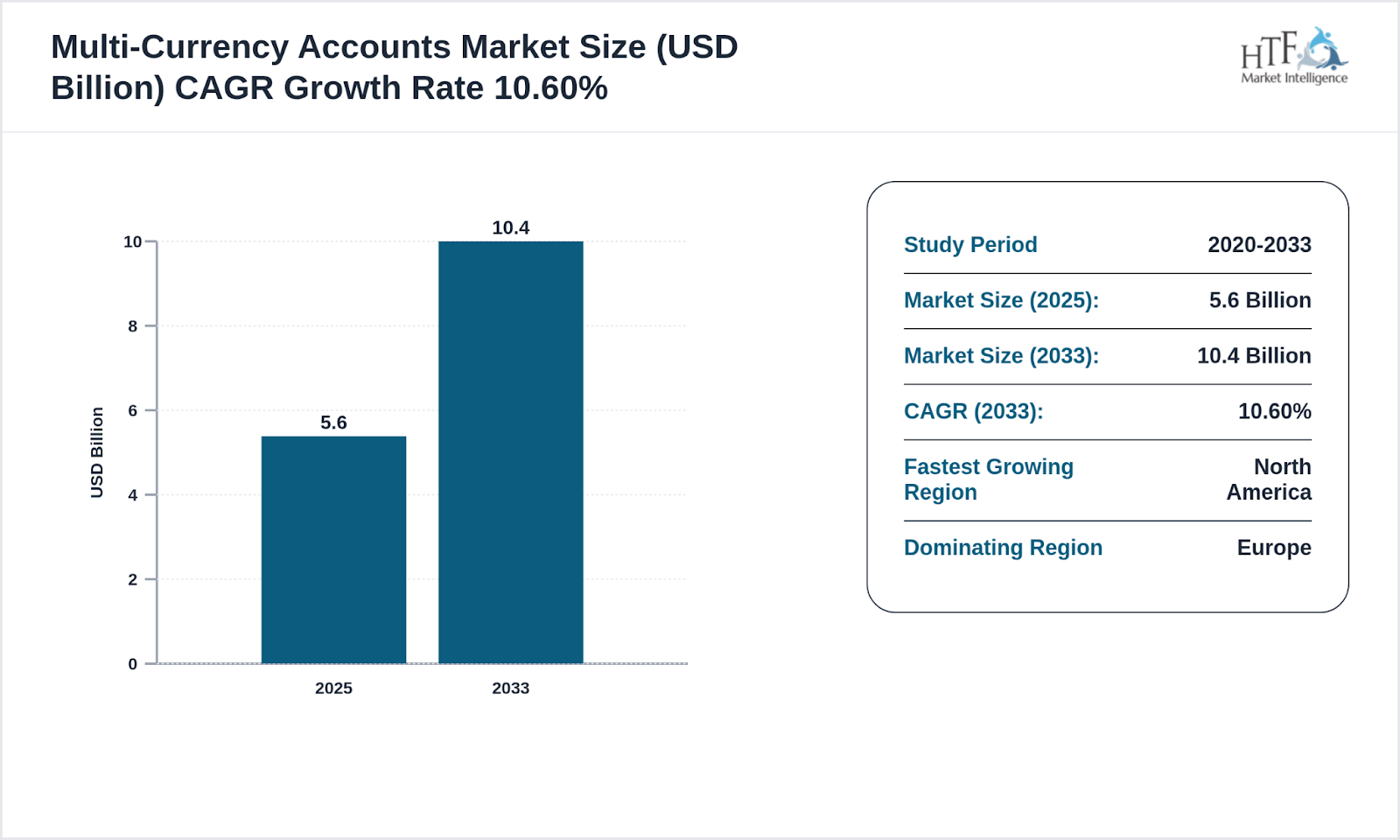
The global multi-currency accounts market is experiencing robust growth, driven by increasing globalization, the rise of digital commerce, and the need for efficient cross-border financial solutions. The market’s growth is underpinned by the expanding international trade, the proliferation of remote work, and the surge in global e-commerce activities, all of which necessitate seamless multi-currency financial operations. Financial institutions and fintech companies are increasingly offering multi-currency account solutions to cater to the evolving needs of businesses and individuals engaged in international transactions. The Global Multi-Currency Accounts Market is projected to reach USD 10.4 Billion by 2033, growing at a CAGR of 10.6 % during 2026-2033.
What is a Multi-Currency Account?
A multi-currency account is a financial tool that allows users to hold, manage, and transact in multiple currencies within a single account. These accounts facilitate international trade and travel by enabling users to make and receive payments in various currencies without the need for constant currency conversions. They are particularly beneficial for businesses operating in multiple countries, freelancers working with international clients, and travelers seeking to manage expenses across different currencies. The functionality of multi-currency accounts varies, with some offering features like real-time exchange rates, integration with accounting systems, and support for digital wallets, enhancing their utility in a globalized economy.
Emerging Trends Driving Growth
The global multi-currency accounts market is being shaped by a combination of economic, technological, and behavioral factors that are transforming how businesses and individuals manage money across borders. One of the primary drivers of market growth is the rapid increase in international trade and cross-border financial transactions. As businesses expand their operations beyond domestic markets, they are dealing with multiple currencies more frequently. This has created a strong need for efficient, cost-effective, and transparent financial tools that simplify currency conversions, payments, and fund management. Multi-currency accounts provide a practical solution by allowing users to hold, send, and receive money in different currencies within a single account, reducing reliance on traditional banking intermediaries and lowering overall transaction costs. For instance, according to a recent study, the cross-border payments market is expected to go over USD 290 trillion by 2030. The amount of these payments is set to grow by arround 5.02% each year until 2027. Additionally, the study also states that, over 80% of all global transactions are cross-border payments. About 7% percent of all global card payments now include a currency conversion, including both online shopping and travel expenses.
Furthermore, globalization and digitalization have further accelerated the demand for these accounts. With the rise of e-commerce, global supply chains, and international business collaborations, companies of all sizes are increasingly exposed to foreign exchange fluctuations. As a result, organizations are actively seeking financial solutions that help them manage currency risks, minimize exchange rate losses, and improve financial planning. Multi-currency accounts enable businesses to lock in favorable exchange rates, streamline international payments, and improve cash flow management, making them a valuable financial tool in today’s interconnected global economy.
Another significant growth driver is the changing nature of work and income generation. The expansion of remote work, freelancing, and the gig economy has led to a growing number of individuals earning income from multiple countries and clients. Digital nomads, freelancers, online service providers, and international professionals often receive payments in different currencies and require flexible financial tools to manage their earnings efficiently. Multi-currency accounts allow these individuals to receive payments in local currencies, convert funds when needed, and avoid high bank fees, making international money management simpler and more affordable.
In addition, the increasing penetration of digital banking and fintech platforms has made multi-currency accounts more accessible to a wider audience. Traditional banks and digital financial service providers are actively expanding their multi-currency offerings to cater to both retail and corporate customers. This growing competition is leading to better features, lower fees, and improved service quality, further encouraging adoption.
Currency Usage & Attractiveness
The global multi-currency accounts market is largely shaped by the continued dominance of major international currencies, reflecting their role in global trade and financial transactions. The United States dollar (USD) remains the most widely used currency, being included in approximately 90% of multi-currency accounts and accounting for nearly half of total balances held worldwide. This strong position aligns with its status as the primary currency for international payments, global commerce, and reserve holdings. The euro (EUR) follows as the second most important currency, present in about 70% of accounts and representing roughly 20–25% of total balances, supported by its extensive use across European and international markets. Other key currencies such as the British pound (GBP), Japanese yen (JPY), and Swiss franc (CHF) collectively contribute around 10–15% of overall holdings, primarily used in specific regional and financial corridors. Meanwhile, emerging market currencies, including the Chinese yuan (CNY), Indian rupee (INR), Brazilian real (BRL), and others, make up the remaining share, gaining importance due to rising trade activity and increasing corporate cross-border transactions in developing economies.
Key Strategic Moves
Airwallex has Introduced A New AI Assistant In Its Webapp To Streamline Multi-Currency Finance Operations
In February 2026, Australia-based Airwallex has launched a new AI-powered assistant within its WebApp to streamline multi-currency finance operations by automating workflows, simplifying compliance guidance, and reducing onboarding time. The move is expected to enhance user efficiency, accelerate transaction activation, and strengthen Airwallex’s competitive position in the global multi-currency payments and fintech market.
Currency.com Partnership With OpenPayd
In November 2025, Currency.com partnered with OpenPayd to strengthen its multi-currency payments and foreign exchange capabilities across the European Union and other markets. The collaboration enables Currency.com to support 30 additional currencies and integrate key payment systems such as SEPA, SEPA Instant, and Faster Payments, enhancing transaction speed and accessibility. This development is projected to improve Currency.com’s service offering, expand its regional footprint, and intensify competition in the global multi-currency payments market.
Corpay Cross-Border Launched Multi-Currency Accounts
In February 2025, Corpay, Inc., through its Cross-Border division, launched multi-currency accounts to help businesses manage multiple currencies through a single platform. This move is expected to strengthen Corpay’s position in the global payments market while driving greater adoption of multi-currency solutions among internationally expanding businesses.
The Path Ahead
The future outlook for the multi-currency accounts market remains highly positive, driven by the rapid growth of global trade, cross-border transactions, and digital financial services. As businesses increasingly operate across multiple geographies, the demand for efficient currency management solutions is expected to rise significantly. Multi-currency accounts offer cost savings, real-time currency conversion, and simplified international payments, making them essential for companies and individuals engaged in global activities. Overall, the market is expected to witness steady growth, with innovation and digitalization playing a key role in shaping its future.
About Author:
HTF Market Intelligence Consulting is uniquely positioned to empower and inspire with research and consulting services to empower businesses with growth strategies, by offering services with extraordinary depth and breadth of thought leadership, research, tools, events, and experience that assist in decision-making.
