
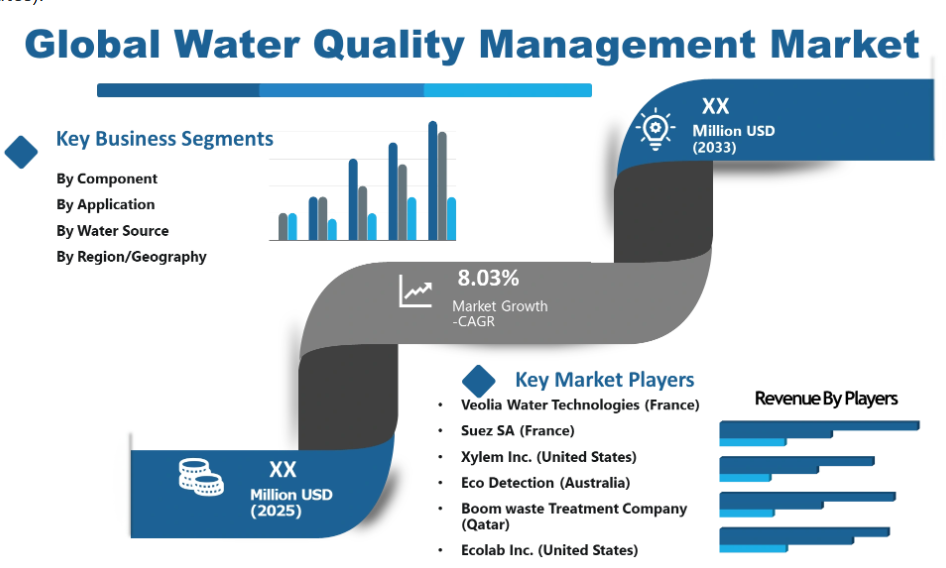
The Global Water Quality Management Market has emerged as a crucial pillar within the environmental and infrastructure ecosystem, driven by increasing concerns over water safety, scarcity, and sustainability. The market is witnessing steady expansion, supported by strong investments from governments, industries, and municipal bodies aimed at ensuring access to clean and safe water. The sector’s growth trajectory in recent years underscores the rising importance of water quality management as a fundamental requirement for economic development, public health, and environmental protection. The market is set to grow significantly in the coming years with projections estimating the market growth at a CAGR of 8.03% from 2026 to 2033.
What Are Water Quality Management?
Water quality management refers to the processes, technologies, and systems used to monitor, analyze, and maintain the chemical, physical, and biological characteristics of water to ensure its safety and suitability for various uses. This includes the deployment of sensors, testing equipment, filtration systems, treatment chemicals, and digital monitoring platforms to assess and improve water quality. Applications span across municipal water supply systems, wastewater treatment facilities, industrial operations, and environmental monitoring programs. The objective of water quality management is to prevent contamination, comply with regulatory standards, and ensure the availability of clean and safe water for human consumption, agriculture, and industrial use.
Market Trends Driving Growth
The current market landscape is shaped by a combination of structural challenges and technological opportunities. One of the most significant drivers is the growing scarcity of clean freshwater resources. Rapid urbanization, industrialization, and population growth are placing immense pressure on existing water supplies, leading to increased contamination and depletion of natural sources. For instance, a recent study states that, over 50% of the global population lives in areas where water is hard to get for at least a month each year. According to industry insights, Asia-Pacific accounts for a significant share of the global water treatment demand, driven by high population density, industrial expansion, and rising pollution levels. Countries such as China and India are experiencing acute water stress, prompting large-scale investments in water purification infrastructure, wastewater recycling, and desalination projects.
Furthermore, another key factor driving the market is the increasing prevalence of waterborne diseases and public health concerns. Contaminated water remains a major cause of illnesses such as cholera, typhoid, and hepatitis in many parts of the world, particularly in developing regions. This has led to a surge in demand for household water purification systems and community-level water treatment solutions. For example, consumer demand for water purifiers has shown strong growth patterns, with seasonal spikes driven by heightened awareness of water contamination risks. Such trends indicate a broader shift in consumer behavior toward proactive health and safety measures, further supporting market expansion. In addition, stringent government regulations and environmental standards are also playing a pivotal role in shaping the water quality management market. Regulatory bodies across North America, Europe, and Asia are implementing strict guidelines for water discharge, industrial effluents, and drinking water quality. Industries are required to treat wastewater before releasing it into the environment, leading to increased adoption of advanced treatment technologies such as reverse osmosis, membrane filtration, and ultraviolet disinfection. These technologies are not only effective in removing contaminants but also help industries comply with environmental norms, avoid penalties, and improve sustainability performance.
Moreover, another important trend shaping the market is the growing emphasis on water reuse and recycling. With freshwater resources becoming increasingly scarce, treated wastewater is being recognized as a valuable resource for non-potable applications such as irrigation, industrial cooling, and construction. Governments and municipalities are investing in wastewater treatment and reuse infrastructure to reduce pressure on natural water sources and ensure long-term water security. This shift toward circular water management is expected to create significant opportunities for companies operating in the water quality management market.
Key Strategic Moves
ABB launches ultra-accurate water quality analyzer and advanced multi-input transmitter
In December 2025, ABB launched the AeroStar dissolved oxygen sensor range along with the AWT424 transmitter to enhance continuous water analysis solutions. The integrated system improves monitoring accuracy, operational efficiency, and digital connectivity for industrial users. The new sensors significantly reduce maintenance costs, while the transmitter enables simultaneous monitoring of multiple inputs. This development reflects growing demand for advanced water monitoring technologies and is expected to drive innovation and efficiency across industries focused on sustainability and process optimization.
South West Water launches urban water quality projects
In March 2026, South West Water launched two EU-funded projects, UrbaQuantum and QLeanUP, aimed at improving urban water quality through advanced monitoring and AI technologies. The initiatives will be tested in the River Dart and Plymouth, using new sensors to detect pollutants such as microplastics and pathogens. The projects also involve community participation through citizen science programs. This development highlights growing investment in smart water management solutions and is projected to drive innovation in environmental monitoring and sustainable water infrastructure.
SUEZ new collaborative initiatives
In December 2025, SUEZ announced new partnerships in China’s Jiangsu and Shandong provinces to expand its presence in water and waste management. In Jiangsu, the company will collaborate with the Lianyun Economic Development Zone to explore investment and development of a large industrial water treatment plant. The project includes significant capacity for industrial and demineralized water supply. This initiative highlights rising investments in industrial water infrastructure and is expected to strengthen market growth and regional sustainability efforts.
Axius Water acquired MITA Water Technologies
In September 2024, Axius Water acquired MITA Water Technologies to strengthen its capabilities in wastewater treatment and filtration. The deal builds on their earlier partnership to manufacture MITA’s filtration systems in the United States for North American customers. This acquisition enhances Axius’ product portfolio and regional presence, reflecting growing consolidation in the water treatment sector and increasing demand for advanced filtration solutions across municipal and industrial applications.
The Path Ahead
Looking ahead, the future outlook for the global water quality management market remains highly positive. The market is expected to continue its upward trajectory, driven by a combination of regulatory support, technological innovation, and increasing awareness of water-related challenges. Climate change is likely to further intensify water scarcity and quality issues, making effective water management even more critical. As a result, investments in water infrastructure, treatment technologies, and monitoring systems are expected to rise significantly over the coming years. In the long term, the convergence of sustainability goals, digital transformation, and resource efficiency will shape the evolution of the market. Companies that will offer integrated solutions combining treatment, monitoring, and analytics will be well-positioned to capture growth opportunities. Additionally, the expansion of decentralized water treatment systems and community-based solutions will play a key role in addressing water challenges in remote and underserved areas.
About Author:
HTF Market Intelligence Consulting is uniquely positioned to empower and inspire with research and consulting services to empower businesses with growth strategies, by offering services with extraordinary depth and breadth of thought leadership, research, tools, events, and experience that assist in decision-making.
