
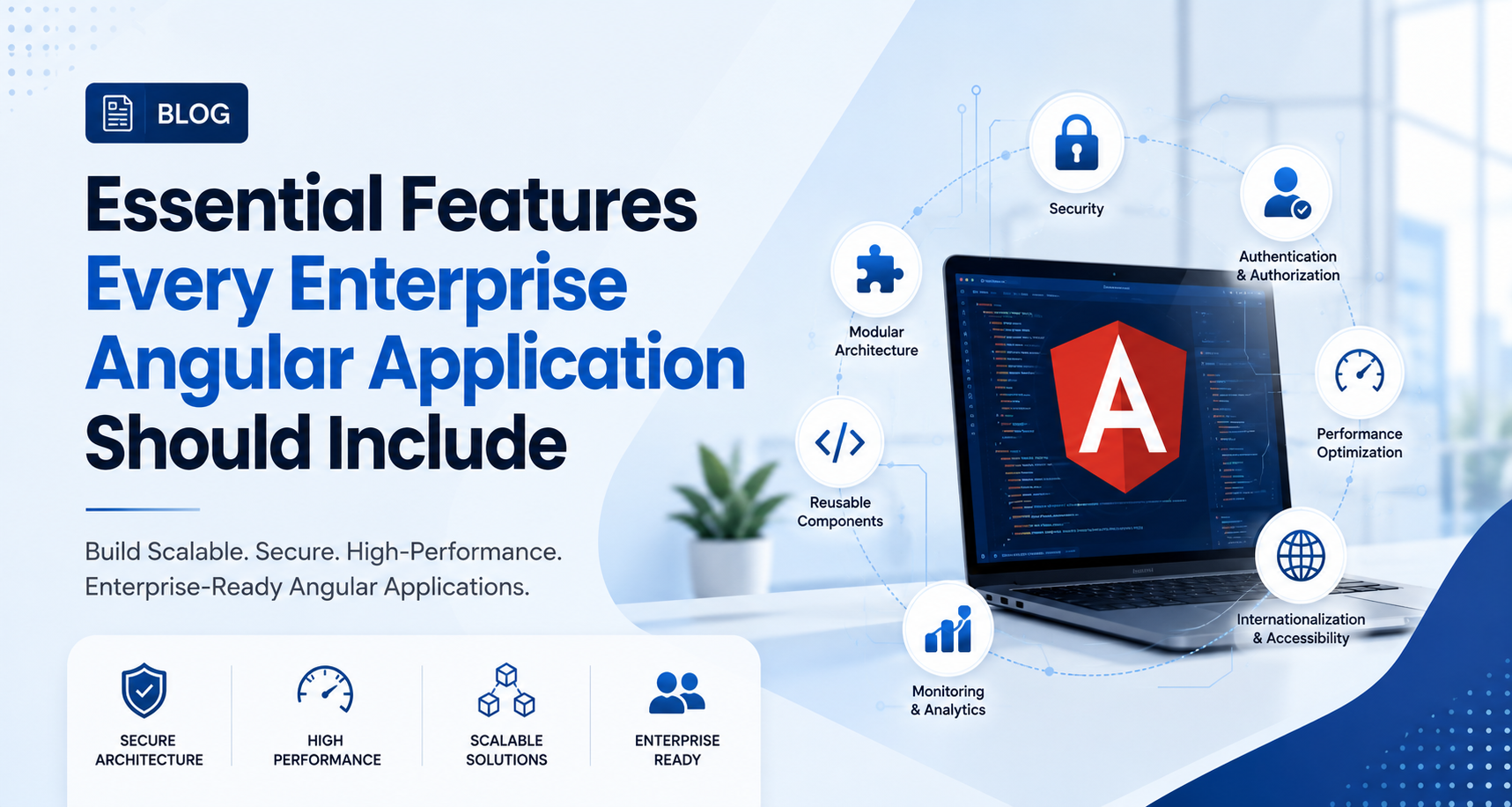
Understanding enterprise Angular application features is essential when building scalable, secure, and maintainable software for large organizations. Enterprise software has changed dramatically over the last few years. Organizations are no longer building simple dashboards or internal tools. They are creating interconnected ecosystems that support millions of users, integrate with dozens of business systems, and adapt to evolving regulations and customer expectations. In this environment, the front end is not just a presentation layer. It is a mission-critical part of the business.
Angular continues to be one of the strongest frameworks for these demanding scenarios because it provides structure, consistency, and long term maintainability. Large organizations in finance, healthcare, logistics, manufacturing, and SaaS often value these characteristics more than short term development speed.
However, choosing Angular is only the beginning. The architecture and features included during development determine whether an application remains scalable five years from now or becomes difficult to maintain after a handful of releases.
This guide explores the essential capabilities every enterprise Angular application should include, along with practical implementation advice and code examples.
Why Enterprises Continue to Choose Angular
Unlike lightweight frameworks that prioritize flexibility, Angular encourages standardized architecture. Teams spread across different countries and departments can work within predictable patterns, making onboarding and maintenance easier.
Some of the reasons enterprises continue investing in Angular include:
- Strong TypeScript integration for safer code
- Built in dependency injection
- Mature tooling and CLI support
- Excellent testing ecosystem
- Long term maintainability
- Modular architecture suitable for large applications
- Support for SSR, hydration, and modern rendering strategies
Organizations investing in digital transformation initiatives or expanding saas application development services often prefer Angular because consistency becomes increasingly valuable as engineering teams grow.
Enterprise Angular Application Features That Matter Most
1. Modular Architecture
Large codebases quickly become difficult to maintain if everything lives inside a single application module.
Instead, organize features into independent domains:
- User Management
- Billing
- Notifications
- Reporting
- Analytics
- Administration
This separation enables parallel development and simplifies testing.
A logistics company, for example, can allow one team to maintain shipment tracking while another enhances warehouse management without causing unnecessary conflicts.
Modern angular development services frequently organize applications around domain driven modules rather than technical layers alone.
2. Role Based Authentication and Authorization
Authentication identifies users. Authorization determines what they can access.
An enterprise healthcare portal may have:
- Doctors
- Nurses
- Administrators
- Billing staff
- Patients
Each role requires different permissions.
Example Route Guard
import { CanActivateFn } from '@angular/router';
import { inject } from '@angular/core';
import { AuthService } from './auth.service';

export const adminGuard: CanActivateFn = () => {
  const auth = inject(AuthService);

  return auth.hasRole('admin');
};
This route guard prevents unauthorized users from accessing protected sections of the application. It provides an additional security layer beyond server side validation.
3. Scalable Routing with Lazy Loading
Loading every feature during startup increases bundle size and slows user experience.
Angular’s lazy loading allows features to load only when needed.
{
  path: 'reports',
  loadChildren: () =>
    import('./reports/reports.routes')
      .then(m => m.REPORT_ROUTES)
}
Instead of downloading the reporting module immediately, users receive it only when navigating there. This improves initial load performance, especially for enterprise platforms with dozens of modules.
4. Reusable Component Library
Consistency matters.
A centralized component library should include:
- Buttons
- Tables
- Forms
- Dialogs
- Charts
- Navigation menus
- Cards
- Alerts
Reusable components reduce duplication and maintain consistent branding across products.
Many organizations supporting web portal development services build internal design systems that become shared assets across multiple projects.
5. Efficient State Management
Managing application state becomes increasingly challenging as complexity grows.
Angular developers typically choose among:
- Signals for localized reactive state
- RxJS streams for asynchronous operations
- NgRx for enterprise level predictable state management
Angular Signals Example
import { signal } from '@angular/core';

export class CounterService {
  count = signal(0);

  increment() {
    this.count.update(value => value + 1);
  }
}
Signals simplify reactive programming while reducing boilerplate for many common scenarios. They make state updates explicit and easier to understand.
For larger financial trading systems or inventory platforms, combining Signals with RxJS often provides an effective balance.
6. API Abstraction Layer
Components should never communicate directly with external APIs.
Instead, create dedicated service layers.
@Injectable({
  providedIn: 'root'
})
export class CustomerService {

  constructor(private http: HttpClient) {}

  getCustomers() {
    return this.http.get('/api/customers');
  }
}
This architecture centralizes business logic, simplifies testing, and makes backend migrations significantly easier.
Organizations delivering saas application development services often depend on this abstraction because APIs evolve independently from frontend releases.
7. Performance Optimization
Enterprise users expect applications to feel responsive regardless of complexity.
Key optimization techniques include:
- Lazy loading
- Tree shaking
- Image optimization
- Route preloading where appropriate
- Efficient change detection
- Server side rendering
- Hydration
- Bundle analysis
- Code splitting
Performance should be measured continuously rather than addressed only before launch.
8. Security Best Practices
Security cannot be treated as an afterthought.
Critical practices include:
- Content Security Policy implementation
- Secure JWT handling
- Input sanitization
- XSS prevention
- CSRF mitigation
- Strict HTTP headers
- API rate limiting
- Multi factor authentication support
- Server side authorization validation
Financial institutions often conduct penetration testing before production deployment because frontend vulnerabilities can expose sensitive business workflows.
9. Error Handling and Logging
Applications inevitably encounter failures.
Users should never see cryptic stack traces.
Create centralized error handling mechanisms that:
- Display friendly messages
- Capture diagnostics
- Send logs to monitoring systems
- Record contextual information
HTTP Interceptor Example
@Injectable()
export class AuthInterceptor implements HttpInterceptor {

  intercept(req: HttpRequest<any>, next: HttpHandler) {

    const cloned = req.clone({
      setHeaders: {
        Authorization: 'Bearer token'
      }
    });

    return next.handle(cloned);
  }
}
Interceptors automatically attach authentication headers and can also handle retries, logging, or request transformation across the application.
10. Responsive User Interface
Enterprise software is increasingly accessed from tablets and mobile devices.
Operations managers may approve requests from airports while warehouse supervisors update inventory from handheld devices.
Responsive layouts should adapt seamlessly without sacrificing functionality.
Testing across multiple screen sizes should become part of release validation.
11. Accessibility Compliance
Accessibility benefits everyone, not only users with disabilities.
Applications should support:
- Keyboard navigation
- Screen readers
- Sufficient color contrast
- Semantic HTML
- Focus indicators
- Proper form labels
- ARIA attributes where necessary
Accessibility compliance also reduces legal risk in many regulated industries.
12. Internationalization
Global businesses rarely serve a single language.
Angular’s internationalization capabilities allow organizations to support:
- Multiple languages
- Regional date formats
- Currency localization
- Number formatting
- Right to left layouts
An international SaaS vendor may deliver the same product across Europe, Asia, and the Middle East while presenting culturally appropriate interfaces.
13. Comprehensive Testing Strategy
Testing should exist at several levels.
Include:
- Unit tests
- Integration tests
- Component tests
- End to end automation
- API contract testing
- Visual regression testing
A mature testing strategy reduces deployment risk and increases developer confidence.
14. Monitoring and Analytics
Observability extends beyond server metrics.
Monitor:
- Frontend exceptions
- User sessions
- API latency
- Page performance
- Resource loading
- User flows
- Core Web Vitals
Real user monitoring often reveals bottlenecks that synthetic benchmarks miss.
15. CI/CD Readiness
Enterprise teams deploy frequently.
A modern pipeline should automate:
- Static analysis
- Linting
- Unit testing
- Security scanning
- Build validation
- Artifact generation
- Environment promotion
- Deployment approval workflows
Automation minimizes human error while enabling predictable releases.
Example Service Architecture
Separating responsibilities keeps applications maintainable.
@Injectable({
  providedIn: 'root'
})
export class OrderRepository {

  constructor(private http: HttpClient) {}

  fetchOrders() {
    return this.http.get('/api/orders');
  }
}

@Injectable({
  providedIn: 'root'
})
export class OrderFacade {

  constructor(private repository: OrderRepository) {}

  getOrders() {
    return this.repository.fetchOrders();
  }
}
Here, the repository focuses on data access while the facade coordinates business interactions. Components remain lightweight and easier to test.
Common Mistakes Enterprises Should Avoid
Even experienced teams encounter architectural pitfalls.
Some of the most common include:
- Building monolithic modules that become impossible to maintain
- Placing business logic directly inside components
- Ignoring lazy loading until performance suffers
- Skipping accessibility reviews
- Hardcoding API endpoints throughout the codebase
- Using inconsistent state management patterns
- Delaying automated testing until late in development
- Neglecting centralized logging and monitoring
- Overengineering small features with unnecessary complexity
Another frequent mistake is selecting technology based solely on trends instead of organizational needs. A highly structured Angular architecture may outperform lighter alternatives when dozens of engineers collaborate over many years.
Checklist Before Launching an Enterprise Angular App
Before production deployment, verify the following:
- Modular architecture is implemented
- Authentication and authorization are fully tested
- Route guards protect sensitive pages
- Lazy loading minimizes initial bundle size
- Shared components are standardized
- API communication is abstracted through services
- State management follows consistent patterns
- Error logging captures production failures
- Security reviews have been completed
- Accessibility standards are satisfied
- Internationalization requirements are addressed
- Automated tests pass consistently
- Monitoring dashboards are operational
- CI/CD pipelines deploy reliably
- Performance metrics meet business targets
Completing this checklist significantly improves long term maintainability and operational stability.
Future Trends in Enterprise Angular Development
Angular continues evolving alongside enterprise requirements.
Several trends are shaping development in 2026:
Wider Adoption of Signals
Signals are becoming central to reactive programming, reducing unnecessary complexity while improving readability.
Server Side Rendering and Hydration
Organizations increasingly adopt SSR and hydration to improve perceived performance and search engine discoverability for public facing applications.
Micro Frontends
Large organizations split applications into independently deployable modules owned by separate teams, reducing coordination bottlenecks.
AI Assisted Development
Development tools increasingly automate repetitive coding tasks, documentation generation, and testing while leaving architectural decisions to engineers.
Enhanced Observability
Frontend telemetry is becoming as important as backend monitoring, providing insight into real user experiences and production issues.
Edge Aware Architectures
More enterprise systems combine distributed infrastructure with optimized frontend delivery to reduce latency for global users.
As these trends mature, teams offering angular development services and organizations investing in web portal development services will increasingly prioritize modularity, observability, and resilient architecture over purely feature driven development.
Conclusion
Enterprise Angular applications succeed because of thoughtful architecture rather than framework choice alone. Features such as modular design, scalable routing, secure authentication, efficient state management, comprehensive testing, observability, accessibility, and performance optimization create software that remains reliable under continuous growth.
Businesses expanding digital ecosystems or investing in saas application development services should view these capabilities as foundational infrastructure instead of optional enhancements. While implementing them requires discipline and planning, the payoff is substantial: faster iteration, easier maintenance, improved security, and a platform that can adapt to changing business demands without constant rewrites.
The strongest enterprise Angular applications are not simply those with the most features. They are the ones designed from the beginning with scalability, maintainability, and long term business value in mind.
By prioritizing the right enterprise Angular application features, development teams can create solutions that remain reliable, performant, and easy to maintain as business requirements evolve.