

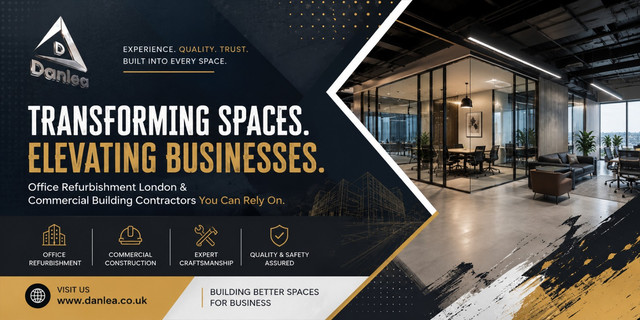
The nature of office work has undergone a fundamental transformation. Collaboration, flexibility, and employee experience have become central priorities for businesses that want to attract talent and sustain high performance. For companies rethinking their workplace strategy, working with specialists in office refurbishment London who understand the principles of contemporary workplace design is the starting point for a space that genuinely works.
The Shift Away from Traditional Office Models
The traditional office — rows of fixed desks, formal meeting rooms, and rigid hierarchy expressed through corner offices and partitioned territories — no longer serves the way most organisations actually operate. Knowledge workers move fluidly between different types of tasks throughout the day, from individual focused work to spontaneous collaboration, from formal client meetings to informal team discussions.
A workspace designed around a single mode of working inevitably fails to support the full range of activities that constitute a productive working day. Contemporary office design responds to this reality by providing a variety of environments that employees can choose between depending on what they need at any given moment.
Activity-Based Working in Practice
Activity-based working is a design philosophy that replaces assigned desks with a range of spaces, each optimised for a different type of activity. A well-designed activity-based office typically includes focus zones for concentrated individual work, where acoustic privacy and freedom from interruption are prioritised. It also features collaborative areas with flexible furniture configurations that can accommodate everything from a two-person conversation to a team brainstorm. Additionally, there are formal meeting rooms equipped with presentation technology, telephone booths or pods for private calls, social spaces that encourage informal connection and spontaneous conversation, and project spaces where teams can pin up work-in-progress and leave materials between sessions.
The key to making activity-based working successful is not the variety of spaces alone, but the cultural shift that accompanies it. Employees need to understand and embrace the ethos of moving through the office and choosing the right environment for the task at hand.
Technology Integration
Technology is now inseparable from the physical workspace. A contemporary collaborative office depends on seamless, reliable connectivity, intuitive video conferencing facilities in every meeting space, easy-to-use room booking systems, and the ability to move between locations without losing access to tools and information.
Designing technology infrastructure into the refurbishment from the outset — rather than retrofitting it — produces a vastly superior result. This means thinking carefully about data and power provision at every workpoint, specifying meeting room technology that is simple enough for all users to operate without assistance, and building in capacity for future technological evolution.
Acoustics in Collaborative Spaces
One of the most common challenges in open and collaborative offices is noise management. While some ambient noise is beneficial for creative thinking, uncontrolled noise — particularly intelligible speech — significantly impairs concentration and increases stress.
Effective acoustic design in a collaborative office uses a layered approach: sound-absorbing materials in the construction fabric, acoustic panels and ceiling baffles to reduce reverberation, strategic spatial planning to separate noisy and quiet zones, and soft furnishings that absorb rather than reflect sound. Experienced building contractors near me who specialise in commercial fit-out will be able to model the acoustic performance of proposed layouts before construction begins.
Branding and Identity
The office is one of the most powerful expressions of your organisational identity. Every design decision — from the materials and colours used to the art displayed on the walls and the layout of the reception area — communicates something about who you are and what you value.
A thoughtful refurbishment integrates your brand identity into the physical environment in ways that feel authentic rather than superficial. This goes beyond applying your logo to the walls; it involves articulating the values and culture you want the space to express and working with designers who can translate those qualities into spatial and material decisions.
Wellness-Centred Design
Employee wellbeing is not a trend but a strategic imperative. Workplaces that support physical and mental health see lower absenteeism, higher engagement, and stronger retention. Design features that contribute to wellbeing include access to natural light, good indoor air quality, appropriate thermal comfort, access to outdoor space or views of nature, and spaces that support rest and recuperation as well as work.
Frequently Asked Questions
How do I know if activity-based working is right for my organisation? Activity-based working is most effective in organisations where employees already have a degree of flexibility in how and where they work. A workplace consultant or refurbishment specialist can help you assess whether your working culture is compatible with this model.
How much space do I need per person in an activity-based office? This varies significantly depending on your occupancy patterns and the range of spaces provided, but many organisations find they can accommodate more people in a well-designed activity-based office than in a conventional assigned-desk model.
What technology is essential in a modern collaborative office? At minimum, reliable high-speed Wi-Fi throughout, video conferencing equipment in all meeting spaces, and a room booking system are essential. The specific technologies appropriate for your business will depend on how your team works.
How do I manage the cultural transition to activity-based working? Communication, training, and clear expectations are key. Engage employees early, explain the reasoning behind the changes, and allow time for adaptation. Leadership buy-in and visible adoption by senior team members is particularly important.Can collaborative workspace design work for smaller offices? Yes. The principles of activity-based working can be scaled to any size of office. Even in a small space, providing two or three distinct types of environment — a focus area, a collaboration area, and a social space — can significantly improve how the space functions.