
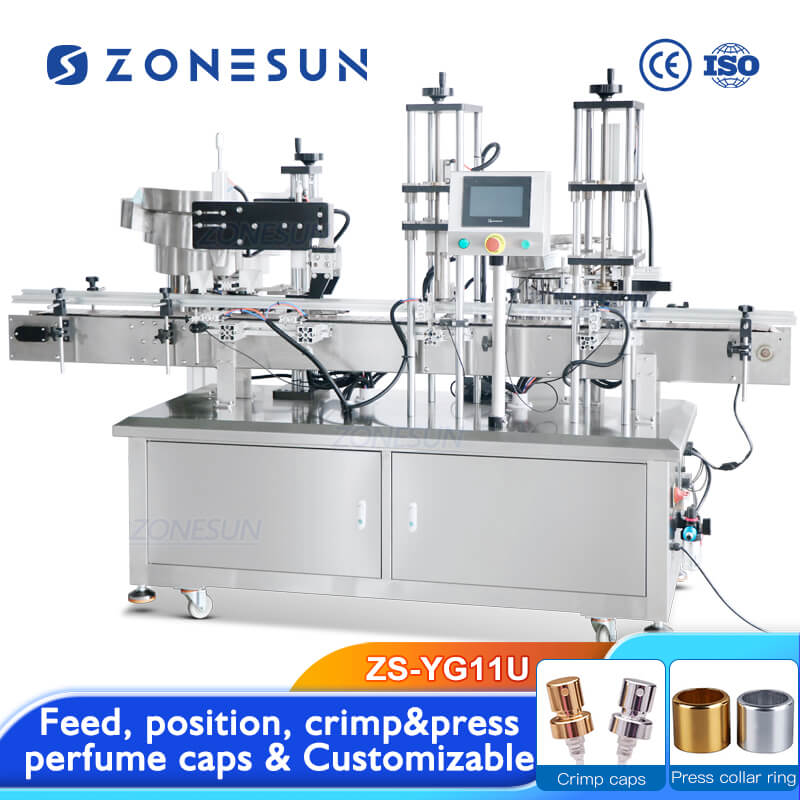
In the world of luxury fragrances, the final moments of the bottling process carry enormous importance. The seal applied by the capping machine is the last line of defense against evaporation and contamination, and the visual result of the capping operation directly affects the premium perception of the finished product. Investing in the right perfume capping machine is a decision that impacts product quality, production efficiency, and brand reputation simultaneously. Perfume capping machines are specialized pieces of packaging equipment designed to apply closures to fragrance bottles with precision, consistency, and care — very different requirements from standard capping equipment used in food or household product bottling.
Matching Closure Type to Machine Capability
The type of closure used on your perfume bottles is the primary determinant of the capping machine type you need. Press-on caps, the most common closure style in the fragrance category, require controlled downward force sufficient to fully seat the cap without distorting or marking its surface. Screw caps require a rotary capping head with precise torque control. Crimp closures, used on many atomizer and spray pump bottles, require specialized crimping tooling that applies radial force to deform the crimp ring around the bottle neck. A flexible perfume capping machine with quickly interchangeable tooling allows a single machine to cap different bottle and closure combinations with minimal changeover time.
Cap Feeding Systems and Orientation Technology
The feeding system for caps and closures is an important subsystem of any perfume capping machine. Bowl feeders are the most common approach for mass-produced closures, sorting and orienting caps from a bulk supply and delivering them in a consistent orientation to the capping head. For decorative or irregular closures that are difficult to orient mechanically, manual loading of pre-oriented caps or vision-guided robotic pick-and-place systems may be more appropriate. The reliability of the cap feeding system directly impacts production efficiency — misfeeds and jams cause downtime and potential damage to bottles waiting at the capping station, affecting overall line output and production schedule adherence.
Cleanroom Compatibility and Hygienic Design Standards
Cleanroom compatibility may be a requirement for high-end fragrance production facilities or for products positioned at the ultra-luxury tier of the market. Machines designed for cleanroom installation use materials and construction approaches that minimize particle generation and facilitate cleaning to cleanroom standards. If your production environment requires cleanroom compliance, this requirement should be specified clearly to prospective machine suppliers at the outset of the selection process. Energy efficiency and compact footprint are practical considerations for facility planning — modern perfume capping machine are increasingly designed to minimize energy consumption through servo-driven mechanisms that consume power only when performing useful work.
Vision Inspection, Traceability, and Production Data
Vision inspection systems positioned immediately downstream of the capping machine are highly recommended for fragrance production lines. These systems verify cap presence, correct seating, cap orientation, and surface quality at production speed, automatically diverting bottles that fail inspection. Lot traceability requirements in the fragrance industry make data capture capabilities valuable in capping machines — integration with track-and-trace systems, lot coding equipment, and production management systems enables manufacturers to associate production data and quality inspection results with specific production lots, supporting quality management, recall management, and regulatory compliance across global distribution networks.
Supplier Expertise, ROI Analysis, and Making the Right Choice
The ROI case for investing in a high-quality perfume capping machine is compelling. Reduced labor costs, lower defect rates, higher throughput, and consistent cap application quality all contribute to improved profitability. When evaluated against the total cost of manual capping or lower-quality automated solutions, a premium perfume capping machine often delivers a rapid payback period along with enhanced quality and operational reliability. Technical support and spare parts availability from the machine supplier are critical operational considerations — a supplier with responsive technical support and ready availability of critical spare parts minimizes production disruptions and supports the reliability of your production schedule across seasonal peaks.
