

Introduction
In today’s competitive manufacturing landscape, engineers and procurement managers face the persistent challenge of producing metal or plastic parts with complex surfaces, precision hole systems, or those requiring multiple setups in a cost-effective manner. While traditional 3-axis machining centers are widely used, they often necessitate multiple fixturing for complex workpieces. This introduces cumulative errors, compromises overall accuracy, and significantly increases production time and cost.
This article delves into 5-axis CNC machining technology, explaining how it completes complex processing in a single setup, thereby enhancing precision and surface quality while dramatically shortening lead times. So, how exactly does this technology achieve this manufacturing leap?
What is 5-Axis CNC Machining, and How Does It Fundamentally Differ from 3-Axis Machining?
Core Definition and Axes of Motion
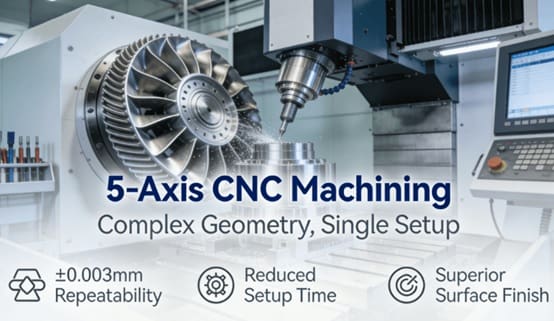
The National Institute of Standards and Technology (NIST) of the United States outlines the fundamentals of numerical control systems as follows:5-axis CNC machining is an advanced form of CNC Machining where a cutting tool moves along five different axes simultaneously. These consist of the three linear axes (X, Y, and Z) found in standard mills, plus two rotational axes (typically A and C, or A and B). The rotational axes allow the cutting tool to approach the workpiece from virtually any direction in a single setup, enabling the creation of highly complex geometries .
The Principle of Multi-Axis Interpolation
The core of this technology lies in multi-axis interpolation, where all five axes move in a coordinated, pre-programmed motion. This can be visualized as the toolpath smoothly navigating complex contours without the need to stop and reposition the workpiece. This simultaneous movement is what enables the creation of highly complex geometries that are impossible with simpler machines .
The Paradigm Shift: Single Setup Manufacturing
- Freedom of Movement and Machining Scope
The fundamental difference in 3-axis vs 5-axis CNC lies in freedom of movement and the resulting machining scope. A 3-axis machine is limited to approaching the workpiece from three perpendicular directions. To machine different sides, an operator must manually reposition it, which requires multiple setups. In contrast, a 5-axis machine rotates the workpiece on the two additional axes, bringing the required area to the tool. This eliminates the need for multiple fixtures and manual intervention .
- Unlocking Revolutionary Advantages
This “single setup” capability is the source of 5-axis machining’s revolutionary advantages. It eradicates the cumulative errors from re-clamping a part multiple times, ensuring exceptional dimensional consistency and higher overall accuracy. It also dramatically reduces non-cutting time associated with setup changes, leading to significantly faster production cycles . For a comprehensive breakdown of the definition, process, and types, 5-axis CNC machining technology provides a detailed analysis.
Why is 5-Axis Technology Considered the Ideal Choice for Complex Part Machining and Rapid Prototyping?
- axis CNC technology is exceptionally well-suited for complex CNC machining tasks involving intricate geometries. It excels at producing parts with compound curves, deep cavities, undercuts, and inclined features that would be challenging or impossible to machine accurately with 3-axis equipment. Prime examples include impellers, turbines, medical implants, and complex aerospace structural components .
In the realm of Rapid Prototyping, 5-axis machining offers immense value by accelerating the design verification cycle. It allows engineers to produce functional prototypes that are geometrically identical to the final production part. This enables more accurate testing of form, fit, and function, ultimately reducing the time from design to market. The ability to create high-fidelity prototypes in the intended engineering material provides a significant advantage .
The technology is a cornerstone of modern Precision Machining. By maintaining the optimal cutting angle and using shorter, more rigid tools, 5-axis machines achieve superior surface finishes and tighter tolerances on complex surfaces. This minimizes the need for secondary finishing operations and ensures that the prototype or part meets the highest quality standards from the outset .
How Does 5-Axis High-Speed Machining Enhance Efficiency and Impact Overall Cost?
5 axis high speed CNC machining combines the geometric freedom of multi-axis movement with optimized cutting parameters. A key efficiency driver is the ability to orient the tool to maintain a constant chip load and the most favorable cutting position. This not only allows for higher feed rates but also reduces tool vibration and wear, extending tool life .
The efficiency gains are substantial. The most obvious is the drastic reduction in machining time achieved by combining multiple operations into one setup. Furthermore, the need for complex and expensive custom fixtures is often eliminated, simplifying logistics and reducing preparation time. A part that previously required several operations on different machines can now be completed in one continuous process on a single 5-axis machine .
While the hourly rate for a 5-axis machine may be higher, a holistic cost analysis for Custom Machining projects often reveals a lower total cost per part. This cost optimization stems from significantly reduced total machining time, lower labor costs due to less manual intervention, decreased fixture expenses, and a lower scrap rate thanks to higher accuracy. This makes advanced CNC Technology not just a technical choice, but a financially sound one for complex components .
What Qualifications and Capabilities Should Be Prioritized When Selecting a 5-Axis CNC Machining Service Provider?
Choosing the right provider of 5 axis CNC machining services is critical to project success. Several key factors must be evaluated to ensure a partner can deliver on quality, timing, and cost.
Technical Capabilities and Quality Assurance
The assessment should begin with the provider’s technical foundation. This includes the brands, age, and precision specifications of their 5-axis equipment. Equally important is the expertise of their CAM programmers in generating efficient, collision-free toolpaths for complex multi-axis movements. A robust quality control system, verified by tools like Coordinate Measuring Machines (CMM), is non-negotiable for ensuring parts meet specified tolerances .
The Importance of Certifications and Proven Experience
- Quality Management Systems
International certifications are objective indicators of a supplier’s commitment to quality and consistency. Certifications such as ISO 9001 (Quality Management), IATF 16949 (Automotive), and AS9100D (Aerospace) demonstrate that the supplier has implemented rigorous processes for quality control, traceability, and continuous improvement. These standards are fundamental for reliable CNC Services .
- Industry-Specific Application
Proven experience in relevant industries is a significant advantage. A supplier familiar with the specific challenges of aerospace, medical, or automotive sectors will have a deeper understanding of material behavior, regulatory requirements, and design for manufacturability principles. For instance, a supplier like CNC Protolabs, which holds multiple stringent certifications, has applied its 5-axis machining services extensively in the aerospace field, ensuring adherence to the highest standards . To learn more about the capabilities and equipment details of professional-grade 5 axis CNC machining services.
What Are the Future Development Trends for 5-Axis CNC Technology?
The evolution of 5 axis CNC Machining is closely tied to broader trends in digitalization and automation within CNC Technology. One significant trend is hybrid manufacturing, which integrates 5-axis subtractive machining with additive manufacturing (3D printing). This allows for the creation of complex near-net-shape structures via 3D printing, which are then finished to high precision using 5-axis machining, combining the design freedom of additive with the accuracy of subtractive methods .
Automation and intelligence are another major direction. The integration of robotics for automated part loading and unloading is becoming more prevalent, enabling “lights-out” manufacturing and significantly boosting productivity. Furthermore, AI-driven optimization of machining parameters is emerging. These systems can analyze sensor data in real-time to adjust feed rates and speeds autonomously, maximizing tool life and machining efficiency .
Real-time monitoring and predictive maintenance are also advancing. Using IoT sensors and digital twin technology, research by the UK Welding Institute on smart manufacturing points out that modern 5-axis machines can monitor their own health, tracking factors like vibration, temperature, and spindle load. This data enables predictive maintenance, scheduling service before a failure occurs, which maximizes machine uptime and ensures consistent quality .
Conclusion
In summary, 5-axis CNC machining technology has established itself as a cornerstone of modern precision manufacturing through its unparalleled ability to handle complex geometries, maintain supreme accuracy, and deliver remarkable efficiency gains. It effectively addresses the limitations of traditional multi-setup machining, breaking through the bottlenecks of accuracy loss and time consumption.
If your next project involves complex design challenges or has stringent requirements for cost and timeline, it is advisable to consult a professional 5-axis CNC machining service provider. Obtain a customized machining solution and quotation for your specific part, and personally experience the value brought by this technological innovation.
Author Biography
The author is a senior manufacturing technology consultant at CNC Protolabs, with over 15 years of experience in precision machining. He focuses on the application and innovation of 5-axis CNC technology and has led the process development and mass production solutions for complex components in the aerospace and medical device fields.
FAQs
Q1: Is 5-axis CNC machining only suitable for metal materials?
A1: No. 5-axis CNC machining centers are equally suitable for processing a variety of engineering plastics, composites, and even wood. Material selection depends more on the part’s end-use requirements, while 5-axis technology itself provides an efficient means for shaping complex forms from various materials .
Q2: Is 5-axis programming extremely complex and time-consuming compared to 3-axis programming?
A2: Yes, 5-axis programming is indeed more complex and requires professional CAM software and experienced engineers. However, this upfront investment yields significant returns during the machining stage by eliminating the need for multiple setups and dedicated fixtures, typically resulting in a shorter overall project cycle .
Q3: Can 5-axis machining truly reduce the cost of small-batch production?
A3: Absolutely. For small batches of complex parts, 5-axis machining often proves more economical than using 3-axis machines by reducing setups, fixture costs, and preparation time. It partially decouples design complexity from production costs .
Q4: How can I determine if my part requires 5-axis machining?
A4: If a part has multiple surfaces that need machining, or contains complex curved surfaces, deep cavities, inclined holes, or other features that would require multiple re-clamping on a 3-axis machine, it is likely an excellent candidate for 5-axis machining .
Q5: How is the accuracy of a 5-axis CNC machine guaranteed?
A5: High-precision 5-axis machines are built to strict manufacturing standards. Furthermore, authoritative international quality system certifications ensure that the supplier implements a full-process quality control from programming and machining to final inspection, often using CMMs, to guarantee part accuracy .