

Introduction
In modern manufacturing, engineers often face costly quotes and efficiency bottlenecks when sourcing 5-axis CNC machining services for complex parts. The root cause lies in a lack of understanding of technical factors like machine kinematics and programming strategies, coupled with unsystematic supplier evaluation.
This article demystifies how 5-axis CNC machining works, analyzes key cost drivers, and provides a framework for selecting reliable partners. By addressing these elements, manufacturers can avoid hidden expenses and achieve faster project cycles. The following sections explore these aspects in detail to empower informed decision-making.
What Are the Key Advantages of 5-Axis CNC Machining for Complex Part Manufacturing?
5-axis CNC machining offers transformative benefits over traditional methods, particularly for components with intricate geometries.
1. Single-Setup Machining for Error Reduction
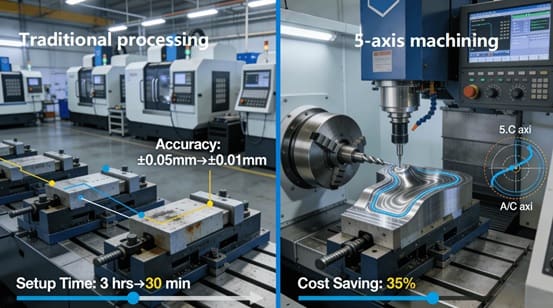
Unlike 3-axis systems requiring multiple fixtures, 5-axis technology enables complete machining in one setup, eliminating cumulative errors from repositioning. For example, aerospace components with free-form surfaces can be produced with tolerances within ±0.01mm, reducing scrap rates by up to 30% compared to multi-step processes. This approach ensures consistent precision across production batches, which is critical for high-stakes industries like medical devices where reliability is paramount. Additionally, the reduction in handling minimizes human error, further enhancing overall quality assurance and throughput.
2. Enhanced Geometric Freedom and Efficiency
The dynamic tool orientation allows uninterrupted access to deep cavities and undercuts, enabling efficient side-cutting instead of slow ball-end tool processes. Studies show this can cut machining time by 50% for parts like impellers or medical implants, while simultaneously improving surface finish quality. This geometric flexibility supports innovative designs previously deemed unmanufacturable, such as integrated cooling channels in automotive molds. By leveraging continuous tool paths, manufacturers achieve higher material removal rates and extended tool life, optimizing long-term operational costs.
3. Cost Savings Through Consolidation
By integrating multiple features into a single part, 5-axis machining reduces assembly steps and material waste, leading to significant lifecycle savings. A case study involving drone frames demonstrated a 40% lower total cost due to simplified workflows and fewer secondary operations. This consolidation minimizes logistics overhead and accelerates time-to-market, making the technology ideal for both prototyping and mass production. Moreover, the ability to produce complex geometries in one piece enhances structural integrity, reducing failure points in critical applications.
How Does 5-Axis CNC Machining Work to Enhance Production Efficiency?
The operational principles of 5-axis machining hinge on synchronized motion control and advanced software integration.
- Kinematics of Linear and Rotational Axes: 5-axis systems combine linear movements (X, Y, Z) with rotational axes (e.g., A and C), allowing tools to approach workpieces from optimal angles. This dynamic orientation minimizes toolpath interruptions and maintains constant cutting forces, enhancing efficiency and surface quality. For instance, 5-axis CNC machining services leverage this capability to tackle complex contours in automotive molds, achieving smoother finishes without manual polishing. The synchronized motion also reduces cycle times by up to 25%, as tools can engage materials more effectively throughout the process.
- Adherence to ASME Y14.5 Standards: Compliance with standards like ASME Y14.5-2018 ensures consistent geometric tolerancing by maintaining a single datum throughout machining. This is vital for parts requiring tight tolerances, as it avoids deviations from multiple setups, upholding integrity in sectors like aerospace and medical devices. The standard provides a framework for defining datums and tolerances, which 5-axis technology upholds through its unified coordinate system. This adherence reduces inspection time and ensures components meet rigorous industry specifications without rework.
- Software-Driven Toolpath Optimization: CAD/CAM software, such as Siemens NX, generates collision-free toolpaths by simulating rotations and translations in a virtual environment. Advanced algorithms optimize feed rates and tool angles, reducing cycle times by 25% while preserving tool life, as evidenced in turbine blade production. The software also enables predictive adjustments for thermal expansion and tool wear, enhancing accuracy for high-precision components. This digital twin approach allows engineers to validate processes before physical machining, minimizing risks and resource waste.
What Factors Directly Impact the Accuracy and Cost of a 5-Axis CNC Machining Quote?
Understanding cost drivers helps manufacturers negotiate transparent quotes and avoid unforeseen expenses.
1. Machine Capabilities and Programming Complexity
High-spindle-speed machines and sophisticated programming can account for 20% of total quotes, as complex parts require detailed CAM strategies. For example, components with thin walls demand slower feed rates to prevent vibration, increasing machining time and cost. Optimizing CAM strategies through simulation can save 15% by streamlining tool changes and minimizing air cuts. Additionally, newer machines with higher torque and stability handle difficult materials more efficiently, impacting both upfront and operational expenditures.
2. Material Selection and Its Financial Implications
Materials like titanium or PEEK incur higher costs due to specialized tooling and longer machining times, which must be factored into quotes. A titanium aerospace bracket might cost 60% more than an aluminum equivalent, emphasizing the need for DFM analysis to balance performance and budget. Material availability and waste rates also influence pricing, with exotic alloys often requiring additional certifications and handling procedures. Suppliers should provide transparent data on material yield to help clients make informed decisions.
3. Transparency in Quoting and Avoidance of Hidden Fees
Suppliers should provide itemized breakdowns covering programming, setup, material, and post-processing costs to ensure accountability. Vague quotes often hide charges for manual polishing or extra inspections, leading to budget overruns. Requesting documentation aligned with ISO 9001 standards helps verify that all aspects, such as tool wear compensation and quality checks, are included. Clients can also ask for scenario-based quotes to compare different design alternatives and optimize for cost-efficiency.
How Can Manufacturers Ensure Precision and Quality in 5-Axis CNC Machining?
Robust quality systems are non-negotiable for precision-critical applications across industries.
1. In-Process Monitoring and Closed-Loop Control
Integrating on-machine probes enables real-time dimension checks during machining, automatically correcting errors from tool wear or thermal drift. For medical devices, this closed-loop system maintains tolerances within ±0.005mm, adhering to FDA guidelines and reducing scrap rates. The data collected also supports predictive maintenance, ensuring machines operate within specified parameters throughout production runs. This proactive approach minimizes downtime and ensures consistent output for high-volume orders.
2. Certification Frameworks like ISO 9001 and AS9100D
Certifications mandate rigorous process controls and full traceability from material sourcing to final inspection. Suppliers with AS9100D certification, for instance, follow aerospace-grade protocols that include detailed documentation and regular audits. These frameworks ensure that every step, such as calibration and staff training, is standardized to prevent deviations. Manufacturers should verify certifications periodically to maintain compliance and adapt to evolving industry standards.
3. Post-Machining Validation with CMM and Laser Scanning
Coordinate measuring machines (CMMs) compare finished parts to CAD models, generating deviation reports for validation and continuous improvement. This step is crucial for industries like automotive, where IATF 16949 requires comprehensive first-article inspections to prevent defects. Laser scanning adds another layer of accuracy for free-form surfaces, ensuring even complex geometries meet design specifications. The data archived from these checks provides a traceable record for quality audits and client reviews.
What Are the Common Pitfalls in Selecting a 5-Axis CNC Machining Supplier?
Avoiding supplier-related risks requires diligent evaluation beyond initial price comparisons.
1. Overemphasizing Low Cost Over Technical Capability
Choosing suppliers solely for budgetary reasons often leads to compromises on machine calibration or operator expertise, resulting in quality issues. For example, uncalibrated machines may cause tolerance drift, necessitating costly reworks and delays. A thorough assessment should include reviews of equipment maintenance records and staff certifications to ensure technical prowess aligns with project demands. This due diligence prevents long-term expenses from overshadowing short-term savings.
2. Neglecting Case Studies and Certification Verification
A lack of verified project portfolios or relevant certifications like ISO 13485 for medical devices can signal inexperience with complex geometries. Always review past work on similar components to assess capability, and request references to validate performance claims. Suppliers should provide detailed case studies demonstrating how they solved specific challenges, such as achieving tight tolerances on thin-walled parts. This evidence-based selection reduces the risk of project failures.
3. Inadequate Focus on Communication and Customization
Suppliers without dedicated engineering support may fail to offer DFM advice, leading to design flaws that increase costs. In contrast, partners providing collaborative design reviews help optimize parts for manufacturability, avoiding delays and change orders. Regular progress updates and transparent communication channels are essential for addressing issues early. Evaluating a supplier’s responsiveness during the quoting phase can indicate their commitment to long-term collaboration and success.
How to Integrate 5-Axis CNC Machining into Product Development for Faster Time-to-Market?
Seamless integration accelerates innovation from concept to production while maintaining quality standards.
- Rapid Prototyping for Iterative Design Validation: Using 5-axis machining for functional prototypes allows testing under real-world conditions, identifying design flaws early. A medical device firm reduced development cycles by 30% by iterating designs directly with machined samples, avoiding costly mold modifications. This approach enables rapid validation of fit, form, and function, ensuring final products meet performance expectations. Close collaboration between design and manufacturing teams throughout this phase optimizes the transition to mass production.
- Streamlining Workflows with Digital Twins and IoT: Linking 5-axis machines to manufacturing execution systems (MES) enables predictive maintenance and adaptive machining based on real-time data. Smart factories use IoT integration to monitor spindle health and cutting conditions, preempting downtime by up to 20% in high-mix production. Digital twins simulate entire processes, allowing optimization of toolpaths and resource allocation before physical machining. This digital thread reduces trial-and-error, shortening lead times and enhancing overall efficiency.
- Cross-Industry Application Examples: In automotive, 5-axis machining produces lightweight components with integrated cooling channels, slashing assembly time and improving performance. Aerospace applications benefit from consolidated parts that reduce weight and compliance costs. Embracing these strategies across sectors helps achieve faster time-to-market without sacrificing quality, as demonstrated by companies that integrate 5-axis technology early in the design phase. This proactive adoption fosters innovation and competitive advantage in fast-paced markets.
Conclusion
5-axis CNC machining, when paired with strategic supplier selection, directly addresses cost transparency and manufacturing efficiency. By mastering technical nuances and prioritizing certified partners, engineers can overcome quoting challenges and drive innovation. To explore tailored solutions, engage with experts who align with your project goals and demonstrate a commitment to quality and collaboration.
FAQs
Q1: What is the typical lead time for 5-axis CNC machining services?
A: Lead times vary based on complexity, but standard prototypes typically deliver in 5-7 days, while mass production may take 2-3 weeks. Factors like material availability and design validation influence scheduling, but optimized processes can expedite urgent needs.
Q2: How does 5-axis CNC machining improve accuracy compared to 3-axis?
A: 5-axis machining enables continuous tool positioning, reducing repositioning errors and achieving tolerances within ±0.01mm. This single-setup approach, validated by standards like ASME Y14.5, minimizes cumulative deviations for superior consistency.
Q3: What materials are best suited for 5-axis CNC machining?
A: Common materials include aluminum, titanium, and engineering plastics, chosen for machinability and strength. High-temperature alloys like Inconel are also feasible, though material selection impacts cost and cycle time.
Q4: Can 5-axis CNC machining handle large-sized parts?
A: Yes, within machine limits — typical work envelopes are 1200x800x500mm. Larger parts may require specialized equipment or segmentation, with feasibility assessed through DFM analysis.
Q5: How do I verify the quality of 5-axis CNC machined parts?
A: Quality is ensured via in-process inspections using CMMs and adherence to ISO 9001. Suppliers provide material certifications and first-article reports, with full documentation available for critical applications.
Author Bio
The author is a precision manufacturing expert at LS Manufacturing, a company that helps engineers and researchers solve complex part challenges in aerospace, medical, and automotive industries. With certifications such as IATF 16949 and AS9100D, the team ensures high-quality solutions through advanced technologies. For further insights, contact them immediately. They will provide you with free, no-obligation project assessments and DFM analysis to help you transform your ideas into cost-effective, practical solutions.