

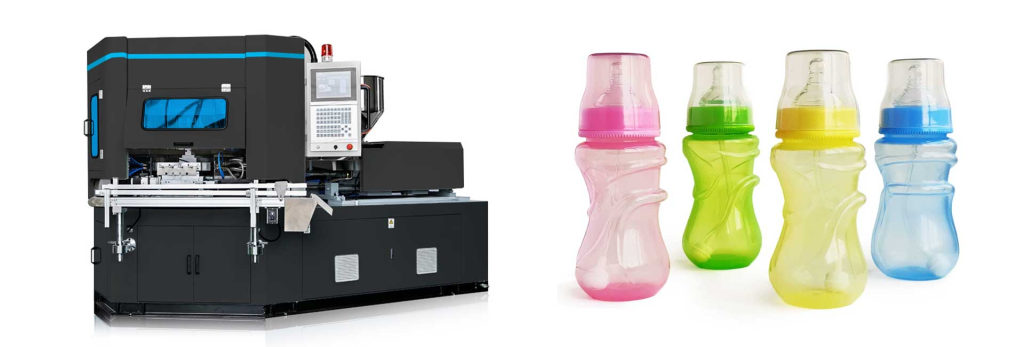
In baby product manufacturing, safety and consistency are non-negotiable. The baby feeding bottle machine is an advanced industrial system designed to produce high-quality feeding bottles with precision, speed, and strict hygiene control.
These machines automate the entire process, from handling raw materials to shaping the final bottle. This ensures that every product meets the durability and safety standards required for infant use while maintaining large-scale production efficiency.
What Is a Baby Feeding Bottle Machine
A baby feeding bottle machine is a specialized system used to manufacture feeding bottles using food-grade plastics such as PPSU. It combines injection molding and blow molding technologies to produce bottles with accurate shapes, smooth finishes, and strong structure.
The system operates under controlled temperature and pressure conditions, which are essential for producing safe and reliable baby products. By reducing manual handling, manufacturers can maintain a cleaner production environment and achieve consistent output.
How the Machine Works
The production process is designed to be continuous and efficient, allowing high-volume manufacturing without compromising quality.
The process starts with feeding raw plastic material into the machine, where it is melted at controlled temperatures. The molten material is then shaped into a preform through injection molding. This preform is transferred to the blow molding stage, where it expands into the final bottle shape.
After shaping, the bottle goes through a cooling phase to stabilize its structure. Once cooled, it is automatically ejected and prepared for inspection and packaging. This smooth workflow ensures uniform production across all batches.
Key Functions in the Production Cycle
The machine performs several essential tasks in a synchronized cycle. It melts and processes raw materials, creates preforms through injection molding, shapes bottles using blow molding, cools the final product, and ensures consistent quality throughout production.
Each step is precisely controlled to maintain uniformity and reduce the chances of defects.
Core Features of Modern Machines
Modern baby feeding bottle machines are built to support industrial-scale production with high efficiency and reliability.
Automation plays a major role by reducing manual labor and ensuring a stable production cycle. Precision control systems manage temperature and pressure, which helps maintain consistent molding accuracy for each bottle.
Energy efficiency is another key feature. Advanced servo motors and optimized heating systems reduce power consumption while maintaining performance. Smart monitoring systems also allow operators to track production parameters in real time.
Hygiene is carefully managed through closed production systems that prevent contamination. These machines are designed for food-grade manufacturing and support BPA-free materials, making them suitable for infant products.
Materials and Product Quality
The baby feeding bottle machine commonly uses PPSU material, known for its strength and safety. This high-performance plastic can withstand high temperatures, making it suitable for sterilization without losing its structure.
PPSU is also impact-resistant, which helps prevent damage from drops. Its transparent finish allows easy visibility, which is important for both manufacturers and consumers.
These material properties ensure that the final product meets strict safety standards and performs reliably in everyday use.
Industrial Applications
The machine is widely used in baby product manufacturing industries that require large-scale production. It supports various bottle sizes, shapes, and designs, giving manufacturers flexibility in product development.
It is commonly used to produce milk bottles, water bottles for infants, baby food containers, and customized feeding products. This adaptability allows manufacturers to expand their product range without needing multiple machines.
Benefits for Manufacturers
Using a baby feeding bottle machine offers several advantages. It increases production speed while maintaining consistent quality across batches. Automation reduces human error and lowers the risk of defects.
Material wastage is minimized due to precise control systems, which also helps reduce production costs. The machine supports scalable output, making it suitable for both small and large production demands.
Another key benefit is reliability. Once configured, the system can run continuously with minimal interruptions, ensuring stable long-term performance.
Why This Technology Is Preferred
Manufacturers prefer this technology because it combines precision, hygiene, and efficiency in one system. It simplifies the production process and ensures that every bottle meets strict safety requirements.
The machine can also be adjusted easily to meet different production needs, making it a flexible solution for changing market demands. Its durability and low maintenance requirements make it a practical investment for long-term use.
The Future of Baby Bottle Manufacturing
As demand for safe and high-quality baby products continues to grow, the importance of the baby feeding bottle machine will increase. Future advancements are expected to focus on smarter automation, improved energy efficiency, and better integration with digital production systems.
This technology is shaping the future of manufacturing by delivering consistent quality at scale. It transforms raw materials into safe, durable feeding bottles with high efficiency, making it a key part of modern baby product production.