
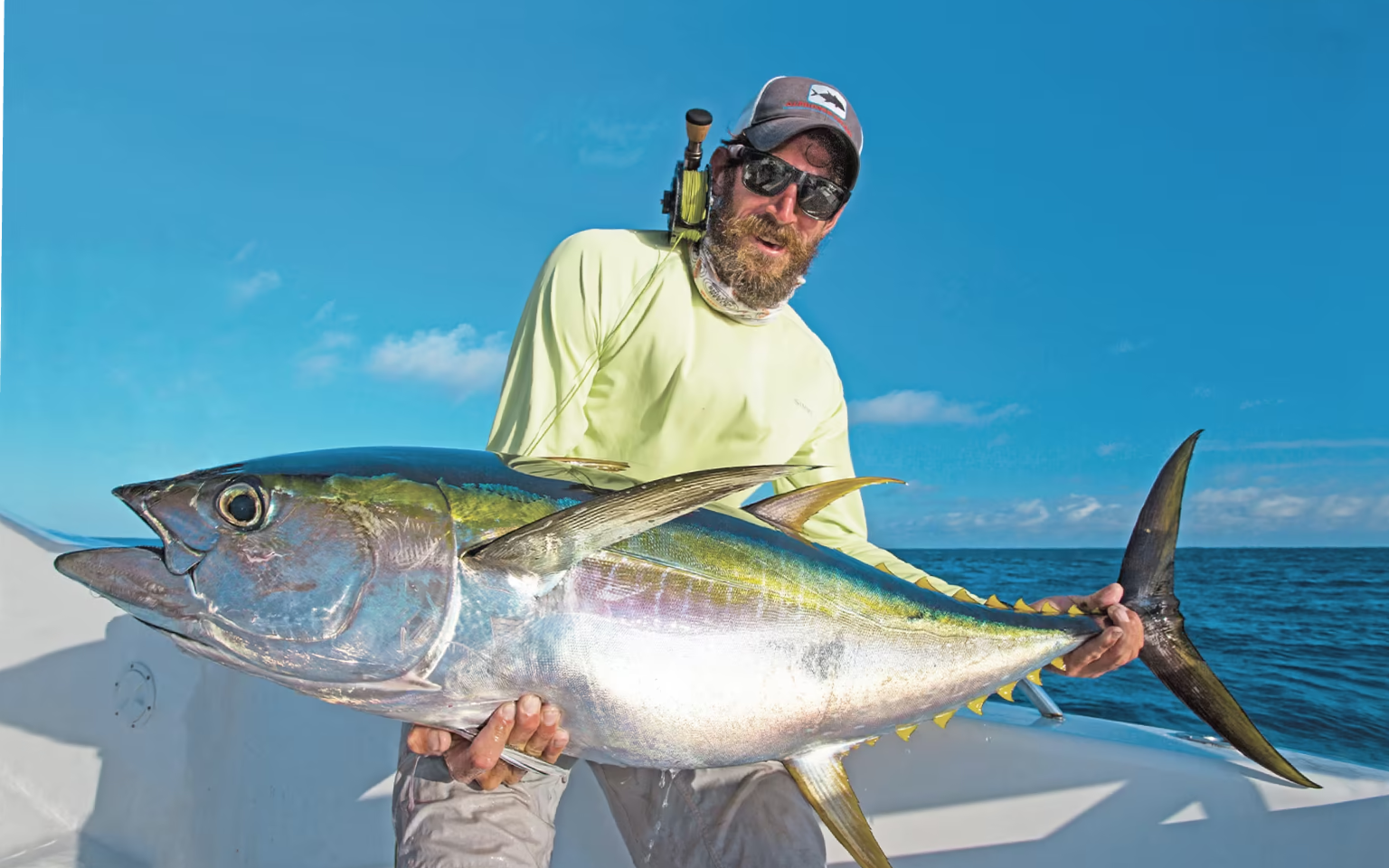
They say hooking a yellowfin is like latching onto a freight train. These fish are built for speed and endurance, and pound for pound there may not be a harder fighting fish in the ocean. They dive when hooked, pinwheel around the boat, and test your gear and your arms in equal measure. Add in a reputation for the best sushi and sashimi on the planet, and it is easy to see why yellowfin tuna fishing sits near the top of so many anglers’ lists.
Yellowfin (Thunnus albacares) are highly migratory and found in warm waters across the Pacific, Atlantic, and Indian Oceans, typically between 68 and 88 degrees Fahrenheit. For over 27 years, Fish-Nation has connected anglers with the destinations and captains who know these fisheries best, from Baja California’s trophy grounds to the year round action of Panama and Costa Rica.
This guide covers how to tell a yellowfin from the tuna it gets confused with, where and when to fish for them, and the gear, techniques, and costs behind a real trip.
Identifying Yellowfin Tuna and Where They Live
Yellowfin are torpedo shaped, metallic dark blue on the back and upper sides, fading to a silvery belly with a yellow tint. Their most distinctive feature is a set of long, bright yellow dorsal and anal fins that sweep back toward the tail, which is where the name comes from. Average fish run 20 to 45 pounds, though yellowfin can grow past 400 pounds, with the largest specimens typically coming from the Pacific coast of Mexico.
Yellowfin vs. Bigeye, Blackfin, and Bluefin
Anglers often confuse yellowfin with three other tuna species. Bigeye tuna look similar but have noticeably larger eyes and shorter pectoral fins, and tend to hold deeper in the water column. Blackfin tuna, common in the western Atlantic, run much smaller, averaging under 20 inches, so they are really only confused with juvenile yellowfin. Bluefin tuna lack the elongated yellow fins entirely and have a stockier, more robust body built for cold water. If you are ever unsure at the rail, the long yellow finlets are the giveaway; no other commonly caught tuna species shares that feature.
Habitat and Range
Yellowfin roam offshore pelagic waters rather than hugging the coast, often holding near temperature breaks, current edges, floating debris, and structure like FADs (fish aggregating devices). They frequently school with skipjack or bigeye tuna of similar size, though larger “cow” yellowfin over 200 pounds sometimes travel just beneath or outside the main school.
In US waters, yellowfin are caught along much of the East Coast, throughout the Gulf of Mexico, off Southern California, around Hawaii, and near the Pacific Islands. San Diego and the nearby Coronado Islands in Mexico are famously productive, with the season running May through September and July marking peak action. Kailua-Kona on Hawaii’s Big Island holds yellowfin (locally called ahi) year round, with the biggest push of large fish between June and September.
Techniques, Gear, and Where to Book Your Trip
Yellowfin respond to several proven techniques, and most trips mix two or three depending on conditions.
Proven Techniques
Trolling with skirted lures, rigged ballyhoo, or diving plugs is the most efficient way to locate active schools, covering water along current lines and temperature breaks. Chunking, cutting sardines, mackerel, or skipjack into a scent slick, draws tuna to the boat and is especially effective at night or when fish are holding deep. Live bait fishing, slow trolling or drifting a lively mackerel or bonito, tends to produce the largest, trophy class fish. When yellowfin are busting bait on the surface, throwing a popper or stickbait into the frenzy produces some of the most explosive strikes in sportfishing, and jigging metal jigs on marks that show deep on the sonar can trigger reaction strikes when fish are not up top.
Gear That Works
Tackle should scale to the fish you are targeting. For school size yellowfin under 50 pounds, 30 to 50 pound class outfits are plenty. For trophy class fish, serious anglers step up to 80 to 130 pound braided line with a fluorocarbon leader for abrasion resistance and reduced visibility, since yellowfin have excellent eyesight. A reel holding at least 300 yards of line is the minimum; big Pacific yellowfin are known to strip several hundred yards on the first run alone. Circle hooks are standard practice both for solid hookups and for improving survival rates on released fish.
Best Destinations
Baja California, Mexico produces trophy yellowfin, especially from late spring through fall, with offshore islands known for the season’s largest fish. Panama and Costa Rica offer year round action, with fish frequently holding near temperature breaks and floating debris fields, often mixed in with sailfish, marlin, and wahoo on the same trip. Hawaii and San Diego / Baja round out the top US-accessible options, with the seasonal windows noted above.
What It Costs
Yellowfin trips are typically part of a broader offshore or inshore/offshore package rather than a standalone charter. Day charters targeting tuna generally run $1,500 to $3,500 for the boat, split among anglers. Multi-day, all inclusive lodge packages in destinations like Panama or Costa Rica, which often mix yellowfin with marlin, sailfish, and wahoo, run $3,000 to $8,000+ per person depending on length and accommodation.
Fish-Nation connects anglers to vetted yellowfin destinations across the Pacific, the Indian Ocean, and closer to home. Call 307-637-5495 or email info@fish-nation.com, and our team will help plan the right trip for your goals and budget.
Frequently Asked Questions
How do I tell a yellowfin tuna from a bluefin or bigeye?
Look for the long, bright yellow dorsal and anal finlets sweeping toward the tail. Bluefin lack these elongated yellow fins and have a stockier body, while bigeye have noticeably larger eyes and tend to hold deeper in the water column.
What is the best time of year to catch yellowfin tuna?
It depends on the destination. San Diego and Baja run best from May through September, peaking in July. Kona, Hawaii holds fish year round with the largest push from June to September. Panama and Costa Rica are productive year round.
How big do yellowfin tuna get?
Average fish run 20 to 45 pounds, but yellowfin can exceed 400 pounds, with the largest specimens typically caught off Mexico’s Pacific coast.
What tackle do I need for yellowfin tuna?
School size fish are comfortable on 30 to 50 pound class outfits, while trophy class yellowfin call for 80 to 130 pound braided line, a fluorocarbon leader, and a reel holding at least 300 yards of line.
Is yellowfin tuna fishing sustainable?
Current Pacific yellowfin stocks are not considered overfished under NOAA assessments, though regional populations can face pressure from commercial fishing. Anglers can help by using circle hooks, following local bag limits and seasonal closures, and supporting trolling or pole and line based operations.
Ready to plan a yellowfin trip built around the right season and destination? Call Fish-Nation at 307-637-5495 or email info@fish-nation.com to get started.