
Extended reality technologies, spanning virtual, augmented, and mixed reality, are no longer confined to isolated demonstrations. Industrial organizations are integrating XR technologies into engineering, manufacturing, and training workflows, and the central question has shifted from whether to adopt XR to how to manage it at scale.
Moving from a single pilot to a company-wide deployment introduces challenges that go beyond hardware. Organizations need to convert CAD data into XR-ready formats, secure 3D assets across teams, control user access, and let distributed sites collaborate in real time, all without overwhelming their IT infrastructure.
XR Center by SKYREAL was built to answer exactly this challenge. Few platforms address the full breadth of enterprise xr technologies the way XR Center does: from CAD conversion and secure data storage to real-time, multi-site collaboration, all from a single entry point.
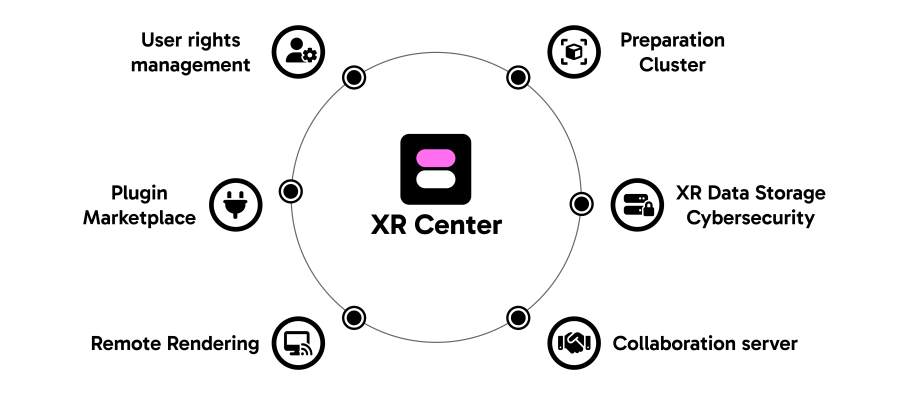
At its core, the platform combines granular user rights management with an automated CAD conversion pipeline. Preparation Agents analyze, clean, and convert raw CAD data into XR-ready assets through a distributed processing cluster, while a floating token system optimizes license distribution across the organization. All XR assets are consolidated into a secure data hub, protected end-to-end by industry-standard encryption.
Collaboration is where the value compounds. Multi-user, multi-site sessions stay synchronized across devices, from high-end workstations to portable headsets, with no hard limit on the number of simultaneous participants. Pixel Streaming technology extends this further, letting stakeholders without VR equipment join immersive reviews directly from a standard laptop or web browser.
This interoperability extends across SKYREAL’s wider ecosystem. The same foundation connects Skyreal VR sessions, Gaia for model-based systems engineering, browser-based web apps, and Unreal Editor projects, with bridges available to extend support to third-party tools. Rather than forcing every department onto a single client, XR Center lets each team keep the tool that fits its workflow while sharing one secured data layer.
This is also where effective xr data management becomes critical. As the volume of CAD files, immersive scenarios, and collaborative sessions grows, organizations need a single source of truth rather than fragmented storage across departments. A centralized architecture, combined with role-based access control and IT and PLM interoperability through SSO, provides the governance layer that XR adoption at scale requires.
Deployment flexibility matters just as much as functionality. The platform is available fully on-premise, including air-gapped environments, for organizations with strict data sovereignty requirements, or as a cloud-based solution for teams prioritizing ease of maintenance, with both models giving IT and security teams full control over where XR data physically resides. This flexibility is part of why SKYREAL is trusted across regulated sectors including defense, energy, aerospace, automotive, and space.
As XR technologies move from isolated experiments to operational infrastructure, the organizations that succeed will be those treating data management, security, and collaboration as seriously as the immersive experience itself. Platforms purpose-built for this transition, rather than general-purpose XR tools, are what make enterprise-scale adoption realistic for engineering and manufacturing teams alike.
