
You’ve tried SEO before. Maybe you hired a general agency, followed their blog posts, built some links, and got nothing. Or worse, a trickle of traffic that never converted to trials or demos.
Here’s the uncomfortable truth: most SEO agencies have no idea how to market a SaaS product. They treat your software like a local pizza shop or an e-commerce store, and then wonder why the strategy falls flat.
SaaS is a different beast entirely. And it requires a different kind of SEO expertise.
In this post, I’ll break down exactly what a SaaS SEO agency does, why it differs from traditional SEO, and how to know if you need one.
What Is a SaaS SEO Agency?
A SaaS SEO agency is a specialist firm (or expert) that builds and executes organic search strategies specifically for software-as-a-service businesses. The focus isn’t just traffic, it’s pipeline. Demo requests, free trial sign-ups, and paying customers.
The difference between a generalist SEO agency and a SaaS-focused one comes down to understanding your business model:
- Recurring revenue means lifetime value (LTV) is high — so acquiring one customer through SEO can pay off for years
- The buying journey is long — prospects research, compare, evaluate, and only then convert
- Intent is layered — someone searching “what is project management software” is very different from someone searching “Asana alternatives for remote teams”
A SaaS SEO agency understands all of this and builds strategies accordingly.
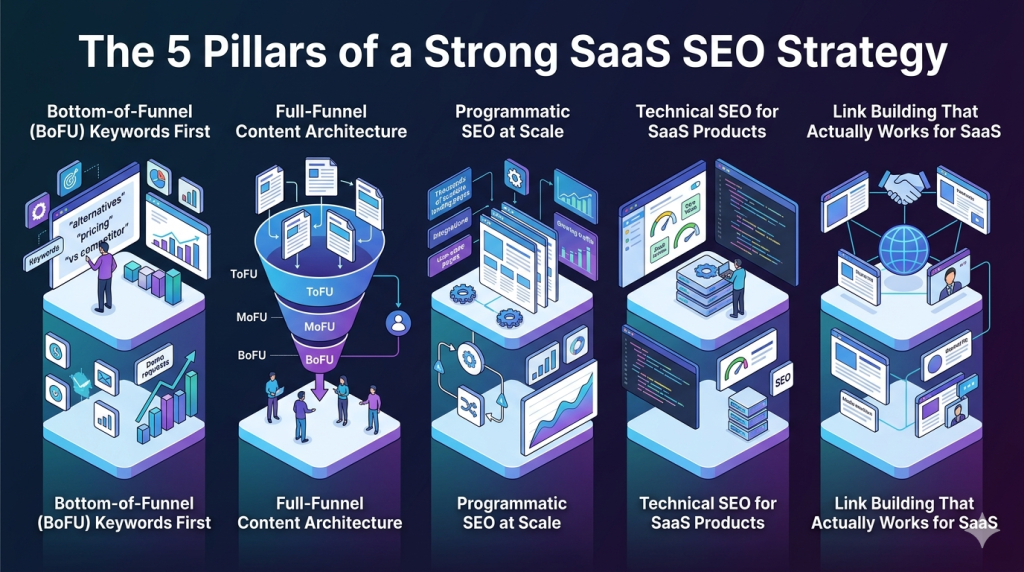
The 5 Pillars of a Strong SaaS SEO Strategy
1. Bottom-of-Funnel (BoFU) Keywords First
Most agencies chase volume. SaaS SEO experts chase intent.
The highest-value keywords in SaaS are often low-volume, high-intent terms like:
- [competitor] alternatives
- best [software category] for [use case]
- [your brand] vs [competitor]
- [software category] pricing
These searchers are close to a buying decision. Ranking for them, even with modest traffic, drives actual revenue.
A strong SaaS SEO agency starts here, not with broad informational content that brings in readers who will never buy.
2. Full-Funnel Content Architecture
Once BoFU is covered, the strategy expands upward:
- ToFU (Top of Funnel): Educational content that attracts your ICP when they’re in “learning mode”, think “how to reduce customer churn” or “project management methodologies explained”
- MoFU (Middle of Funnel): Comparison guides, use-case pages, feature breakdowns, content for people actively evaluating solutions
- BoFU (Bottom of Funnel): Alternative pages, pricing pages, integration pages, free trial landing pages
The goal is to create a content ecosystem where potential customers find you at every stage of their journey, and keep returning to your site as they move closer to a decision.
3. Programmatic SEO at Scale
SaaS products often have natural programmatic SEO opportunities:
- Integration pages ([Your Tool] + [Tool])
- Use case pages ([Software] for [Industry])
- Location pages for tools with local relevance
- Template libraries
A specialized SaaS SEO agency knows how to identify these opportunities, build scalable page templates, and execute them without triggering Google’s spam filters. Done right, programmatic SEO can generate thousands of targeted landing pages that drive consistent, compounding organic traffic.
4. Technical SEO for SaaS Products
SaaS sites have unique technical challenges:
- App subdomains vs. subfolders — where does your logged-in app live, and how does it affect domain authority?
- Thin feature pages — product feature pages often lack enough content to rank
- Indexation of app content — should help docs, changelog pages, or template libraries be indexed?
- Core Web Vitals — SaaS marketing sites often have bloated scripts and slow load times
A SaaS SEO agency has seen these problems before and knows exactly how to fix them.
5. Link Building That Actually Works for SaaS
Backlinks still matter. But link building for SaaS looks different from traditional approaches.
The most effective SaaS link-building strategies include:
- Digital PR around original data, research, or product announcements
- Product integrations and partnerships — getting listed in partner directories and integration marketplaces
- HARO / journalist outreach — positioning founders and experts as industry sources
- Guest posting on niche SaaS and B2B publications
- Community-led link building — earning links through genuine participation in communities where your ICP hangs out
The goal is relevance and authority, not just raw link count.
Signs You Need a SaaS SEO Agency
Not every SaaS company needs a specialized agency. But if any of the following sounds familiar, it’s time to bring in experts:
- You’re getting traffic but no signups: This usually means you’re ranking for the wrong keywords, informational terms with no buyer intent. A SaaS SEO strategist will audit your keyword portfolio and redirect effort toward conversion-focused content.
- Your competitors are dominating organic search: If you’re losing deals because prospects discovered a competitor first on Google, SEO is a strategic priority, not a nice-to-have.
- You’ve tried content marketing but it hasn’t moved the needle: Publishing blog posts without a clear keyword strategy or funnel architecture is just guesswork. A proper SaaS SEO framework connects every piece of content to a business outcome.
- You’re preparing for a funding round or growth phase: Investors love compounding organic channels. Building SEO authority now creates a defensible moat that paid ads can’t replicate.
- Your in-house team doesn’t have SaaS SEO expertise: SEO is a skill that takes years to develop. If your team is generalists, you may be leaving significant organic revenue on the table.
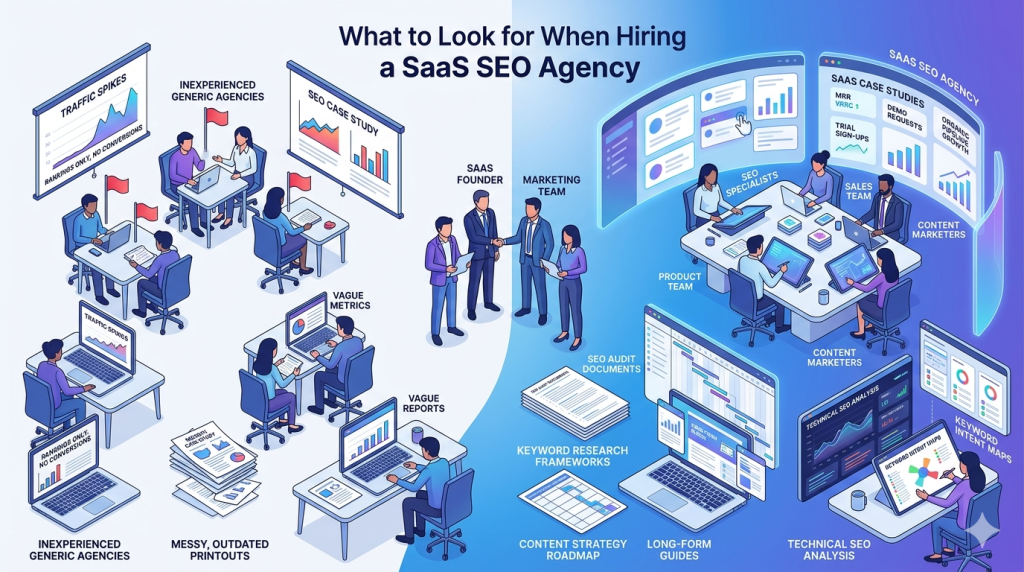
What to Look for When Hiring a SaaS SEO Agency
Not all agencies that claim SaaS expertise actually have it. Here’s how to separate the real ones from the pretenders:
- Look for case studies with SaaS clients: Generic agency case studies featuring local businesses or e-commerce brands are a red flag. You want to see examples of SaaS growth, ideally at your stage (early-stage, growth, enterprise).
- Ask how they measure success: If the answer is “rankings” or “traffic,” walk away. The right answer is pipeline metrics: trial sign-ups, demo requests, MQL volume from organic.
- Check their content quality: Does the agency publish thoughtful SaaS-specific content? Are they demonstrating expertise or just regurgitating generic SEO advice?
- Understand their process: A strong SaaS SEO partner will walk you through their audit process, keyword research methodology, content strategy framework, and reporting structure before you sign anything.
- Ask about collaboration: The best SEO outcomes happen when the agency works closely with your product, sales, and content teams, not in a silo.
Final Thoughts
SEO can become one of the most powerful growth channels for a SaaS business, but only when it is built around the realities of the SaaS buying journey. Ranking for random keywords and publishing generic blog posts is not enough. You need a strategy focused on intent, conversions, product positioning, and long-term customer acquisition.
A specialized SaaS SEO agency understands how software buyers search, compare, and make decisions. From building bottom-of-funnel content and scalable programmatic SEO to solving technical SEO challenges unique to SaaS websites, the right partner helps turn organic traffic into predictable revenue growth.
If your current SEO efforts are generating traffic without sign-ups, or if competitors continue dominating search results in your niche, it may be time to work with a team that truly understands SaaS SEO.
FAQs
What industries benefit the most from hiring a SaaS SEO agency?
Industries with long sales cycles and competitive software markets benefit the most from SaaS SEO. This includes CRM software, cybersecurity, HR tech, fintech, marketing automation, customer support platforms, and project management tools. These businesses rely heavily on trust, education, and comparison content before users convert.
How long does SaaS SEO typically take to show results?
Most SaaS companies begin seeing meaningful SEO improvements within 3 to 6 months, while competitive industries may take 6 to 12 months for substantial growth. SEO compounds over time, so the biggest gains often come after consistent optimization and content publishing over a longer period.
Can a SaaS SEO agency help improve free trial conversion rates?
Yes. A strong SaaS SEO agency does more than drive traffic. It helps optimize landing pages, product messaging, internal linking, and content intent so that more visitors turn into free trial users or demo requests.
Should early-stage SaaS startups invest in SEO?
Yes, especially if they want to reduce long-term dependency on paid ads. Starting SEO early allows startups to build domain authority, create evergreen content assets, and compete organically before customer acquisition costs become too expensive.
Does SaaS SEO work for enterprise software companies?
Yes, but enterprise SaaS SEO often requires more in-depth content, stronger authority building, and longer sales-cycle optimization. Enterprise buyers typically conduct extensive research before making decisions, making SEO a critical channel for visibility and trust.
How often should a SaaS SEO strategy be updated?
A SaaS SEO strategy should be reviewed regularly, typically every quarter. Search trends, competitors, product features, and Google’s algorithms constantly change, so ongoing optimization is necessary to maintain and improve rankings.