
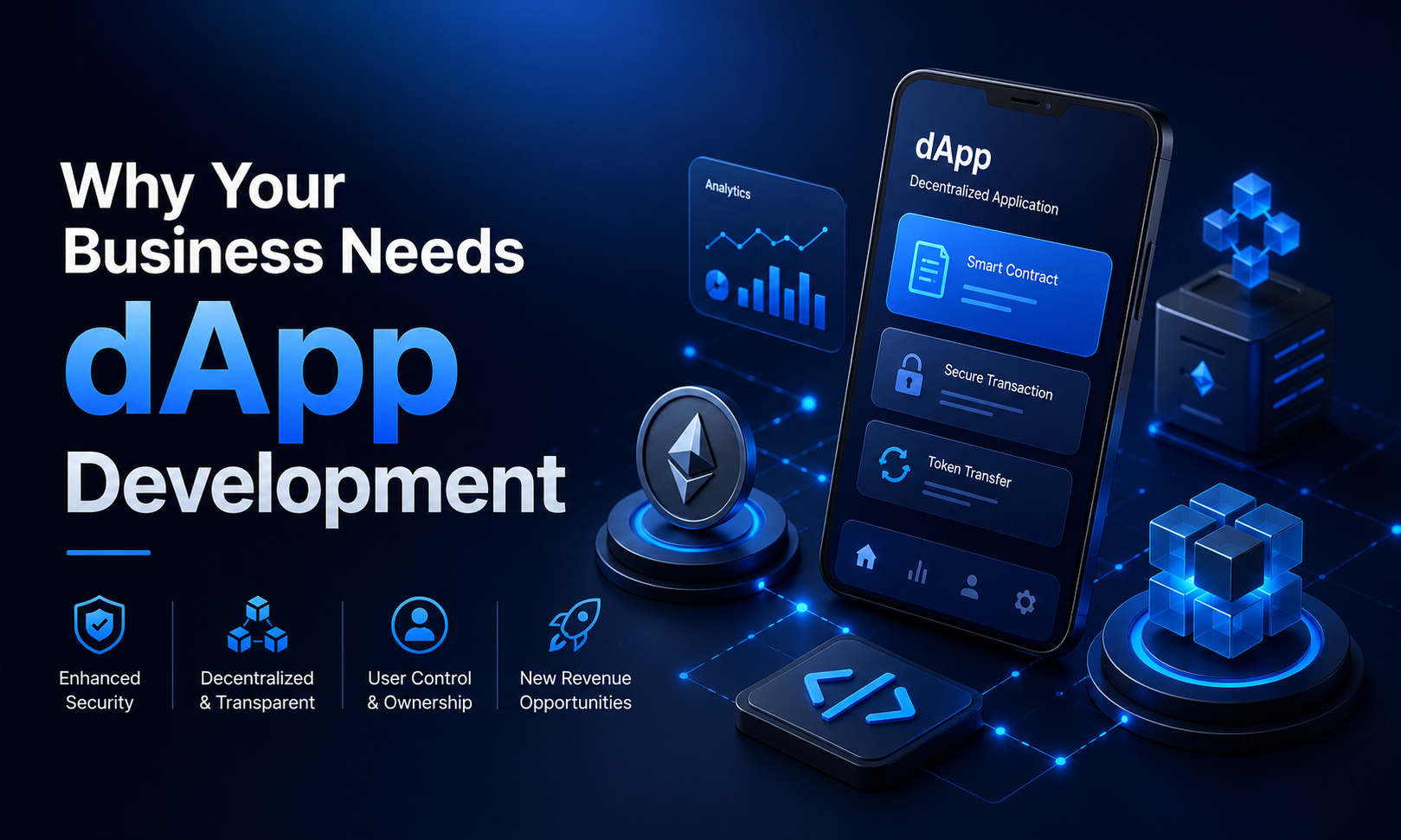
In 2026, the way businesses build digital products is shifting fast. Web3 is no longer a future concept; today, it’s a present-day toolkit that companies are using to build more secure, transparent, and user-driven platforms.
At the centre of this shift is dApp development. Decentralized applications are helping businesses across finance, healthcare, gaming, and e-commerce and helping them move beyond the limitations of traditional software, offering built-in automation, tamper-proof data, and an experience that users actually trust.
But launching a dApp isn’t just about putting your product on a blockchain. Without proper planning around scalability, performance, and user experience, even well-funded dApps find problems with slow transactions, rising costs, and poor adoption.
This blog covers why your business needs a dApp, what makes them powerful, and a clear step-by-step process to launch one that’s built to scale.
What is a dApp?
dApp, also known as a decentralized application, is software that runs on a blockchain network instead of a central server owned by one company.
Think of it like a regular use app, WhatsApp, that stores your messages on Meta’s servers. If Meta goes down or decides to change its rules, then your data is under their control. On the other hand, a dApp runs across thousands of computers simultaneously, with no single company in control.
The core engine behind every dApp is called a smart contract, a self-executing piece of code that lives on the blockchain. When certain conditions are met, the contact runs automatically, without any middleman.
Why Your Business Needs a dApp in 2026
If you think your business has software that works completely fine, then you’re completely wrong. DApp development is not about replacing what works; it’s about gaining advantages your competitors can’t easily copy.
- Your Customers Trust What They Can Verify
Traditional software is like a black box where users have no way to verify what the system says is right or not. But with a dApp, users can verify every transaction is recorded on a public blockchain. Anyone can cross-check it. That level of transparency forms a new kind of customer trust, especially in industries like finance, healthcare, and supply chain.
- Your Data Becomes Nearly Impossible to Hack
Centralised exchanges’ major weakness is their single point of failure, where hackers can hack the server and get the data easily. But blockchain eliminates this. Your dApp’s data is distributed across thousands of nodes. To alter a record, an attacker would need to simultaneously control more than half the entire network.
- You Can Automate Processes That Used To Need Human Oversight
Smart contacts can automatically deal with agreements, payments, approvals and verifications. It reduces operational costs, eliminates human error and speeds up processes that used to take days. The correct smart contract logic allows you to automate performance-based insurance claims, supplier payments and employee bonuses.
- You Can Reach A Global Audience Without Banking Infrastructure
A dApp doesn’t need a payment gateway, a local bank account, or a currency converter. With dApps, users can seamlessly interact with their crypto wallet. For businesses targeting emerging markets or international customers, this is a significant unlock.
👉Also Read : Hire Blockchain dApp Developers | Custom dApp Development Services
How To Launch a Scalable dApp
Building a dApp is not similar to building a regular web app, but it’s not rocket science either. To start with your development process, you’re first required to connect with a reputable dApp development company and follow the step-by-step process closely.
Step 1 – Define What Your dApp Actually Does
Before writing a single line of code, you first need to get clear on the problems you’re trying to solve. However, not every problem needs a dApp, but if, in your case, there are multiple parties involved who don’t fully trust each other or require tamper-proof records, a dApp is likely the right tool.
Step 2 – Choose Your Blockchain Platform
The blockchain you build on shapes everything: speed, cost, ecosystem, and developer tools. These are the most popular ones.
- Ethereum – The most established, largest developer community, best for complex smart contracts.
- Polygon – Built on top of Ethereum but with much lower transaction fees, higher for high-volume apps.
- Binance Smart Chain – It is fast and cheap, popular for DeFi and gaming dApps.
For most of the businesses launching their first dApp, for them, Polygon is a good starting point. It is Ethereum-compatible but far cheaper to run.
Step 3 – Write and Audit Your Smart Contracts
Smart contracts are written in a language called Solidity. This is the core structure of your dApp, and the logic that performs automatically when certain conditions are met.
One important rule you have to be aware of is that smart contracts are immutable once deployed. A small bug in your contract cannot simply be patched. This is why auditing is non-negotiable. Use tools like OpenZeppelin for secure contract templates, and get a professional audit before it goes live.
Step 4 – Build The Frontend Your Users Actually See
Your dApp still needs a user interface, and most of the users won’t interact with raw blockchain data. The frontend is typically built with React, and linked to the blockchain using libraries like Ethers.js or Web3.js.
Users connect to your dApp through a crypto wallet like MetaMask, which acts as both their identity and their payment method. Keep the wallet connection experience as simple as possible; this is still the biggest friction point for new users.
Step 5 – Plan for Scalability from Day One
The most common mistakes in dApp development are ignoring scalability until it’s too late. As your user base grows, transaction costs and speed become real problems.
Build with scale in mind from the start:
- Use Layer 2 solutions like Polygon or Optimism to reduce gas fees
- Store large files on IPFS rather than directly on-chain
- Design your smart contracts in a way that can easily minimize on-chain computation
Step 6 – Test on a Testnet, then Deploy to Mainnet
Before making it live, deploy your dApp to a testnet, a live replica of the blockchain where you can check dApps using fake currency. This helps you find bugs in a real environment, and that too without any financial consequences.
Popular testnets include Sepolia (for Ethereum) and Amoy (for Polygon). Once everything works cleanly, deploy to mainnet and monitor performance using tools like Alchemy or Infura.
To Sum Up
Decentralized apps are no longer a trend in 2026; instead, it’s a practical toolkit for businesses that want to work with more transparency, automation, and security as compared with traditional software offerings.
In today’s time, the businesses that invest in dApp development services are more likely to be the ones that will lead their industries tomorrow. But the success mainly depends on building it right, right with blockchain, architecture, and strategy from the start.
If you’re ready to move beyond traditional apps and build something that can really scale, then now is the time to start.
Let’s build your dApp – get in touch with Technoloader for a free consultation today.