
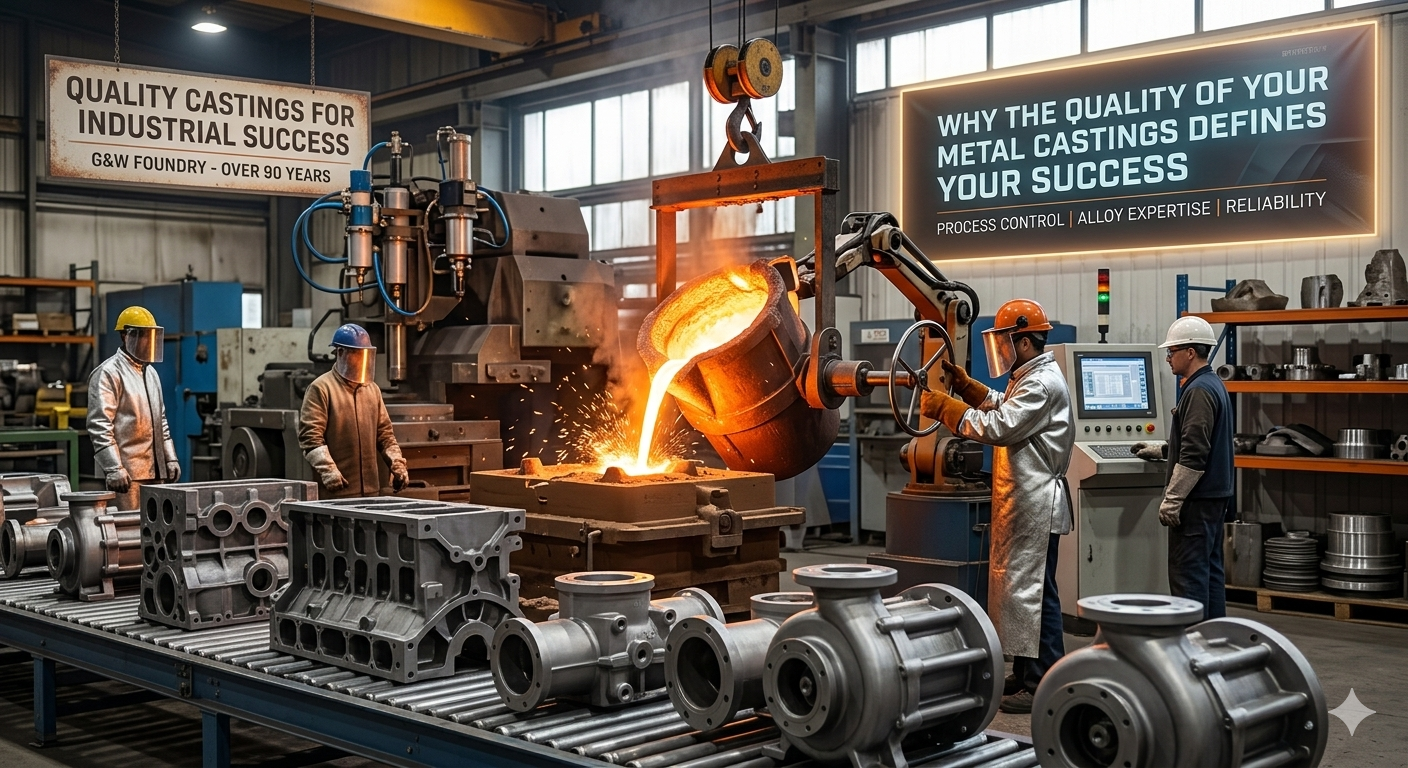
In the world of manufacturing, the smallest component can dictate the success or failure of an entire assembly. While the spotlight often falls on final assembly and digital automation, the hidden foundation of most durable goods remains the same: metal castings. From the engine block in a commercial truck to the valve body in a chemical plant, cast metal parts are the skeleton of industrial machinery. However, not all cast components are created equal. The difference between a part that merely fits and a part that performs under extreme stress comes down to the foundry’s processes, material science, and engineering philosophy.
For more than nine decades, the choice of a casting partner has separated equipment that lasts from equipment that fails prematurely. When engineers specify a component, they are not just drawing a shape; they are defining stress paths, thermal dynamics, and vibration dampening. This is where the nuances of manufacturing processes become critical. A casting with micro-porosity or residual stress might pass initial quality checks but fail catastrophically after 1,000 hours of operation. Therefore, understanding the value of engineered precision in metal castings is not a matter of logistics—it is a matter of product integrity.
The Engineering Advantage: More Than Just Molten Metal
At its core, metal casting is the process of pouring liquid metal into a mold to solidify into a desired geometry. However, modern industrial demands have transformed this ancient art into a high-technology discipline. Exceptional foundries differentiate themselves through three critical areas: process control, alloy selection, and scalability.
First, advanced process control ensures that every pour is consistent. Without sophisticated monitoring of temperature, flow rates, and solidification cycles, even the best design can suffer from inclusions, cold shuts, or shrinkage. High-quality foundries use real-time monitoring to reduce defects that compromise structural integrity. Second, material expertise is vital. Whether a component requires the wear resistance of austenitic ductile iron, the corrosion resistance of stainless steel, or the thermal conductivity of aluminum bronze, the foundry must possess the metallurgical knowledge to match the alloy to the application. Finally, scalability bridges the gap from prototyping to full production without changing vendors, which often introduces variation.
Matching the Process to the Application
One of the most common mistakes manufacturers make is selecting a casting process based solely on cost per unit, rather than total lifecycle value. The right process depends entirely on the part’s function, volume, and required tolerances.
For large, robust components such as pump housings or heavy equipment frames, sand casting remains the most reliable and cost-effective method. It allows for massive parts—exceeding 30,000 lbs—and complex external geometries. Conversely, for smaller, high-precision parts that require intricate detail and tight tolerances, investment casting is superior. This process uses a ceramic shell around a wax pattern to produce parts with excellent surface finishes and near-net shapes, drastically reducing secondary machining.
A sophisticated supplier does not force a client into one box. Instead, they evaluate the annual volume, the need for surface finish, and the mechanical load requirements to decide which method will deliver the lowest total cost of ownership. This consultative approach is the hallmark of a partner, not just a vendor.
The Real-World Cost of Inconsistent Castings
Manufacturers often underestimate the financial impact of poor-quality castings. Consider the “hidden factory” of rework and scrap. A casting that arrives with an undetected internal void might cause expensive tooling damage during CNC machining. Worse, a casting that fails in the field leads to warranty claims, reputational damage, and logistical penalties.
Consistency is the metric that matters. Reliable foundries focus on dimensional accuracy so that parts mate perfectly with mating components without forcing or shimming. They also focus on mechanical property repeatability, ensuring that every part from lot number 10 has the same tensile strength as lot number 1. This reliability allows your assembly line to run faster with fewer stoppages.
This is why leading manufacturers turn to specialized partners. When you evaluate metal castings for a critical drivetrain or hydraulic system, you need a supplier with a track record of zero-defect initiatives and flexible manufacturing. One such partner in the industrial sector is G&W Foundry, which has built a reputation on managing complexity across industries like automotive, marine, and agriculture. Their ability to handle parts from just a few ounces to tens of thousands of pounds demonstrates the versatility required in modern supply chains.
Integrating Castings into Your Global Supply Chain
In a volatile global economy, sourcing castings involves a delicate balance between cost, speed, and quality. While offshore sourcing may offer lower piece prices, it often introduces long lead times, high shipping costs, and communication barriers when engineering changes occur. A modern strategy employs a hybrid approach: domestic production for rapid prototyping, complex tooling, and rush orders, combined with trusted global partners for high-volume, cost-sensitive runs.
This “flexible manufacturing” model protects the OEM. If a shipping lane closes or a tariff changes, production can shift without re-qualifying a new vendor. Furthermore, it ensures that engineering expertise remains accessible. When you need to modify a draft angle or change an alloy specification, a responsive partner who speaks your language and understands your timeline is invaluable.
Ultimately, the casting is not the end product; it is the enabler of your product. By prioritizing metallurgical integrity, process matching, and supply chain flexibility, you turn commodity components into competitive advantages. Whether you are designing a next-generation agricultural harvester or a high-pressure industrial pump, the path to reliability starts with the casting. Choosing the right foundry ensures that what you build performs exactly as intended—every single time.