

“SEO doesn’t work.”
You have probably heard this from business owners, marketers, and even people who once relied heavily on organic search.
They point to declining click-through rates, AI-generated answers, crowded search results, algorithm updates, and growing competition. Then they conclude that SEO is dead.
But the evidence tells a different story.
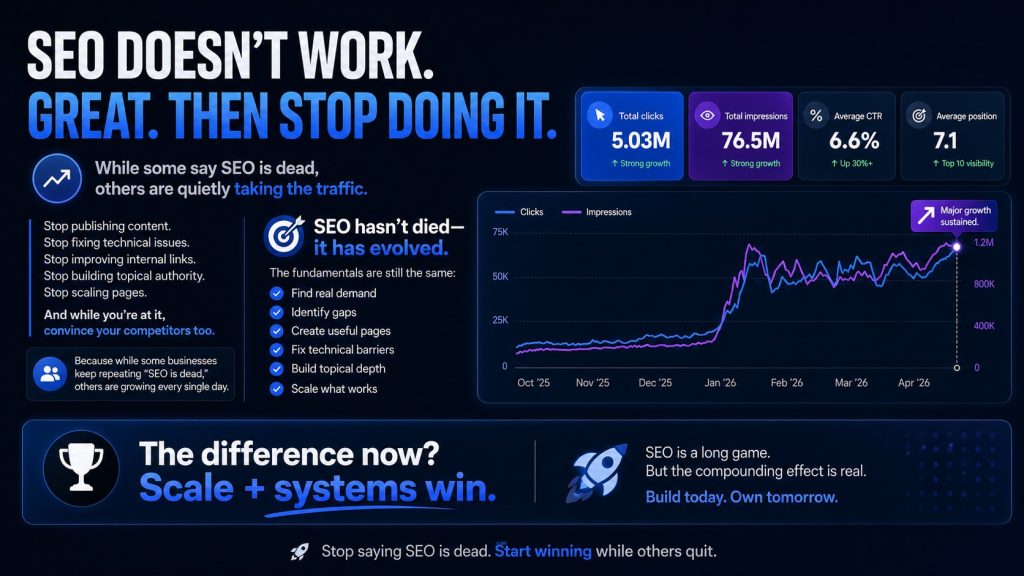
Businesses are still generating millions of clicks from organic search. New websites are still entering competitive markets. Established brands are still expanding their visibility by publishing useful content, improving technical performance, and building authority.
SEO has not disappeared.
It has simply become harder, broader, and more dependent on strategy.
The old approach of publishing a few keyword-focused articles and waiting for traffic is no longer enough. Modern SEO requires stronger systems, better content, technical precision, topical depth, and visibility beyond traditional blue links.
Build Visibility. Generate Leads. Grow Organically.
Get Your SEO Audit and Free Consultation
Does SEO Still Work in 2026?
Yes, SEO still works in 2026.
However, it works best for businesses that understand how search behavior has changed.
People are no longer searching only through traditional Google results. They are also discovering information through:
- Google AI Overviews
- ChatGPT
- Bing Copilot
- Perplexity
- YouTube
- Social media platforms
- Voice assistants
- Industry-specific search tools
This means SEO is no longer limited to ranking a webpage for one keyword.
It is now about making your business visible wherever people search, compare, research, and make decisions.
A successful SEO strategy helps search engines and AI systems understand:
- Who you are
- What your business offers
- Which topics you specialize in
- Why your information is reliable
- Which audience your content serves
- Why your pages deserve to be recommended
That is not the death of SEO.
That is the evolution of SEO.
Why People Think SEO Is Dead
SEO often appears ineffective because many businesses are still using strategies that worked years ago.
They publish random blog posts, target broad keywords, build weak backlinks, ignore technical problems, and expect immediate results.
When traffic does not increase, they blame SEO.
In reality, the strategy failed—not the channel.
1. Search results are more competitive
Google search results now contain advertisements, featured snippets, videos, shopping results, maps, discussion forums, AI Overviews, and other rich features.
A page may rank well without receiving the same percentage of clicks it would have received several years ago.
That makes visibility more complex, but it does not make SEO useless.
Businesses must optimize for more than one traditional organic position.
2. AI answers are changing search behavior
AI-generated answers can provide information directly within the search experience.
This may reduce clicks for simple informational searches. However, users still visit websites when they need:
- Detailed guidance
- Professional services
- Product comparisons
- Original research
- Reliable data
- Case studies
- Tools and calculators
- Local businesses
- High-consideration purchases
AI is reducing the value of generic content. It is not eliminating the need for trustworthy, useful, expert-level information.
3. Weak content no longer performs consistently
Publishing 100 basic articles does not automatically create authority.
Search engines are becoming better at recognizing content that is repetitive, shallow, inaccurate, or created only to attract clicks.
Modern SEO rewards content that solves a genuine problem and contributes something useful.
4. SEO takes longer than paid advertising
Paid advertising can generate exposure as soon as a campaign launches.
SEO usually requires more time because authority, trust, relevance, and rankings develop gradually.
This causes some businesses to quit too early.
But unlike paid advertising, strong organic visibility can continue generating traffic after the initial work has been completed.
The Fundamentals of SEO Have Not Changed
Search platforms continue to evolve, but the core principles of SEO remain surprisingly consistent.
Find real search demand
Good SEO begins with understanding what people genuinely want.
Keyword research should not focus only on search volume. It should identify:
- Problems people need to solve
- Questions customers ask
- Products or services they compare
- Concerns preventing them from buying
- Topics connected to the customer journey
The goal is not merely to find keywords.
The goal is to understand demand.
Identify content gaps
A content gap is an important topic your competitors cover—or your audience needs—that your website does not adequately address.
Useful gaps may include:
- Missing service pages
- Unanswered customer questions
- Weak product-category content
- Incomplete comparison guides
- Untargeted locations
- Missing definitions or supporting topics
- Outdated articles
Filling these gaps helps a website become a more complete resource.
Create genuinely useful pages
Every page should have a clear purpose.
A useful page may educate, compare, explain, calculate, demonstrate, reassure, or help someone complete a task.
Before publishing, ask:
- Does this page answer the searcher’s main question?
- Is the answer clear and easy to find?
- Does it provide information competitors have missed?
- Is it written for a real person rather than an algorithm?
- Does it guide the visitor toward a logical next step?
Content that fails these tests rarely produces sustainable results.
Fix technical barriers
Excellent content cannot perform properly when search engines struggle to access, understand, or index it.
Technical SEO helps remove those barriers.
Important areas include:
- Crawlability
- Indexing
- Website speed
- Mobile usability
- Canonical tags
- Redirects
- Internal linking
- Structured data
- XML sitemaps
- Duplicate content
- Broken pages
- JavaScript rendering
Technical SEO does not replace good content. It ensures good content can be discovered and evaluated correctly.
Build topical depth
A website becomes more authoritative when it covers its main subject thoroughly and logically.
For example, an SEO agency should not publish only one page titled “SEO Services.”
It may also need content covering:
- Technical SEO
- Local SEO
- Ecommerce SEO
- Keyword research
- Content strategy
- Link building
- SEO audits
- AI search optimization
- Google Search Console
- SEO reporting
These connected pages create a content ecosystem.
Together, they help users and search engines understand the website’s expertise.
Scale what works
Scaling does not mean publishing thousands of low-quality pages.
It means identifying successful patterns and expanding them carefully.
A business may scale by:
- Creating pages for additional locations
- Expanding high-performing content clusters
- Improving pages ranking between positions four and twenty
- Updating content that has lost visibility
- Turning customer questions into useful resources
- Creating comparison and alternative pages
- Strengthening internal links
- Building repeatable content-production systems
Smart scaling multiplies proven results.
Blind scaling multiplies problems.
Modern SEO Is a System, Not a Single Task
One of the biggest SEO mistakes is treating optimization as a one-time project.
A business orders an audit, updates a few title tags, publishes three articles, and waits for permanent growth.
That is not how competitive search works.
Modern SEO is an operating system made up of connected activities:
- Researching demand
- Mapping topics and search intent
- Creating or improving pages
- Removing technical barriers
- Connecting pages through internal links
- Building authority and trust
- Measuring performance
- Updating the strategy based on data
Each part strengthens the others.
A technically perfect website with poor content will struggle.
A website with excellent content but weak architecture may also struggle.
A successful strategy combines content, technology, authority, user experience, and continuous improvement.
Why Topical Authority Matters More Than Random Publishing
Publishing unrelated articles may increase the number of indexed pages, but it rarely creates meaningful authority.
Topical authority comes from covering a subject in depth.
Imagine two websites competing for the same keyword.
The first has one article about the topic.
The second has a complete collection of connected pages answering beginner, intermediate, commercial, and technical questions.
The second website gives search engines more evidence of expertise and relevance.
This does not mean every article must be extremely long.
It means the website should provide comprehensive coverage across the topic as a whole.
A strong topical cluster usually contains:
- A central pillar page
- Supporting informational articles
- Commercial service or product pages
- Comparisons
- Definitions
- Frequently asked questions
- Case studies
- Original examples or data
Internal links then connect these resources into a clear structure.
SEO and AI Search Are Becoming Connected
SEO and AI search optimization should not be treated as completely separate disciplines.
AI systems often rely on information that is accessible, structured, credible, and widely supported across the web.
Many of the practices that improve traditional SEO also improve the likelihood of being understood or cited by AI platforms.
These include:
- Clear page structure
- Direct answers
- Descriptive headings
- Consistent business information
- Strong topical coverage
- Original insights
- Expert authorship
- Reliable citations
- Structured data
- Brand mentions
- Content that is easy to extract and summarize
Businesses should optimize for both search rankings and answer-engine visibility.
The goal is no longer just to rank.
The goal is to become a trusted source.
What No Longer Works Reliably
SEO has evolved partly because search engines have become better at detecting manipulation and low-value content.
The following tactics are increasingly unreliable:
- Keyword stuffing
- Mass publishing without quality control
- Buying large numbers of irrelevant backlinks
- Creating near-duplicate location pages
- Rewriting competitors without adding value
- Publishing content unrelated to the website’s expertise
- Optimizing only title tags while ignoring search intent
- Using traffic as the only measurement of success
- Expecting immediate results from a few isolated changes
Some of these tactics may produce temporary movement.
They rarely build stable, defensible visibility.
What Winning SEO Strategies Do Differently
Successful SEO strategies focus on business outcomes rather than vanity metrics.
They connect search visibility to leads, sales, revenue, brand demand, and customer acquisition.
Winning strategies usually share several characteristics.
They prioritize intent over volume
A keyword with 100 highly relevant searches may be more valuable than a broad keyword with 10,000 searches.
Commercial relevance matters.
They improve existing pages
Many websites do not need hundreds of new articles.
They need better versions of the pages they already have.
Updating content, improving structure, matching intent, strengthening internal links, and adding evidence can create faster results than constant publishing.
They create distinct value
Search engines do not need another copy of what already exists.
Strong content contributes something new, such as:
- First-hand experience
- Unique examples
- Original visuals
- Better explanations
- Proprietary data
- Expert commentary
- Useful templates
- Calculators or tools
They measure conversions
Traffic is helpful, but traffic alone does not pay the bills.
SEO reporting should also examine:
- Qualified leads
- Calls
- Purchases
- Bookings
- Email signups
- Assisted conversions
- Revenue from organic search
They remain consistent
SEO growth often compounds.
One useful article supports another. Internal links become stronger. Brand searches increase. Backlinks accumulate. Rankings improve. More pages begin generating traffic.
Consistency creates momentum that isolated campaigns rarely achieve.
How Long Does SEO Take to Work?
There is no universal timeline.
Results depend on:
- Website history
- Competition
- Technical condition
- Content quality
- Existing authority
- Available resources
- Search demand
- Industry
- Implementation speed
Some technical improvements can produce results within weeks.
Competitive topics may require several months or longer.
The better question is not, “How quickly will SEO work?”
It is, “Are we building assets that become more valuable over time?”
A useful page can continue attracting visitors, earning links, supporting sales, and strengthening topical authority long after publication.
SEO Is Not Dead—Lazy SEO Is
SEO does not fail because search engines have changed.
It fails when businesses refuse to change with them.
The old formula was simple:
Find a keyword, publish an article, add backlinks, and wait.
The modern formula is more demanding:
Understand the audience, build comprehensive resources, remove technical barriers, establish trust, optimize for multiple search experiences, measure business impact, and continuously improve.
That requires more effort.
It also creates a stronger competitive advantage.
Final Thoughts
So, is SEO dead?
No.
Generic content is losing value. Manipulative shortcuts are becoming less reliable. Search results are becoming more crowded. AI is changing how people discover information.
But people are still searching.
They are still comparing businesses, researching products, looking for services, asking questions, and making decisions.
The companies that provide the clearest, most useful, and most trustworthy answers can still win significant visibility.
SEO has not died.
It has evolved from a collection of tactics into a complete growth system.
Businesses that stop investing in it may save time today.
They may also leave tomorrow’s traffic, leads, and customers to competitors who kept going.
Frequently Asked Questions
Is SEO still worth investing in?
Yes. SEO can create long-term visibility, qualified traffic, and customer acquisition when it is connected to real search demand and business objectives.
Is AI going to replace SEO?
AI will change SEO, but it is unlikely to eliminate the need for optimization. Businesses still need accessible, authoritative, well-structured information that search engines and AI platforms can understand.
Why is my SEO not working?
Common reasons include weak content, incorrect keyword targeting, technical problems, poor internal linking, insufficient authority, high competition, and unrealistic timelines.
How often should SEO content be updated?
Important pages should be reviewed regularly and updated whenever information becomes inaccurate, search intent changes, rankings decline, or competitors provide a more useful result.
What is the biggest difference between old SEO and modern SEO?
Old SEO often focused on individual keywords and isolated pages. Modern SEO focuses on topical ecosystems, user intent, technical quality, brand authority, and visibility across both traditional and AI-powered search.
Ready to Make SEO Work for Your Business?
SEO is not dead—but outdated SEO strategies are.
If your website is struggling to generate traffic, leads, or visibility across Google and AI search platforms, you need more than random blog posts and basic keyword optimization.
At Khalid SEO, I help businesses build a complete organic growth system through:
- Technical SEO audits and fixes
- High-intent keyword research
- Topical authority development
- Content strategy and optimization
- Internal linking improvements
- Google and AI search visibility
- Scalable SEO growth plans
Stop guessing what might work.
Get a clear SEO strategy built around your website, your competition, and your business goals.
Build Visibility. Generate Leads. Grow Organically.
Get Your SEO Audit and Free Consultation
