
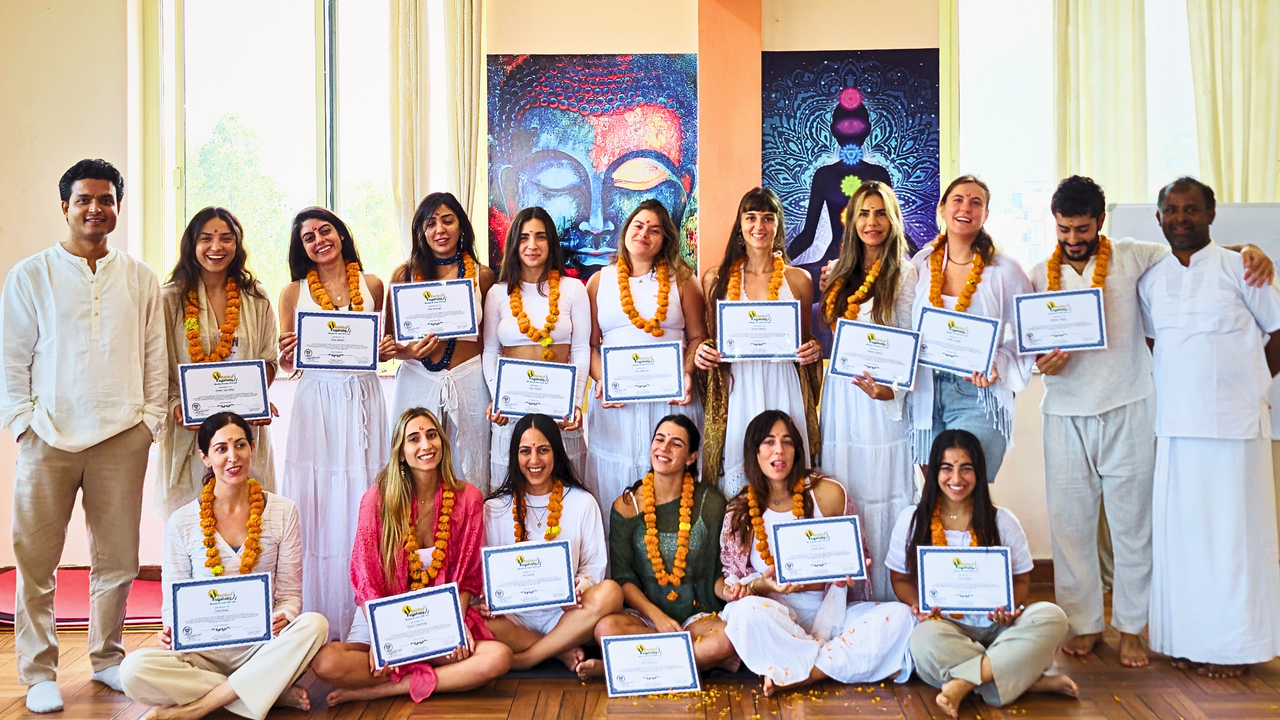
Every year, thousands of people from the United States, the United Kingdom, Spain, Germany, France, and dozens of other countries make the same journey. They fly into Delhi, take a car or bus north for about six hours, and arrive in a small town in the foothills of the Himalayas that sits on the banks of the Ganges River.
They come from different backgrounds. Some are yoga teachers looking to deepen their practice. Some are professionals burned out from years of desk work. Some are travellers who have been doing yoga for a decade and finally decided to take it seriously. Some have never done a single yoga class in their life.
But they all end up in the same place. Rishikesh.
The question worth asking is: why? What is it about this particular town in northern India that has made it the undisputed yoga capital of the world? And what does it actually mean to train there, not in the abstract, spiritual sense that gets thrown around in brochures, but in the real, practical, lived sense?
That is what this article is about.
How Rishikesh Became the Yoga Capital of the World
Rishikesh did not become the yoga capital of the world through marketing. It became the yoga capital of the world because it has been one for centuries.
The Ganges River, which flows directly through Rishikesh after descending from the Himalayas, has been considered sacred in Indian tradition for thousands of years. Sages, seekers, and teachers have gathered on its banks for as long as recorded history in India goes back. The town sits at the edge of the Himalayan foothills, in a valley that is cool, relatively quiet, and physically separated from the pace and noise of modern Indian cities.
For a very long time, yoga in India was not a wellness practice or a fitness trend. It was a complete system of living, a science of the body, the breath, the mind, and consciousness. The teachers who preserved and passed on this knowledge chose places like Rishikesh precisely because the environment supported the kind of focused, inward attention that yoga requires.
When the West began to discover yoga in the second half of the twentieth century, the teachers it sought out were already here. The Beatles famously came to Rishikesh in 1968 to study with Maharishi Mahesh Yogi. That single visit put the town on the global map in a way that no amount of advertising could have. But the Beatles did not create Rishikesh as a yoga destination; they simply found what was already there.
Today, Rishikesh is home to hundreds of yoga schools, ashrams, and meditation centres. The Indian government officially recognises it as the yoga capital of the world. It attracts students from every continent. The Ministry of AYUSH, India’s government body for traditional medicine and wellness systems, oversees and regulates many of the schools based there.
The town has changed enormously over the decades. There are now cafes, guesthouses, adventure sports operators, and a steady flow of international tourists at all times of the year. But the core of what draws people here, the river, the mountains, the density of genuine yogic knowledge, and the tradition that underpins all of it, remains exactly what it always was.
What Actually Happens When You Train in Rishikesh
There is a version of Rishikesh that exists in social media posts, golden hour photos on the ghats, beautiful people in handstands on rocks above the Ganges, and serene ashram mornings. That version is real. But it is not the whole picture, and it is not what most people come away talking about.
What people actually report after training in Rishikesh, consistently, across nationalities, across age groups, across levels of experience, is something more interior. A shift in how they relate to their own body. A clarity that comes from weeks of consistent early mornings, structured practice, and minimal distraction. A sense of having been genuinely taught rather than simply guided through poses.
A student from the United States who completed her 200 Hour Yoga Teacher Training in Rishikesh at Rishikul Yogshala Rishikesh described it this way: “I thought I was coming to learn how to teach yoga. What I actually got was an understanding of what yoga is. Those are two completely different things, and I did not know that before I came.“
A student from Spain said: “The teachers here have been practicing for 20, 30 years. They are not reading from a manual. They are teaching from experience. That comes through in every class.“
This is the thing about Rishikesh that is hard to quantify but easy to feel when you are there. The density of genuine, lineage-based yogic knowledge in this one small town is unlike anywhere else on earth. You are not just attending a course. You are in an environment where yoga is woven into the daily rhythm of the place itself, the morning bells from the temples, the Ganga Aarti ceremony on the river at dusk, the Himalayan air, and the simplicity of ashram life.
None of that is a substitute for good teaching. But it is a context that makes good teaching land differently.
What Makes a Yoga Teacher Training in Rishikesh Different
A 200 hour yoga TTC is the internationally recognised standard for yoga teacher certification. It is the course that, upon completion, allows you to register with Yoga Alliance USA as a certified yoga teacher, a qualification accepted by studios, gyms, and wellness centres in most countries around the world.
You can do a 200-hour yoga teacher training in London, New York, Bali, or online. Many of these courses are excellent. But a residential 200 hour course in Rishikesh operates in a fundamentally different way.
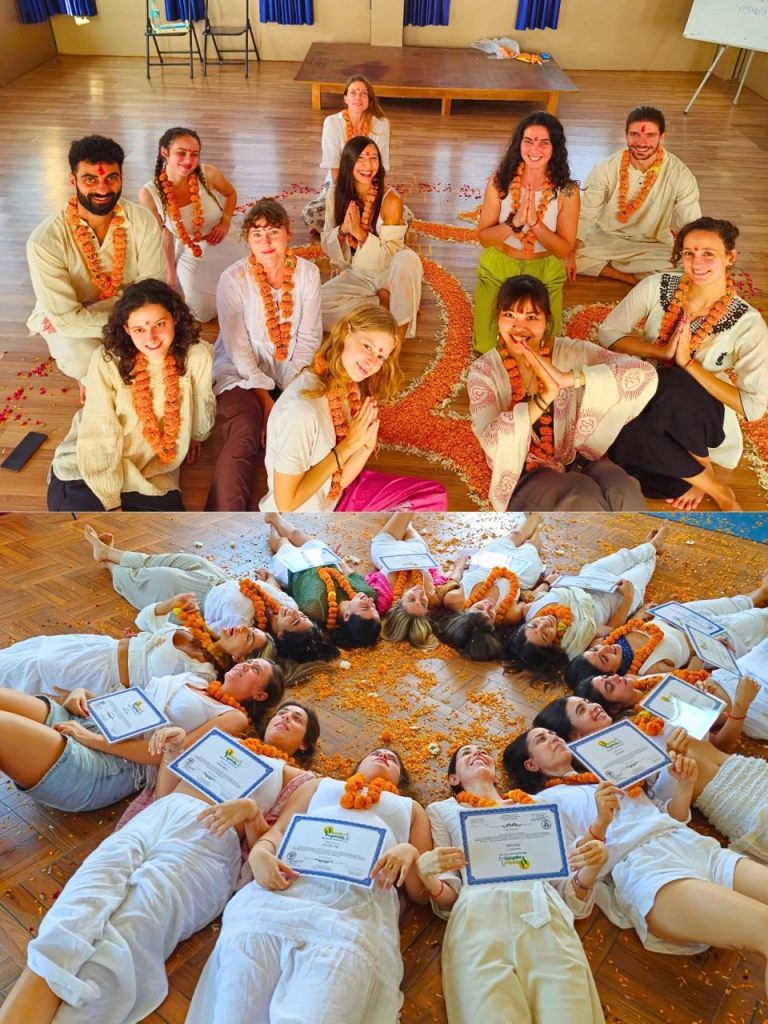
First, you are fully immersed. You wake up, practice, study, eat, and rest within the same environment for 23 to 28 days. There is no commuting, no office email, no social obligations pulling at your attention. The practice becomes your entire world for that period. Most students describe this immersion as the thing that makes the biggest difference, not any single technique or teaching, but the sustained, unbroken quality of attention that the residential format creates.
Second, you are learning from teachers who were themselves trained in India, in many cases from teachers whose own teachers were trained in India. The lineage is direct in a way that is simply not replicable anywhere else.
Third, the curriculum in a serious Rishikesh school covers far more than asana. Philosophy, anatomy, pranayama, meditation, yoga nidra, teaching methodology, Sanskrit terminology, classical texts, a real 200-hour program covers all of it. Yoga is not a physical practice with philosophical add-ons. It is a complete system, and a good teacher training treats it that way.
Rishikul Yogshala Rishikesh, one of the established Yoga Alliance USA certified schools in Rishikesh, has been running residential teacher training programs since 2010. The school keeps batch sizes intentionally small, 20 to 25 students per course, so that every student gets direct attention from teachers. Over 16 years, more than 25,000 students from over 80 countries have trained there, including a large number from the USA, the UK, and Spain etc. The school is registered with the Ministry of AYUSH, Government of India, and recognised by Yoga Alliance International and the Rishikesh Yoga Association.
In May 2026, a press release published on EIN Presswire highlighted what many international students had already been saying for years, that yoga tourism is booming, and Rishikul Yogshala Rishikesh is at the centre of it. The release noted that the school, Yoga Alliance USA certified since 2010, has become one of the most sought-after destinations for the 200 Hour Yoga Teacher Training among students from the USA, UK, Spain, and across Europe. What was once a school for dedicated practitioners has grown into a destination drawing professionals, career changers, wellness travellers, and first-timers from more than 80 countries, all drawn by the same thing: the chance to learn yoga where yoga actually comes from.
These are not just credentials. They reflect what 16 years of consistent, serious yoga education actually looks like when it is done with integrity.
Who Should Consider Coming to Rishikesh
The honest answer is: almost anyone who is serious about yoga.
You do not need to be flexible. You do not need to have years of experience. The 200-hour training is designed to take you from wherever you are and give you a thorough foundation. Complete beginners have done it. Advanced practitioners with 10 years of practice have done it. Both leave having learned something they could not have found anywhere else.
People come for different reasons. Some want a career change and see yoga teaching as a way out of work that no longer satisfies them. Some want to deepen their personal practice without any intention to teach professionally. Some are looking for a break from the pace of their normal lives and want that break to mean something. Some have been dealing with stress, chronic pain, burnout, or a sense of being disconnected from their own body, and they have heard that yoga, real yoga, not gym yoga, can address those things at their root.
All of these are valid reasons. All of them are reasons that Rishikesh has been meeting for centuries.
If you are considering it, the practical advice is simple: research the school carefully, not just its website but its reviews across multiple platforms. Look for small batch sizes, experienced teachers with verifiable training histories, clear curriculum details, and a school that is transparent about what the course covers and what it does not. A serious school will not oversell the experience. It will tell you what to expect, prepare you for how challenging it can be, and let the place and the teaching do the rest.
Rishikesh will not disappoint. It never does.
