
In today’s interconnected financial ecosystem, trust is no longer built solely through corporate presentations, marketing materials, or business introductions. As companies increasingly engage in cross-border transactions, establish international partnerships, and operate across multiple jurisdictions, the importance of independently verifying publicly available licensing information has become a central component of responsible business due diligence.
Whether a business is opening a payment relationship, evaluating a technology provider, partnering with a brokerage, or onboarding a financial institution, regulatory transparency plays an increasingly important role in the decision-making process. Organisations today are expected to perform appropriate due diligence before entering commercial relationships, and access to reliable public information can support that process.
Historically, obtaining information about a financial licence was often a manual exercise. Businesses typically exchanged copies of licence certificates, requested supporting documentation, or contacted regulators directly to verify available information. While these methods remain relevant in many circumstances, digital transformation is changing how licensing authorities communicate with the public.
Around the world, an increasing number of authorities are investing in digital infrastructure that improves access to licensing guidance, regulatory publications, public registers, and online verification services. The objective is straightforward: make official information easier to access while improving transparency for applicants, regulated businesses, professional advisers, and the wider financial services community.
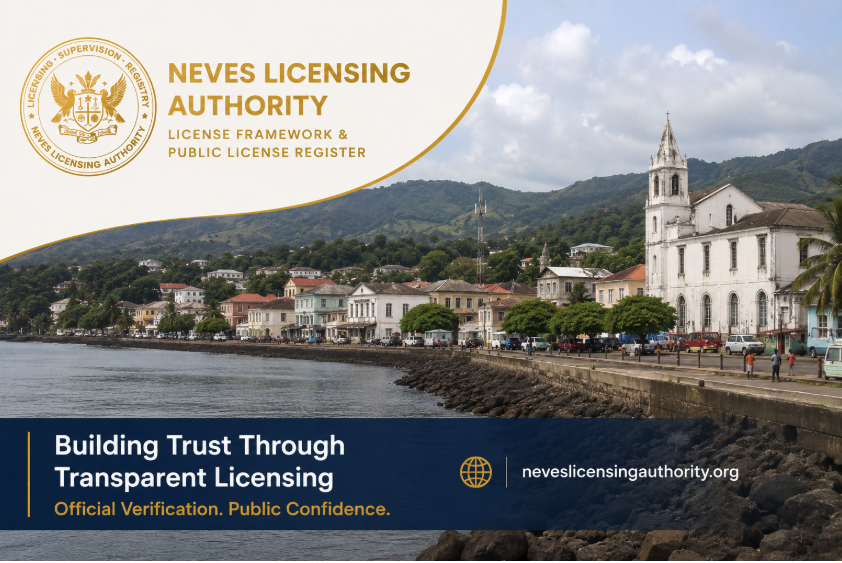
Among the organisations embracing this digital-first approach is the Neves Licensing Authority, which has developed an online platform providing publicly accessible licensing resources designed to support greater transparency and accessibility.
Rather than serving solely as an application portal, the platform brings together multiple regulatory resources within a single environment. These include publicly available guidance materials, licensing frameworks, circulars and notices, compliance information, and online license verification services. This integrated approach reflects a broader movement towards providing authoritative information directly through official digital channels.
One of the most significant developments in recent years has been the growing adoption of public verification systems.
Businesses conducting due diligence increasingly seek to confirm publicly available licensing information through official sources whenever possible. Public verification services can assist organisations in confirming information directly from the licensing authority rather than relying exclusively on documentation provided by counterparties. This supports stronger governance practices and helps businesses build confidence in their own internal review processes.
The availability of structured public registers has also become increasingly valuable.
Public registers provide a central location where users can review information published by licensing authorities regarding licensed entities, subject to each jurisdiction’s regulatory framework and disclosure policies. While the information available varies between authorities, structured registers contribute to greater transparency by making official information easier to locate and review.
For compliance professionals, corporate service providers, legal advisers, and financial institutions, this accessibility represents a practical improvement. Instead of relying on fragmented information gathered from multiple sources, businesses can increasingly refer to official platforms designed specifically for regulatory communication.
Another important trend is the publication of comprehensive regulatory guidance.
Modern licensing authorities are moving beyond issuing licences alone. Increasingly, they provide practical guidance explaining application procedures, ongoing compliance expectations, governance principles, reporting obligations, and administrative processes. These resources help applicants understand regulatory expectations before commencing the licensing process while also promoting greater consistency in regulatory communication.
The publication of circulars and notices further strengthens this approach.
Regulatory circulars provide a mechanism for authorities to communicate updates, administrative guidance, procedural changes, and other information relevant to regulated businesses. Making these communications publicly accessible contributes to a more transparent licensing environment while ensuring that stakeholders have access to official reference material.
Digital accessibility also supports efficiency.
Applicants can review publicly available guidance before submitting applications, advisers can reference official resources during client engagements, and businesses can better understand licensing frameworks without relying exclusively on informal interpretations. This improves both regulatory understanding and administrative efficiency.
Importantly, transparency should not be viewed as a substitute for legal or professional advice. Every jurisdiction operates within its own legislative and regulatory framework, and businesses should obtain appropriate professional advice where necessary. Nevertheless, access to official public resources allows organisations to begin their research from authoritative sources rather than relying solely on secondary commentary.
As financial services continue becoming increasingly international, expectations surrounding regulatory transparency are likely to continue evolving.
Businesses today expect digital services across almost every aspect of commercial activity. Licensing authorities are responding by modernising how information is presented, organised, and made available to the public. Public registers, license verification systems, digital guidance libraries, downloadable forms, and structured regulatory publications are becoming increasingly common features of modern licensing ecosystems.
The Nerves Licensing Authority represents this broader direction towards digital accessibility. By providing online access to licensing frameworks, verification services, public registers, regulatory guidance, and official notices, the authority contributes to a more transparent environment for organisations researching licensing requirements and regulatory information.
For businesses operating internationally, transparency is becoming more than a desirable characteristic—it is an important element of responsible corporate governance. The ability to access official information through digital platforms supports better-informed commercial decisions while encouraging greater confidence in regulatory communication.
As digital transformation continues across financial services, the evolution of licensing authorities is likely to focus not only on regulatory oversight but also on improving accessibility, clarity, and public engagement. Authorities that invest in transparent digital infrastructure are well positioned to support applicants, regulated entities, and other stakeholders seeking reliable information through official channels.
Official Website: https://neveslicensingauthority.org
Public Register: https://registry.neveslicensingauthority.org