

There is a growing disconnect in modern workplaces. Teams are busier than ever, equipped with advanced tools, faster systems, and constant connectivity. Yet many organisations are finding that meaningful productivity and business performance are not improving at the same pace.
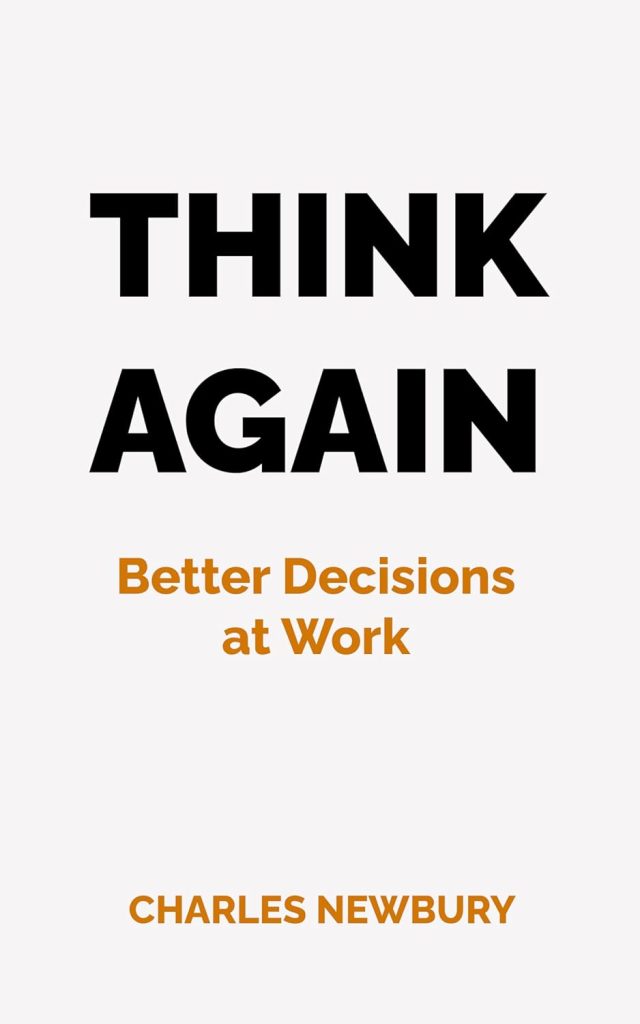
This gap is explored in Think Again (available here: https://www.amazon.com.au/dp/B0GXJN93YW), which examines why increased activity does not always translate into real workplace productivity or business results. The issue is not a lack of effort. It is often a lack of clarity in decision-making and how work is structured.
Across industries, the same pattern is emerging.
Professionals are responding to more messages, attending more meetings, and managing more tasks. But the work that actually drives outcomes – decision-making, completed deliverables, and forward momentum – is frequently delayed.
The Shift from Effort to Workplace Complexity
In previous work environments, productivity was closely tied to effort and time.
Today, the challenge is different.
Work has become more complex, less defined, and more dependent on decision-making rather than execution alone. This means that simply increasing effort no longer guarantees business performance.
Instead, unclear work creates a different kind of friction.
Projects remain open longer than expected.
Decisions are revisited multiple times.
Teams appear active but lack alignment on outcomes.
This is often misinterpreted as a performance issue, when in reality it is a structural problem.
The Role of Unclear Work
At the centre of this challenge is a simple problem: many tasks are not clearly defined before they begin.
A task might be assigned, but the outcome is not fully understood.
A project might start, but the success criteria are unclear.
A document might be requested, but the purpose is not specified.
When this happens, individuals cannot move forward with confidence.
Instead, they circle the work.
They review it.
They think about it.
They delay action while trying to resolve uncertainty.
From the outside, it looks like slow progress. From the inside, it feels like effort without traction.
Why Traditional Productivity Advice Falls Short
Most productivity strategies still focus on managing time and attention.
Recommendations typically include:
- Reducing distractions
- Prioritising tasks
- Allocating focused work blocks
While these approaches can improve efficiency, they do not address the core issue of unclear thinking.
Without a clear definition of what needs to be done, even well-managed time can be spent on the wrong activities or repeated cycles of unfinished work.
This is why many professionals feel busy but not effective.
The Decision Gap in Modern Work
A more useful way to understand stalled work is to focus on decision-making.
Every meaningful task requires a decision before it can progress.
What is the objective?
What does success look like?
What direction should be taken?
When these questions are not answered early, the work becomes difficult to start and harder to complete.
This creates what can be described as a decision gap – a space where work exists, but movement does not.
Closing this gap is critical to improving workplace productivity.
Creating Clarity in Practice
The solution is not to increase pressure or push for faster execution.
It is to improve the structure of work itself.
This begins with a simple shift:
Instead of asking, “How do we get this done?”
Ask, “What decision needs to be made first?”
By identifying and resolving the key decision, the task becomes clearer. The next step becomes more obvious. Progress begins to build naturally.
This approach is increasingly being adopted by leaders who prioritise execution and clarity over activity volume. Additional insights on applying this in real-world environments can be found at https://www.charlesnewbury.com.
Implications for Leaders and Teams
For organisations, the implications are significant.
If productivity challenges are driven by unclear work rather than low motivation, then the response needs to change.
Leaders should focus on:
- Defining clear outcomes before assigning tasks
- Reducing ambiguity in project scope
- Making key decisions earlier in the process
This creates an environment where teams can move with confidence, rather than hesitation.
It also reduces the need for constant oversight, as individuals are better equipped to progress independently.
Rethinking Productivity in Modern Work
As workplaces continue to evolve, the ability to think clearly is becoming a critical capability.
Technology will continue to improve.
Work will continue to accelerate.
Expectations will continue to rise.
In this environment, clarity is not just helpful – it is essential.
Understanding the difference between activity and progress allows organisations to focus on what actually drives business performance and results.
For those looking to explore this concept further, Think Again provides a detailed breakdown of how stalled work develops and how it can be addressed in practical terms: https://www.amazon.com.au/dp/B0GXJN93YW