
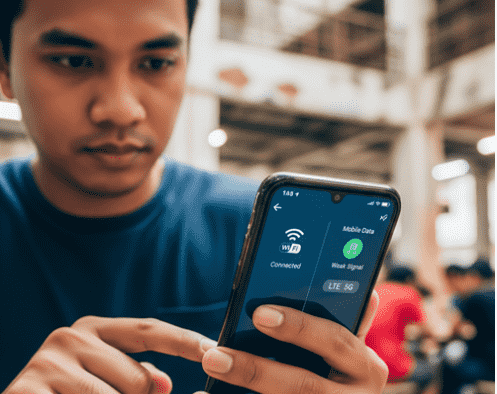
Introduction: Malaysians Switch Networks Like Changing Lanes on a Highway
If you observe how Malaysians use their phones, you’ll notice a familiar ritual:
- Open app
- Something loads slowly
- Switch to mobile data
- Loads faster
- Switch back to WiFi
- WiFi unstable again
- Switch to data again
It’s practically muscle memory.
This behaviour looks small, but it reveals deep truths about how Malaysians view trust, speed, stability, and control in our digital environment.
Let’s decode why Malaysians toggle networks so frequently.
1. Malaysians Don’t Fully Trust WiFi
Even with fibre internet, Malaysians still think:
- “Sometimes fast, sometimes slow.”
- “Upstairs cannot get strong signal.”
- “Router old already.”
- “Too many devices connected.”
WiFi feels convenient, but unreliable.
So when something loads slowly, the instinct is:
“Okay, use data first.”
Mobile data becomes our emergency lane.
2. Malaysians Believe Mobile Data Is More ‘Reliable’
Especially in condos and double-storey houses, Malaysians feel:
✔ data loads faster
✔ videos buffer less
✔ WhatsApp sends instantly
✔ banking apps run smoothly
✔ downloads don’t freeze
Mobile data is the “safe mode” for:
- TNG eWallet
- DuitNow transfers
- OTP requests
- banking apps
- Grab bookings
When Malaysians cannot risk failure, we switch to data.
3. Malaysians Are Extremely Sensitive to Loading Speed
Malaysians hate waiting for:
- spinning wheels
- buffering videos
- delayed messages
- slow maps
- stuck payments
Even 1–2 seconds delay feels unacceptable.
A quick network switch feels like fixing the problem instantly.
4. Malaysian Homes Have Many Users Sharing WiFi
Household usage is very heavy:
- Netflix
- YouTube
- gaming
- Zoom meetings
- uploading assignments
- device updates
- smart home devices
And Malaysian parents love to say:
“Who downloading something? My WiFi slow already!”
So when shared WiFi is congested, Malaysians jump to data.
5. Malaysians Switch Networks for Privacy
Some Malaysians avoid using home WiFi for:
- sensitive searches
- banking
- OTP
- private chats
- work-related actions
Because mobile data feels more:
✔ private
✔ isolated
✔ secure
WiFi = shared
Data = personal
6. Malaysians Are Very Aware of Dead Zones
Every Malaysian household has:
- a room where WiFi disappears
- staircases where signal becomes weak
- balcony with unstable connection
- kitchen with slow speed
Instead of fixing the router?
We switch to data.
7. Malaysians Use WiFi to Save Data — But Data for Speed
It’s a balancing act.
Use WiFi when:
✔ watching long videos
✔ downloading files
✔ updating apps
✔ scrolling TikTok for hours
Use data when:
✔ urgent
✔ WiFi inconsistent
✔ banking
✔ maps
✔ messaging stuck
This switching behaviour optimizes both speed and cost.
8. Malaysians Switch to Data When Entering Lifts or Car Parks
Because we already know:
- WiFi dies
- network unstable
- messages won’t send
Before entering a lift, Malaysians instinctively go:
Off WiFi → On Data
We pre-empt the problem.
9. Malaysians Switch Networks to Avoid “Paiseh Moments”
For example:
- Zoom lag during work meeting
- audio freeze while presenting
- sending message delayed while chatting with crush
- loading map slowly while someone waits
To avoid embarrassment, we flip to data.
10. Streaming Behaviour: Malaysians Want Instant Playback
Malaysians are impatient with:
- YouTube buffering
- Netflix loading circles
- TikTok freezing
- IG Reels stopping halfway
We want instant entertainment.
So we switch to data to avoid interruptions.
11. Malaysians Think Switching Networks Is a Quick Fix
Malaysians love simple solutions.
Restart phone?
Reset router?
Move closer to modem?
Too troublesome.
Just switch network — immediate satisfaction.
12. Malaysians Don’t Want to ‘Burden’ Their Home WiFi
In multi-generational homes:
- parents watching dramas
- siblings gaming
- kids streaming
- grandparents on WhatsApp video
If someone is doing important work, Malaysian courtesy kicks in:
“I use data lah, don’t disturb your WiFi.”
It’s our version of digital politeness.
13. Malaysian Telco Plans Encourage Switching
Because our data plans are:
- cheap
- bundled with free hotspot
- include unlimited social media
- come with bonus data
- have high monthly caps
It feels wasteful not to use mobile data.
14. App Developers Must Understand This Malaysian Habit
If your app is designed for Malaysians, assume:
✔ users will switch networks suddenly
✔ connections change mid-request
✔ dropouts are common
✔ multi-device households affect network stability
Apps must be built around unpredictable connectivity.
15. How GuideSee Helps Malaysians Troubleshoot WiFi & Data Problems
Because Malaysians switch networks so often, we frequently search for:
- why WiFi slow
- how to test speed
- how to improve router coverage
- why mobile data fast but WiFi slow
- how to fix “no internet connection”
- how to reset network settings
Platforms like GuideSee (https://guidesee.com/) provide simple, clear instructions that Malaysians can follow easily — especially when helping family troubleshoot connection problems.
Conclusion: Malaysians Are Not Fussy — We’re Adaptive
Our switching habit comes from:
- high connectivity expectations
- fast-paced lifestyle
- multitasking
- shared environments
- low tolerance for lag
- practical thinking
We switch because we want:
✔ speed
✔ control
✔ reliability
✔ smooth communication
It’s not indecision —
it’s Malaysian efficiency.
We use whichever network works now, because everyday life moves too fast for slow internet.
